The Core Difference: Deterministic vs. Probabilistic Tracking
To understand the tools, you must understand the underlying math.
Legacy SEO Trackers work on a simple logic: Input Keyword -> Scrape HTML -> Report Position (1-100). It is linear. If you check it five times, the result is usually the same.
AI Search Trackers operate in a chaotic environment. An LLM (Large Language Model) uses a “Temperature” setting that introduces randomness.
Prompt 1: “Best CRM” -> Result: Salesforce.
Prompt 2 (5 mins later): “Best CRM” -> Result: HubSpot.
A legacy tool would see this as an error. An AI search tracker sees this as “Share of Voice.” It runs the prompt 100 times to calculate that Salesforce appears 60% of the time and HubSpot 40%.
Feature Showdown: Legacy SEO vs. AI Search Tracking
We have broken down the technical differences into a comparison matrix to help you justify the budget for a new tool.
Feature
Legacy SEO Tracker (e.g., Ahrefs, GSC)
AI Search Tracker (e.g., Topify)
Data Source
Static HTML Index
LLM API & Generated Text
Ranking Logic
Position (1-100)
Citation Presence & Share of Voice
Context
Blind to Context
Understands Sentiment & Nuance
Query Type
Keywords (“CRM software”)
Prompts (“Act as a CFO and recommend a CRM”)
Output
URL List
Synthesized Answer + Footnotes
Volatility
Low (Updates Daily/Weekly)
High (Updates Real-Time/Per Request)
Blind Spot
Cannot see ChatGPT/Claude
Cannot see traditional Blue Links
Why Legacy Tools Are “Blind” to AI Search Tracker Metrics
If you rely solely on Google Search Console (GSC), you are operating with a 40% blind spot in 2026. Here is what legacy tools miss.
The Sentiment Blind Spot
A legacy tool celebrates if you rank #1. But what if the snippet says, “Topify is the #1 ranked tool, but users report frequent crashes”?
Legacy View: Rank #1 (Success).
AI Reality: Negative Sentiment (Failure).
The Fix: Topify uses an NLP Sentiment Engine to grade the quality of the mention, not just the position.
The Hallucination Blind Spot
Legacy crawlers assume the content on the SERP is “true” because it comes from indexed pages. AI models, however, can fabricate facts (hallucinations) that don’t exist on any webpage.
Legacy View: Invisible.
AI Reality: Brand Reputation Risk.
The Fix: Specialized AI search tracking detects when an LLM invents false pricing or features about your brand.
The Multi-Model Blind Spot
Legacy tools are obsessed with Google. But your customers are on Perplexity and ChatGPT.
Legacy View: Google Only.
AI Reality: Fragmented across 5+ models.
The Fix: Tools like Topify monitor the entire ecosystem simultaneously.
See the full list of tools that solve these problems in our review of the best AI search visibility tracking tools.
The AI Search Engine Ranking Tracking Tool Advantage: Topify
Topify represents the next generation of tracking infrastructure. It doesn’t just “scrape”; it “interacts.”
How Topify Closes the Gap:
Multi-Agent Simulation: Topify deploys AI agents that act like different user personas (e.g., “Skeptical Buyer,” “Technical Researcher”) to see how LLMs tailor answers for different intents.
Citation Velocity: It tracks how quickly a new piece of content is absorbed into the RAG (Retrieval-Augmented Generation) pipeline.
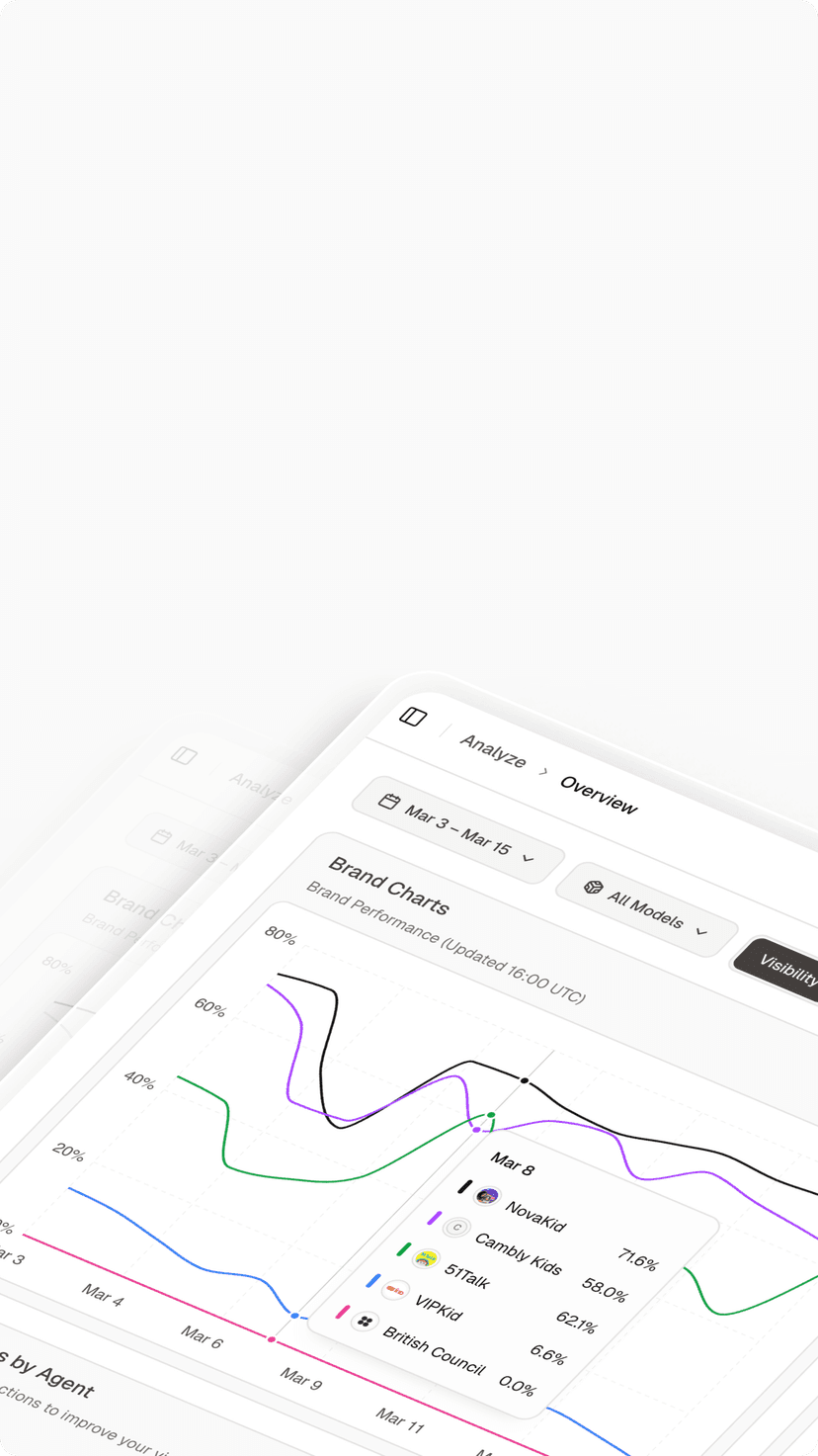
Competitor “Share of Model”: It visualizes exactly how much “mental space” your brand occupies in the AI compared to your rivals.
Strategic Insight: While legacy tools help you optimize your website, Topify helps you optimize your entity. It shifts the focus from “Technical SEO” to “Digital PR and Information Gain.”
For a guide on how to perform an audit using this tech, read how to use an AI search visibility checking tool.
How to Run a Hybrid Strategy (The “Bridge” Approach)
We are not suggesting you cancel your Ahrefs subscription today. In 2026, the winning strategy is Hybrid.
Step 1: Use Legacy Tools for “Input”
Continue using legacy tools for keyword research, backlink analysis, and technical site health. This is the foundation.
Step 2: Use AI Search Trackers for “Output”
Use Topify to monitor how that foundation translates into AI visibility.
Legacy: “We built 10 backlinks to this page.”
AI Tracker: “Did those backlinks increase our Citation Probability in ChatGPT?”
Step 3: Correlate the Data
Look for the disconnects.
Scenario: You rank #1 on Google (Legacy) but are invisible on Perplexity (AI).
Diagnosis: Your content is optimized for keywords but lacks the “Information Gain” required for AI citation.
Action: Refactor content using our content engineering strategies.
The Economic Impact of Switching
Why invest in a second tool stack? Because the cost of inaction is “Zero-Click” irrelevance.
As search volume migrates from Google to AI agents, brands sticking to legacy metrics will see their traffic decay without knowing why. An AI search engine ranking tracking tool provides the leading indicators—Citation Growth and Sentiment Velocity—that predict future revenue.
For enterprise teams, this data integration is critical. Learn more in our enterprise management guide.
Conclusion: Upgrade Your Vision
You wouldn’t navigate a spaceship with a paper map. You shouldn’t navigate the AI web with a keyword tracker.
The transition from “Legacy SEO” to “GEO” requires a fundamental upgrade in your tooling. An AI search tracker like Topify gives you the eyes and ears you need to operate in the probabilistic, generative future.
Stop tracking links. Start tracking answers.
FAQ: AI Search Engine Ranking Tracking Tool vs. Legacy SEO
Can Google Search Console replace an AI tracker?
No. GSC offers limited data on AI Overviews within Google, but it is aggregated and lacks detail on sentiment or citation type. Crucially, GSC cannot see outside of Google (e.g., ChatGPT, Claude), which is where a huge portion of search behavior is shifting.
Do I need to track keywords or prompts?
Legacy SEO tracks keywords. AI search tracking tracks prompts. A prompt gives context (e.g., “Compare X and Y for a small business”). Tracking prompts is essential because LLMs output different answers based on the nuance of the request.
Is “Rank #1” still a valid metric in AI?
Not really. In AI, the metrics are Citation Presence (Are you mentioned?) and Share of Model (How often?). “Rank” implies a list; AI gives a narrative. Being the first brand mentioned in a paragraph is the new “Rank #1.”
How does Topify handle personalization?
Legacy tools strip personalization to show a “clean” rank. Topify embraces it by using persona-based agents. It can show you how your brand appears to a user in New York vs. London, or a technical user vs. a novice.
Is AI tracking more expensive than legacy SEO tracking?
It can be, because it requires more computing power. Running an LLM query (API cost) is more expensive than scraping a static HTML page. However, the ROI is higher because the traffic from AI citations is often 2x-3x more qualified.