Actionable Strategies
Here are five strategies marketers should use now to address AI search visibility and integrate it into their marketing programs.
Map Your AI Visibility Footprint
Why This Matters
If you only monitor Google keyword rank or backlinks, you’ll miss whether your brand is present in AI-driven answer engines. Given that AI is already influencing discovery, this audit is foundational.
How to Execute
Audit across major LLM/AI platforms: ChatGPT, Perplexity, Claude, Google AI Mode.
Choose 10-15 buyer-intent questions your target audience might ask (e.g., “What CDP is best for mid-market SaaS?”).
For each prompt, record which brands are cited, which content links are referenced, and whether your brand appears.
Map visibility gaps by competitor: note which brands appear more frequently and for which prompts.
Topify Integration
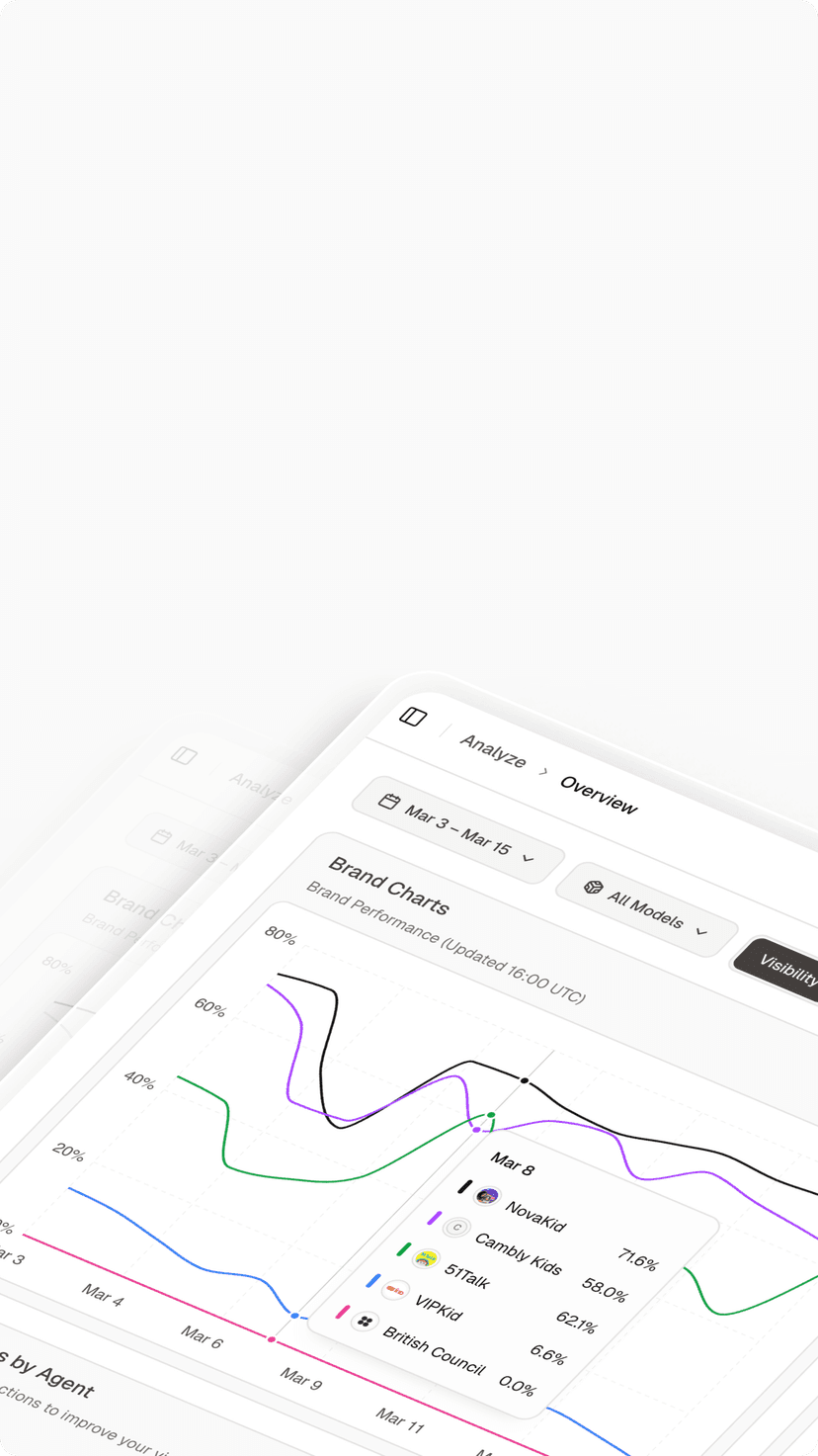
Platforms such as Topify automate this audit by tracking LLM citations and measuring your brand’s presence across AI answer engines.
Key Insight
What you don’t measure, you cannot surface—visibility becomes invisible without systematic tracking.
Build Recognisable Authority Signals for AI Discovery
Why This Matters
AI engines do not simply crawl like search bots—they build semantic associations and evaluate trust signals. Without recognisable authority, your brand may never be surfaced.
How to Execute
Publish research, customer stories or data-driven insights with clear attribution, expert commentary and statistical evidence.
Secure co-citations and brand mentions in authoritative third-party content (industry reports, analyst citations, guest posts).
Use structured data markup (organization schema, breadcrumb, FAQ schema) and agenda-setting author bios to signal expertise.
Topify Integration
Topify enables visibility into competitor benchmarking—highlighting which brands are being cited by AI, and identifying citation-and-sentiment gaps you can act on.
Key Insight
Authority isn’t just backlinks—it’s your brand and solution being part of what AI ‘knows’ and cites.
Optimize Content for LLM Parsing and Citation
Why This Matters
Traditional SEO often emphasises keywords, volume and top-of-funnel traffic. However, AI discovery demands content structured for machine-readable clarity, context, and direct answerability.
How to Execute
Use question-and-answer headings (H2/H3) that mirror natural language buyer queries.
Use clear paragraphs (one idea per paragraph), bullet lists and explicit statements for easy extraction.
Include data points and citations for credibility.
Add schema markup (FAQ, HowTo, Article) to assist AI parsing.
Topify Integration
With Topify you can identify content gaps where your pages are not being cited and receive recommendations for structural improvements and ranking opportunities in AI visibility contexts.
Key Insight
If AI cannot parse your content as an answer, it will pass you over—structure drives extraction.
Benchmark Competitors in AI Search Contexts
Why This Matters
In the traditional SEO world you benchmark SEO rank, backlinks, and organic traffic. In an AI visibility world you need to know which competitors are cited by answer engines and why.
How to Execute
For a defined set of buyer-intent prompts, map which brands appear in AI responses and how often.
Analyse competitor content for citation frequency, mention sentiment, structural cues and semantic positioning.
Identify competitor strengths you lack (e.g., partnership mentions, research citations, product integrations).
Topify Integration
Topify tracks competitor AI visibility metrics—showing share of voice trends across LLM platforms, sentiment analysis of citations and citation-gap opportunities.
Key Insight
You cannot out-compete what you don’t compare—visibility is a competitive metric in AI search.
Monitor Visibility and Adapt in Real Time
Why This Matters
The AI-search landscape is evolving rapidly: new platforms, evolving citation logic and changing user behaviour. Static strategies become stale fast.
How to Execute
Set up ongoing visibility tracking dashboards that measure citations, mentions in AI responses, and trending prompts.
Integrate alerts for drops in citation share or new competitor citations.
Use insights to update content, add new questions/prompts and refresh structural markup quickly.
Topify Integration
Tools like Topify deliver real-time AI-visibility monitoring, alerting your team when citation trends shift and recommending content adaptation opportunities.
Key Insight
Visibility in AI discovery is dynamic—surveillance and iteration turn static content into ongoing presence.
What does the future look like?
The integration of AEO/GEO strategies into enterprise marketing is no longer optional; it’s imminent. Below are four forward-looking trends for CMOs between Q3 2025 and Q2 2026.
Answer Engine Optimization (AEO) evolution — AI platforms will move beyond summarising webpages to proactive brand recommendation engines. Marketers will need to optimise for “why this brand” signals, not just “what brands”.
AI Brand Authority metrics — Traditional KPIs such as organic sessions or keyword ranks will be augmented by metrics like “AI Citation Share”, “LLM Mention Frequency” and “AI-answer Sentiment”. These will replace click-based metrics for brand health.
CMO dashboard transformation — Dashboards will integrate AI-visibility signals (citations, share of voice in LLMs) alongside funnel metrics and product analytics. Marketing leaders will demand visibility into how the brand shows up inside buyer AI-interfaces.
Visibility attribution integration — Marketers will embed AI-visibility metrics into marketing attribution models. For example: “Brand appeared/was cited in ChatGPT prompt → accelerated conversion by X%”. Visibility will drive direct pipeline attribution.
↳ Watch on YouTube: Answer Engine Optimization Explained: Stay Visible in 2025
Predictive statement: By Q3 2026, “AI citation share” will replace “keyword rank” as the primary brand health indicator for at least 68% of digital-first B2B organizations.
Amplify your brand with us
As AI-driven discovery becomes the default entry point for B2B software buyers, the brands that systematically embed visibility into LLM-answer ecosystems will command early advantage. The window for positioning is now.
→ Start your AI Visibility Audit with Topify—see where your brand appears (or doesn’t) in ChatGPT, Perplexity, and Claude responses.