What Is Generative Engine Optimization And How Is It Different From SEO

Why AI is disrupting search ,and why Google still matters?
Generative interfaces feel faster and cleaner. In the process, they reshape user behavior:
Less scanning through ten blue links
More conversational “chained queries” (“best options” → “compare two” → “pricing” → “implementation”)
More reliance on summaries and vendor shortlists inside the answer
At the same time, Google remains enormous. Contentful’s SEO team cited early-2025 scale differences where Google had orders of magnitude more daily searches than ChatGPT.
The implication is not “SEO is dead.”
The implication is:
You still need SEO for coverage and demand capture
You now need GEO for recommendation visibility and narrative control
SEO vs GEO: the differences
At a glance, SEO and GEO can look similar. Both are about visibility in search. Both depend on high-quality content. And in practice, strong GEO performance almost always builds on solid SEO fundamentals.
The difference is where competition happens, what you optimize, and how decisions are made.
What’s different?
1) The unit of competition
SEO: the SERP position
In traditional search, competition happens on the search engine results page (SERP).
Your goal is to rank higher than other pages for a given query. Visibility is positional: being #1 is meaningfully different from being #5.
GEO: the answer itself
In generative search, there is often only one answer.
The competition is no longer “which page ranks higher,” but who gets included, recommended, and emphasized inside the AI-generated response.
In GEO, you don’t compete for a slot on a page—you compete for mindshare inside the answer.
2) The unit of optimization
SEO: pages and keywords
SEO optimizes discrete assets: pages targeting keywords.
Success depends on relevance, authority, and technical performance at the page level.
GEO: entities, claims, proof, and cite-worthy sources
GEO operates at a higher semantic level. AI systems don’t just retrieve pages—they synthesize claims about entities (your brand, product, or service).
In other words, GEO is less about ranking content and more about earning trust in synthesis.
3) The decision journey
SEO: single query → click
Traditional search assumes a linear flow:
-
User searches
-
User scans results
-
User clicks
-
Evaluation happens on your site
-
“What’s the best option for X?”
-
“Compare A vs B”
-
“What about pricing?”
-
“Is it secure or enterprise-ready?”
-
First, clear information architecture still matters.
AI systems rely heavily on well-structured sites to understand what a company does, how products relate to each other, and where authoritative answers live. If your content is fragmented, duplicated, or poorly organized, AI models struggle to form accurate summaries—no matter how good the individual pages are.
-
Second, authoritative pages that deserve citation remain critical.
Generative engines don’t invent credibility; they infer it. Pages that demonstrate depth, clarity, and expertise—such as comparison pages, implementation guides, security documentation, and case studies—are far more likely to be cited or reflected in AI-generated answers.
-
Third, fast, accessible content is still table stakes.
Performance, accessibility, and crawlability influence whether your content can be reliably processed and surfaced. If your pages are slow, gated, or difficult to access, they are less likely to become part of the model’s “trusted” reference set.
-
Finally, differentiated positioning and proof matter more than ever.
SEO rewards relevance. GEO rewards clarity plus evidence. Clear positioning helps AI systems understand what you are best for, while proof—benchmarks, customer examples, certifications, third-party validation—helps determine whether those claims are trustworthy.
-
Presence / Share of Voice (SoV): % of prompts where you appear
-
Primary recommendation rate: % of prompts where you are a top recommendation
-
Citation share: % of cited sources that point to your owned pages (where citations exist)
-
Framing / sentiment: how you’re described (positive/negative, category fit)
-
Accuracy / hallucination risk: wrong claims about pricing, compliance, integrations, capabilities
-
Repeat sampling: AI outputs vary run-to-run.
-
History: you need time series to know what changed and when.
-
Define a prompt library
-
Persona × intent × industry
-
Include long-tail variants: “best for X”, “alternatives”, “vs”, “pricing”, “implementation”, “security”
-
Sample repeatedly
-
Multi-run per prompt
-
Flag high-variance prompts
-
Score outcomes
-
Presence/SoV
-
Recommendation position
-
Citations + framing
-
Diagnose why you lost
-
Missing pages (docs, comparisons, integrations)
-
Missing proof (benchmarks, case studies)
-
Outdated narrative
-
Competitor displacement (they shipped new content)
-
Ship fixes
-
Content + docs + positioning + proof assets
-
Re-check and attribute lift
-
Before/after validation
-
Export results for stakeholders
-
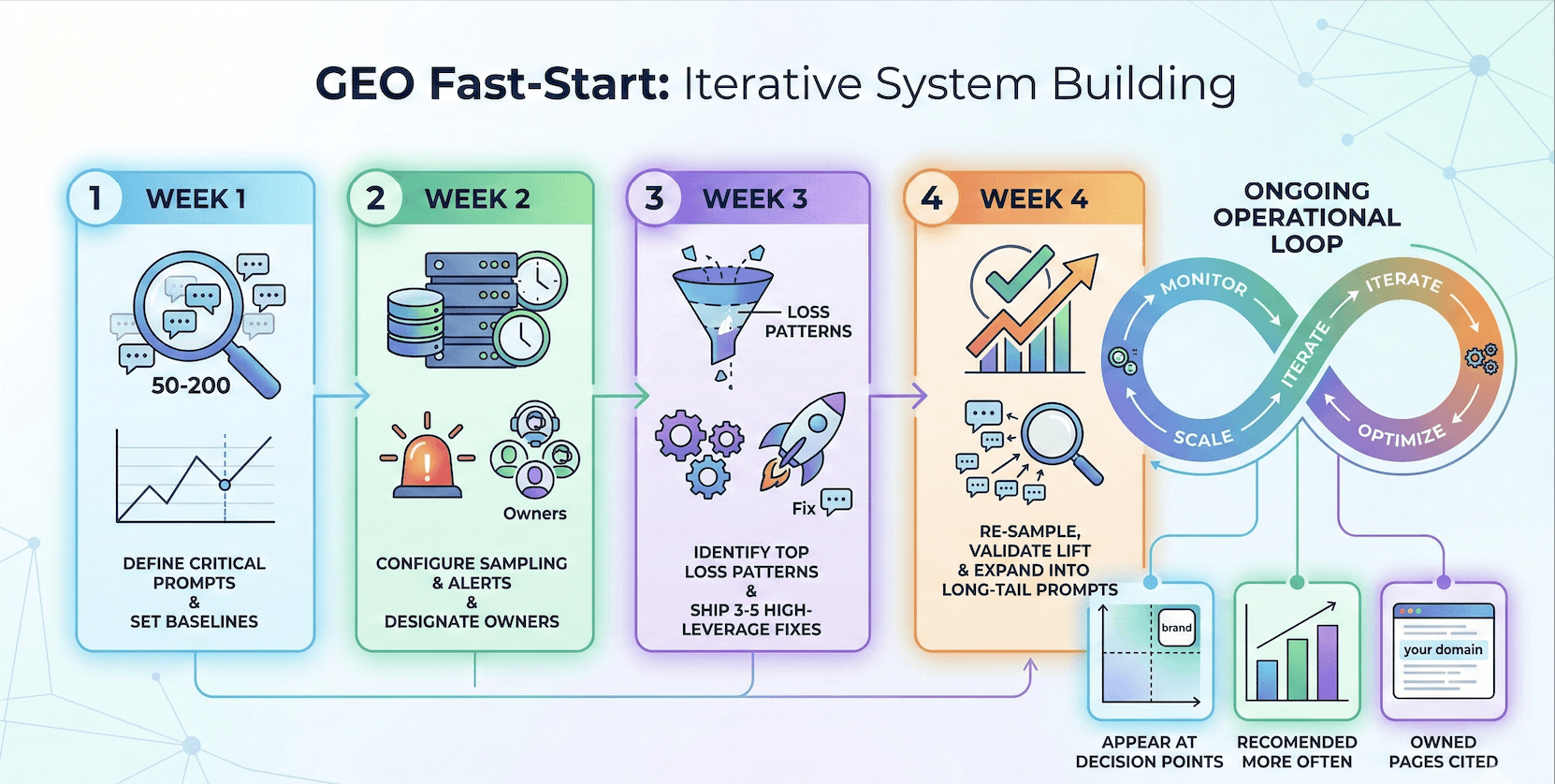
Week 1: define 50–200 critical prompts; set baselines
-
Week 2: configure repeat sampling + alerts; define escalation owners
-
Week 3: identify top loss patterns; ship 3–5 high-leverage fixes
-
Week 4: re-sample, validate lift, expand into long-tail prompts
-
You appear in answers when buyers are making decisions
-
You’re recommended more often than competitors
-
Your owned pages are cited when citations exist
-
Cross-platform coverage: track across major answer engines from one prompt library
-
Repeat sampling + variance control: avoid reacting to noise
-
Explainable diffs: see what changed (answer text, citations, recommendation position)
-
Workflow: convert findings into tasks (owners, comments, status) and validate after fixes ship
-
Stakeholder exports: dashboards and reporting that can be used by Growth, SEO/GEO, and leadership
-
Compare how different AI platforms describe and position your products or services
-
Track brand mentions, citations, recommendation position, and framing over time (with repeat sampling to control variance)
-
Is GEO replacing SEO?
-
How is GEO different from SEO?
-
How do you optimize for GEO?
What Else Most Teams Should Add
To make GEO sustainable, mature teams go beyond tactics and build operational muscle.
They establish cadence—monthly prompt re-sampling to catch variance early, and quarterly narrative reviews to ensure their positioning still matches how AI systems describe them.
They assign clear ownership. One accountable GEO owner, with explicit interfaces to SEO, content, and product marketing. When everyone “contributes,” no one is responsible—and GEO quietly degrades.
They implement alerting. Sudden competitor emergence, framing shifts, or loss of citation authority are not cosmetic changes; they are early warning signals. In an AI-mediated environment, silence is a leading indicator, not a lagging one.
What comes next?
If you’re starting GEO from zero, don’t boil the ocean.
Your objective is not “rank #1.” Your objective is to build an operational system that ensures:
Where Topify fits?
To run the loop above, you need more than occasional manual checks.
Topify is designed as a cross-platform AI visibility layer that helps teams operationalize GEO:
If your goal is to improve visibility (not just observe it), workflow + validation is the difference between “interesting insights” and “measurable lift.”
The future of search isn’t just about being discovered — it’s about being trusted, cited, and recommended inside AI-generated answers.
Generative engines are changing how buyers research and choose solutions. The brands that win will keep strong SEO fundamentals, and add GEO-specific systems to monitor and improve answer-level visibility across ChatGPT, Perplexity, Gemini, and Google AI Overviews.
Use Topify to:
Identify concrete opportunities to increase visibility in AI answers — and turn findings into an execution loop (diagnose → fix → re-check) with collaboration and stakeholder-ready exports
SEO still matters. GEO is the new layer you can’t ignore.
Brands that win will treat GEO as an operations loop: measure → diagnose → ship fixes → validate.
If you want a tool that supports that loop across platforms—with repeat sampling, explainable diffs, and workflow—Topify is built for exactly this new era of answer-first discovery.
FAQs on GEO vs. SEO
Nope. Contrary to popular belief, GEO is not replacing SEO. Rather, it builds on the solid foundation set by SEO. GEO enhances SEO by ensuring visibility on the fast-rising AI-powered search engines.
GEO involves optimizing websites and content for visibility on AI-powered search engines like Microsoft Copilot, while SEO focuses on optimizing websites and content for visibility on traditional search engines like Google.
Optimizing a website for GEO involves producing high-quality and well-structured content, providing clear and concise answers to queries directly, and ensuring easy indexing with schema markups and other structured data.
Since this requires a specialized approach combining technical SEO and advanced content strategy, many businesses rely on professional generative engine optimization services to implement these tactics effectively.
-
-
-
-
-
-
Traffic is the proxy for influence.
GEO: chained queries → shortlist inside the AI interface → fewer, higher-intent clicks
Generative search compresses the journey. Users ask:
What overlaps?
GEO still depends on fundamentals:
In practice, the teams who win in GEO usually keep doing SEO—while adding answer-level measurement and iteration.
Category
Search output
SERP with ranked links
AI-generated text answers
Search engine type
Traditional (Google, Bing)
Generative (ChatGPT, Perplexity, Gemini)
Query format
Short, keyword-based
Longer, more conversational prompts
Optimization target
Higher rank in search results
Inclusion or citation in AI-generated responses
Content delivery
User clicks through to your page
AI summarizes or paraphrases your content inside its answer
Success metrics
Clicks, traffic, rankings, bounce rate
Citations, mentions, and share of voice
Content update needs
Evergreen content can stay ranked for years
Content must stay fresh and authoritative to remain cited
Measurement is evolving: what to track for GEO
SEO has stable metrics. GEO is newer, and most teams struggle because they try to reuse SEO metrics directly.The fastest way to fail at GEO is to reuse SEO metrics and pretend nothing changed. AI systems don’t reward pages. They reward claims backed by evidence.
A practical GEO measurement model starts with a prompt library (a stable set of prompts/queries) and tracks:
Two rules matter more than any dashboard:
A practical GEO workflow
Most teams fail at GEO for the same reason they once failed at SEO:they treat it as a one-time audit, not an operating system.But GEO is not a checklist. It’s not “optimize once and wait.” GEO is an ops loop. A continuous feedback system between AI outputs, content reality, and commercial outcomes.
Below is the simplest loop that works at scale—and, more importantly, why each step exists.