Key Takeaways
The Decline of the Blue Link: Users increasingly favor synthesized answers over browsing multiple URLs, making "Citation Share" the most important new metric.
From Crawling to Retrieval: AI search engines use Retrieval-Augmented Generation (RAG); companies must optimize for "Semantic Proximity" rather than exact-match keywords.
Information Density is Non-Negotiable: Marketing fluff is filtered out; AI models prioritize verifiable, fact-dense data to minimize hallucination risks.
Entity Synchronization: Your brand’s identity across the web must be perfectly aligned to be recognized as a high-authority "Entity" in global knowledge graphs.
Predictive Optimization: Success requires tools like Topify to identify "Invisibility Gaps" where AI models are currently ignoring your brand despite high traditional rankings.
The Technical Foundation: Why Blue Links are Fading
To understand the strategy, one must understand the technical obsolescence of the traditional search index. Traditional SEO was built for "Syntactic Search"—the matching of keywords. GEO is built for "Semantic Search"—the matching of intent and meaning.
Understanding Semantic Vectorization
When a user asks a question, AI search engines convert the query into a multi-dimensional numerical value called a Vector Embedding. It then scans its retrievable database for content that has the highest Cosine Similarity to that query.
The Strategic Shift: Companies can no longer rely on repeating keywords. They must ensure their content is semantically rich and covers the entire "Knowledge Neighborhood" of their industry. This is a core part of from SEO to GEO search strategy.
The Retrieval-Augmented Generation (RAG) Pipeline
AI engines like Perplexity don't just "search"; they execute a RAG pipeline. This involves retrieving snippets from the web and passing them to a generator to write an answer.
The Bottleneck: If your content is buried in heavy JavaScript, lacks structured headers, or uses vague language, the "Retriever" will skip it. To appear in the answer, your content must be the most "scannable" and "trustworthy" source available.
Strategy 1: Trust Engineering and Fact-Dense Content
The primary goal of an LLM is to provide an accurate answer without "hallucinating." To do this, models are programmed to favor sources with high Information Density.
Eliminating Marketing "Noise"
Traditional SEO often rewarded "engaging" or "viral" content that was light on facts but heavy on adjectives. In GEO, this is a liability.
Actionable Step: Replace superlative claims ("the best," "revolutionary") with verifiable specifications. Instead of "We have the best security," use "Our platform utilizes end-to-end AES-256 encryption and undergoes quarterly SOC2 Type II audits."
Metric: Aim for a Fact-to-Word ratio of at least 1:25. This density signals to the AI that your content is a reliable "grounding layer" for its answer.
Structuring for the "Answer-First" Model
Companies must adopt a "Summary-First" hierarchy. The most important, fact-heavy conclusion should appear in the first paragraph or a dedicated "Key Facts" box. This makes it significantly easier for a generator to extract your brand’s value proposition. Explore more in our guide on how to rank in AI Overviews.
Strategy 2: Entity Synchronization and Knowledge Graphs
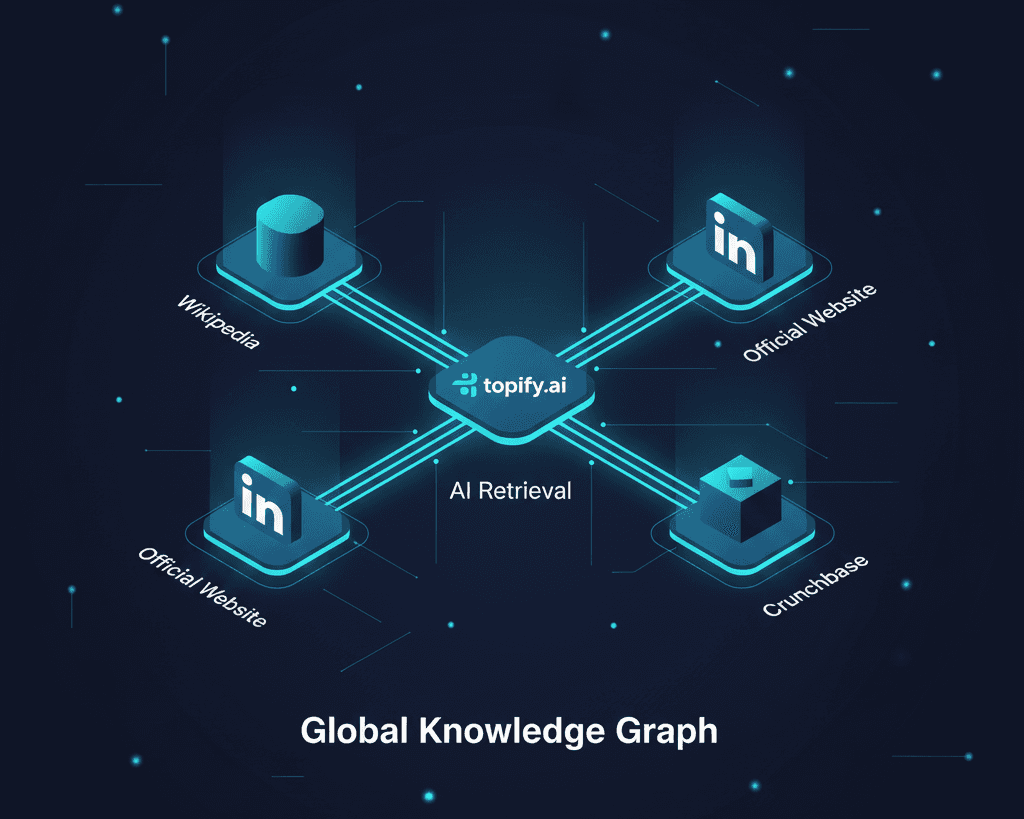
In the eyes of an AI, your company is not a website—it is an Entity. An entity is a unique, identifiable node in a Knowledge Graph. If the AI sees conflicting data about your entity, it will lose trust and stop citing you.
Synchronizing Brand Signals
AI models cross-reference data from Wikipedia, LinkedIn, Crunchbase, and official government registries.
The Conflict Problem: If your LinkedIn says you have 500 employees but your "About" page says 1,000, the AI perceives this as a hallucination risk.
The Solution: Conduct a "Knowledge Graph Audit." Ensure your brand’s founding date, headquarters, key personnel, and core services are identical across all authoritative platforms. This is essential for mastering entity SEO for AI visibility.
Leveraging Structured Data (JSON-LD)
While Schema markup was once for "rich snippets," in GEO, it is the primary machine-readable signal. By explicitly defining your product's features, pricing, and compatibility in a JSON-LD format, you remove the "guessing" phase for the AI retriever.
Strategy 3: Behavioral Intent and Conversational Mapping
Traditional SEO targets short-tail keywords (e.g., "cloud storage"). GEO targets conversational intent (e.g., "What cloud storage is most secure for a healthcare firm using AWS?").
Mapping Long-Tail Conversational Prompts
Companies must identify the "Prompts" that drive their business. This requires moving beyond keyword tools to "Prompt Intelligence" platforms like Topify.
The Workflow: Identify the top 100 questions your customers ask during the sales process. Create dedicated content modules that answer these questions directly and technically. This is the foundation of what is AEO.
Sentiment Monitoring and Correction
Unlike a blue link, an AI answer can be critical of your brand. If a model consistently says your software is "hard to set up," it is because it retrieved negative sentiment from forums or reviews.
Active Correction: Use sentiment analysis to find the source of these negative signals. Address the issue technically and update your public documentation to reflect the fix, allowing the RAG engine to retrieve the "corrected" narrative.
Case Study: Transitioning from Links to Answers
To illustrate the ROI of this shift, let's look at an industrial manufacturing company (pseudonym: EcoLogic Parts) that faced a 40% decline in organic traffic as Google’s AI Overviews rolled out.
The Problem: Invisible Authority
EcoLogic Parts had the highest domain authority in its niche. However, for prompts like "Which industrial valve is best for high-pressure salt water?", the AI was citing a smaller, newer competitor. The reason? The competitor had structured their product pages into machine-readable "Fact Sheets," whereas EcoLogic used PDF brochures that were hard for the AI to "ingest."
The GEO Intervention
Working with Topify, EcoLogic executed a three-month GEO roadmap:
PDF to HTML Conversion: They transformed 500+ PDF specs into fact-dense, structured HTML pages with H2/H3 headers.
Entity Consolidation: They synchronized their brand data across 20+ industrial directories and Knowledge Graphs.
Prompt-Specific FAQ Modules: They built a "Technical Solution Center" specifically designed to answer complex, conversational user prompts.
The Results
Metric | Before GEO | 3 Months After | % Change |
Citation Share (SOV) | 3.20% | 24.80% | 6.75 |
AI Overview Visibility | 12% | 68% | 4.66 |
In-Chat Conversion | 0.80% | 3.40% | 3.25 |
Total Citation Traffic | 400/mo | 2,800/mo | 6 |
This success demonstrates that adaptive AI decision making can turn a traffic decline into a brand dominance opportunity.
Comparison: Traditional SEO Tools vs. AI Visibility Platforms
Most companies try to solve 2025 problems with 2015 tools. Understanding the platform gap is critical for budget allocation.
Feature | Traditional SEO (e.g., Ahrefs) | AI Visibility (e.g., Topify) |
Primary Index | Backlink/Keyword Graph | RAG/Vector Embedding Simulation |
Visibility Metric | SERP Rank (Position 1-100) | AI Share of Voice (SOV) |
Data Focus | Click-Through Rate (CTR) | Citation Frequency & Sentiment |
Strategy Insight | Content length & keywords | Factual Density & Entity Authority |
Platform Scope | Google & Bing | ChatGPT, Perplexity, Gemini, SearchGPT |
For a deeper dive into choosing the right stack, see our guide on how to compare AI search optimization tools.
Strategic Outlook: Agentic Search and the Future of Clicks
By the end of 2025, we will enter the era of Agentic Search. AI agents won't just find answers; they will execute tasks on behalf of the user.
Optimizing for Machine-to-Machine (M2M) Discovery
When an AI agent is tasked with "buying the most reliable CRM," it doesn't read blog posts. It analyzes data structures, API endpoints, and technical compliance logs.
The Strategy: Your website must be machine-legible to an extreme degree. This involves moving beyond "Human Content" to "Signal Content"—data that an AI can ingest and use to make a decision without human intervention. This is the future of search engine optimization.
The Role of Real-Time Social Sentiment
Models like Perplexity are increasingly using Reddit and X as "Grounding Layers" for current events and brand reputation.
The Strategy: Your GEO strategy must include a "Community Reputation" component. High-authority mentions on Reddit act as a secondary verification for the AI model, confirming that the "facts" on your website match the "reality" of the community.
Frequently Asked Questions (FAQ)
1. Will SEO become obsolete because of AI search?
No, but it is evolving. Traditional SEO will still be valuable for "exploratory" browsing and long-form research. However, for "direct-answer" queries, GEO is the new standard. A successful company will run a hybrid strategy: SEO for clicks, and GEO for citations.
2. How does "Information Density" actually help with rankings?
AI models are trained to avoid the risk of "hallucinating" (making things up). When they retrieve information from the web, they calculate a "Confidence Score." Fact-dense content (containing dates, specific numbers, and verifiable entities) increases this confidence score, making the AI more likely to cite your content in its answer.
3. What is an "Invisibility Gap" in AI search?
An Invisibility Gap occurs when your brand ranks highly in traditional Google search for a specific term, but is completely absent from the AI-generated answer for that same topic. This usually happens because your content structure is incompatible with the AI's "Retriever" or because your Brand Signals are inconsistent across the Knowledge Graph.
4. How often should I update my content for GEO?
Because AI models like Perplexity and SearchGPT crawl in real-time, your content should be updated as often as your brand’s facts change. Unlike traditional SEO, where it can take months to see ranking changes, a well-optimized GEO update can be picked up by RAG-based engines in as little as 48 hours.
5. Is it better to be the only citation or one of many?
Being the "Primary Citation" (the first source mentioned) is ideal, as it confers the highest authority. However, in a comparison query (e.g., "Top 5 CRMs"), being one of the citations is essential to remain in the "consideration set." Topify helps you track both metrics to ensure you aren't being left out of the conversation.
Conclusion: Dominating the Answer, Not the Index
The transition from blue links to AI answers is the most profound change in the history of the internet. Companies that continue to focus solely on keyword rankings are optimizing for a declining medium. To win in 2025, brands must transform their content into a verifiable knowledge base that AI models can trust, retrieve, and cite.
By focusing on Trust Engineering, Entity Synchronization, and Conversational Intent Mapping, you can ensure that your brand is not just a result on a page, but the answer to the user's problem.
Ready to start your transition from SEO to GEO?