Quick Verdict: Top 3 Platforms for Tracking AI Mentions
If you are short on time, here are the top recommendations based on our testing:
Best for Growth & Strategy: Topify (Combines metrics with content generation).
Best for Enterprise Attribution: Profound (Deep integration with BI tools).
Best for Tight Budgets: Otterly.ai (Simple, no-frills monitoring).
Comprehensive Review of the Best AI Search Visibility Tools
Topify – The “Operating System” for AI Search
Best For: Growth teams, Content Marketers, and Agencies requiring actionable strategy.
Topify is not just a passive monitor; it is an active optimization platform. While most tools simply tell you “you aren’t visible,” Topify helps you fix it. It is built on the philosophy that monitoring brand visibility in AI is useless without the ability to influence it.
Key Features:
-
Prompt-Level Tracking: Monitor hundreds of natural language queries across major LLMs.
-
GEO Content Generation: A unique feature that generates structured, “citation-ready” content drafts to fill visibility gaps.
-
Sentiment & Hallucination Detection: Flags inaccurate or negative brand mentions instantly.
-
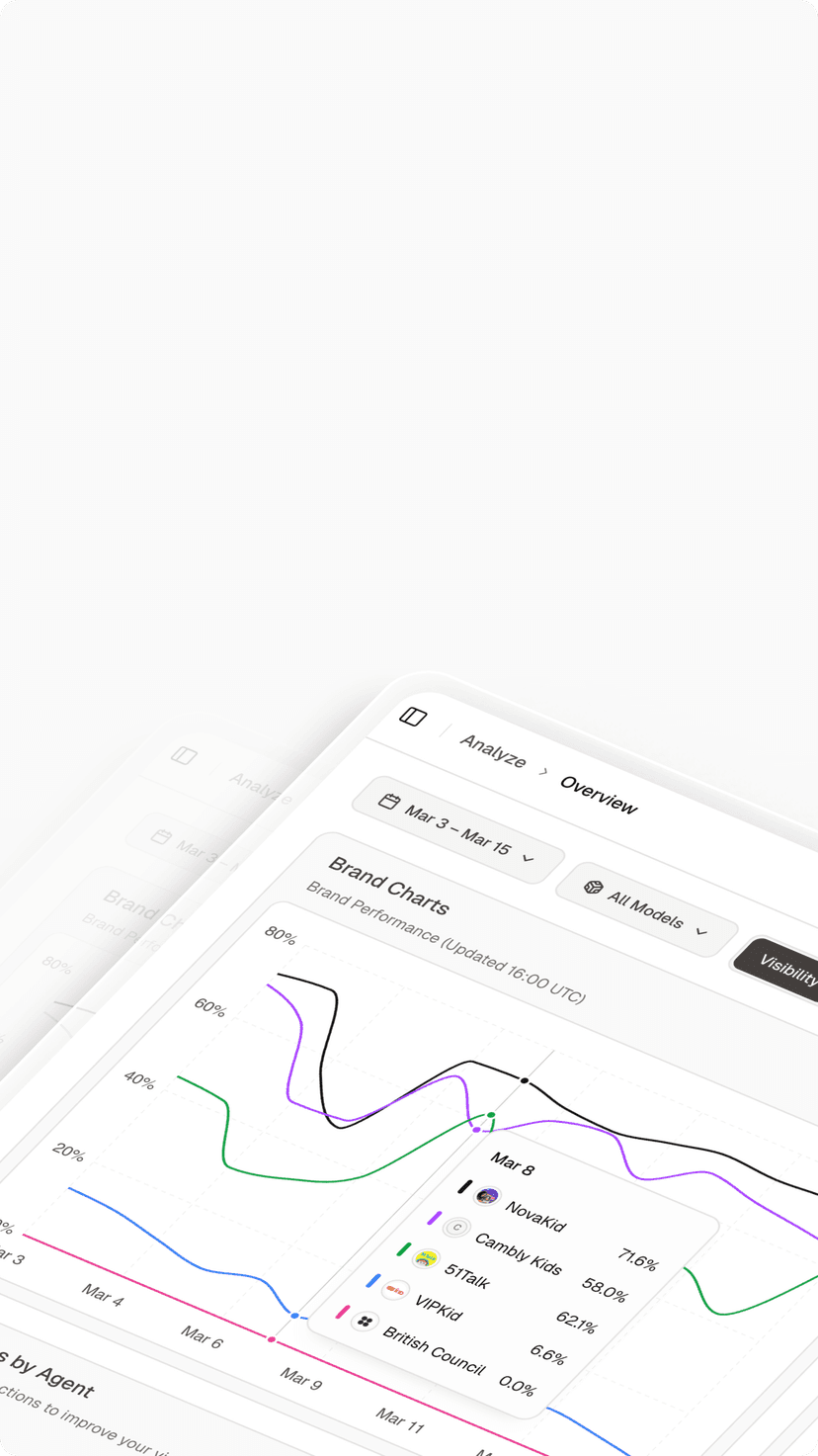
Competitor Benchmarking: Visualizes your SoV against key rivals.
-
Pricing: Starts at $99/mo (Basic) and $199/mo (Pro).
-
Verdict: The most balanced tool among the Best AI Search Visibility Tools for teams who want to measure and improve their standing.
-
Profound – The Enterprise Attribution Engine
-
Key Features:
-
Corporate-grade Share of Voice metrics.
-
Integration with Adobe Analytics and GA4 for revenue attribution.
-
Global language support.
-
Pricing: Custom Enterprise pricing (typically $4,000+/mo).
-
Verdict: Powerful, but likely overkill (and over-budget) for mid-market companies.
-
Goodie.ai – The End-to-End Optimization Suite
-
Key Features:
-
Deep dive analytics into “Why” a brand was chosen.
-
Automated insights for content teams.
-
Pricing: Mid-to-High tier.
-
Verdict: A strong contender, though the interface can be overwhelming for beginners.
-
Otterly.ai – The “Keep It Simple” Monitor
-
Key Features:
-
Simple dashboard for brand mentions.
-
Basic sentiment tagging.
-
Slack alerts.
-
Pricing: Free tier available; paid plans start low.
-
Verdict: The perfect entry point for those dipping their toes into GEO.
-
ZipTie.dev – The Technical Validator
-
Key Features:
-
SGE / AI Overview specific tracking.
-
Technical indexing audits.
-
Pricing: Usage-based.
-
Verdict: Essential for the technical audit phase, but less focused on brand reputation management.
-
Semrush (AI Overview Tracking) – The Transitional Choice
-
Key Features:
-
Tracks if an AI Overview triggers for your keywords.
-
Identifies if your link is cited in the carousel.
-
Limitations: It primarily tracks Google’s AI, not ChatGPT or Claude directly as independent engines.
-
Verdict: Good for tracking Google SGE, but insufficient for a full AI strategy. Read more on GEO vs SEO differences to understand why SERP tools aren’t enough.
-
Peec AI – The Competitor Spy
-
Key Features:
-
Visual comparison of brand presence.
-
Snapshot reports for executives.
-
Verdict: Great for reporting, lighter on actionable optimization features.
-
Writesonic (GEO Mode) – The Content Writer’s Tool
-
Key Features:
-
Content scoring based on AI answer probability.
-
Keyword/Entity suggestions.
-
Verdict: Good for the execution phase, but lacks the monitoring capabilities of a dedicated platform.
-
Authoritas – The Agency Scale Platform
-
Key Features:
-
Bulk tracking of generative answers.
-
Agency white-label reporting.
-
Verdict: Ideal if you are already using their ecosystem.
-
Manual “Synthetic” Testing (The DIY Method)
-
Method: Create a list of 50 prompts. Manually paste them into ChatGPT, Gemini, and Perplexity once a week. Record the results.
-
Verdict: Accurate but unscalable. As you scale, you will need to automate this process to quantify AI Share of Voice effectively.
-
If you need to fix your visibility: Choose Topify. The combination of tracking and content generation means you can actually act on the data.
-
If you just want to “watch” the numbers: Otterly.ai is sufficient.
-
If you are a Fortune 500 CMO: You likely need the custom integrations of Profound.
-
If you are obsessed with Google’s SGE only: Stick with Semrush or ZipTie.
Best For: Zero budget teams or ad-hoc research.
Sometimes, the best tool is a spreadsheet and a subscription to ChatGPT Plus.
Feature Comparison of Major Generative Engine Optimization Platforms
The following table breaks down the features of the top contenders.
Feature
Topify
Profound
Otterly.ai
Semrush
ZipTie.dev
Best For
Strategy & Growth
Enterprise
Budget
SEO Transition
Technical SGE
$$(Mid)
$$$$(High)
$ (Low)
$$$ (Mid-High)
$$ (Usage)
Multi-Model
Yes (GPT, Gemini, Perplexity)
Limited (Google Focus)
Limited (Google Focus)
Sentiment
Limited (Basic)
Content Gen
Complexity
User-Friendly
High
Medium
High
Selecting the Right Solution for Your AI Brand Monitoring Strategy
Choosing the right software depends on where you are in your GEO journey.
Remember, the goal isn’t just to buy a tool; it’s to build enterprise SEO visibility strategies that future-proof your revenue.
Frequently Asked Questions About AI Search Analytics
Q1: Can I just use Google Search Console (GSC) for this?
No. GSC only shows data for Google Search. It does not provide data on whether ChatGPT or Claude is recommending your brand. Even for Google’s AI Overviews, GSC data is currently limited and aggregated.
Q2: Why is “Sentiment Analysis” important for AI tools?
In traditional SEO, a link is a link. In AI search, the context matters. If ChatGPT says, “Brand A is good, but Brand B is a scam,” both are technically “visible,” but only Brand A will get customers. Tools like Topify identify these negative sentiments so you can address them.
Q3: How often should I track these rankings?
Daily or weekly. AI models are updated frequently, and RAG systems (like Perplexity) pull live data. Your visibility can fluctuate much faster than traditional SEO rankings.
Q4: Do these tools guarantee rankings?
No tool can guarantee a ranking in a probabilistic AI model. They provide data, probabilities, and optimization levers to maximize your chances of being cited.
Q5: What is the difference between tracking keywords and prompts?
Keywords (
best crm) are for search engines. Prompts (Compare Salesforce and HubSpot for a small creative agency) are for Answer Engines. Prompt tracking reflects real-world user behavior in chat interfaces. -
Best For: Large SEO agencies managing hundreds of clients.
Authoritas has integrated generative rank tracking into their massive SEO suite, allowing agencies to report on AI visibility alongside traditional rankings.
-
Best For: Writers who want to optimize as they type.
While primarily an AI writing assistant, Writesonic has added GEO features that analyze top-ranking AI answers to suggest content improvements.
-
Best For: Highly competitive verticals.
Peec AI specializes in comparative visualization. It is excellent for showing stakeholders a “We vs. Them” chart.
-
Best For: Existing Semrush users who don’t want a new tool.
Semrush has updated its sensor and position tracking tools to detect “AI Overviews” in Google SERPs.
-
Best For: Technical SEOs and Data Scientists.
ZipTie is created by seasoned SEO veterans and focuses heavily on the technical side of “Indexability” within AI Overviews (SGE). It helps you understand if your content is technically retrievable by the RAG systems.
-
Best For: Startups, Indie Hackers, and budget-conscious teams.
Otterly removes the complexity. It answers one question: “Is ChatGPT talking about me?” It lacks the deep strategic insights or content generation of Topify, but it does the monitoring job well for a fraction of the cost.
-
Best For: Brands looking for a managed service feel.
Goodie.ai positions itself as a comprehensive GEO solution. They emphasize the “flywheel” effect of optimization.
-
Best For: Fortune 500 companies and large enterprises with complex attribution needs.
Profound is a heavyweight in the sector. It focuses heavily on data granularity and historical tracking. Its primary selling point is “SEO for LLMs” at an enterprise scale, often catering to brands that need SOC2 compliance and dedicated account management.