The New Threat: The "Uncontrolled" Spokesperson
Imagine you hired a PR agency that talks to millions of customers daily, but they refuse to read your brand guidelines, frequently make up product features you don't have, and occasionally recommend your competitors.
This is exactly what is happening right now inside Large Language Models (LLMs).
When a potential buyer asks ChatGPT, "What is the difference between [Your Brand] and [Competitor]?", the AI generates an answer based on probabilistic patterns, not your official messaging. If the AI uses an old tagline from 2019 or describes your premium software as "cheap entry-level tools," your Brand Voice has been compromised.
For Brand Managers and CMOs, AI visibility tracking is no longer just a vanity metric; it is a brand safety imperative.
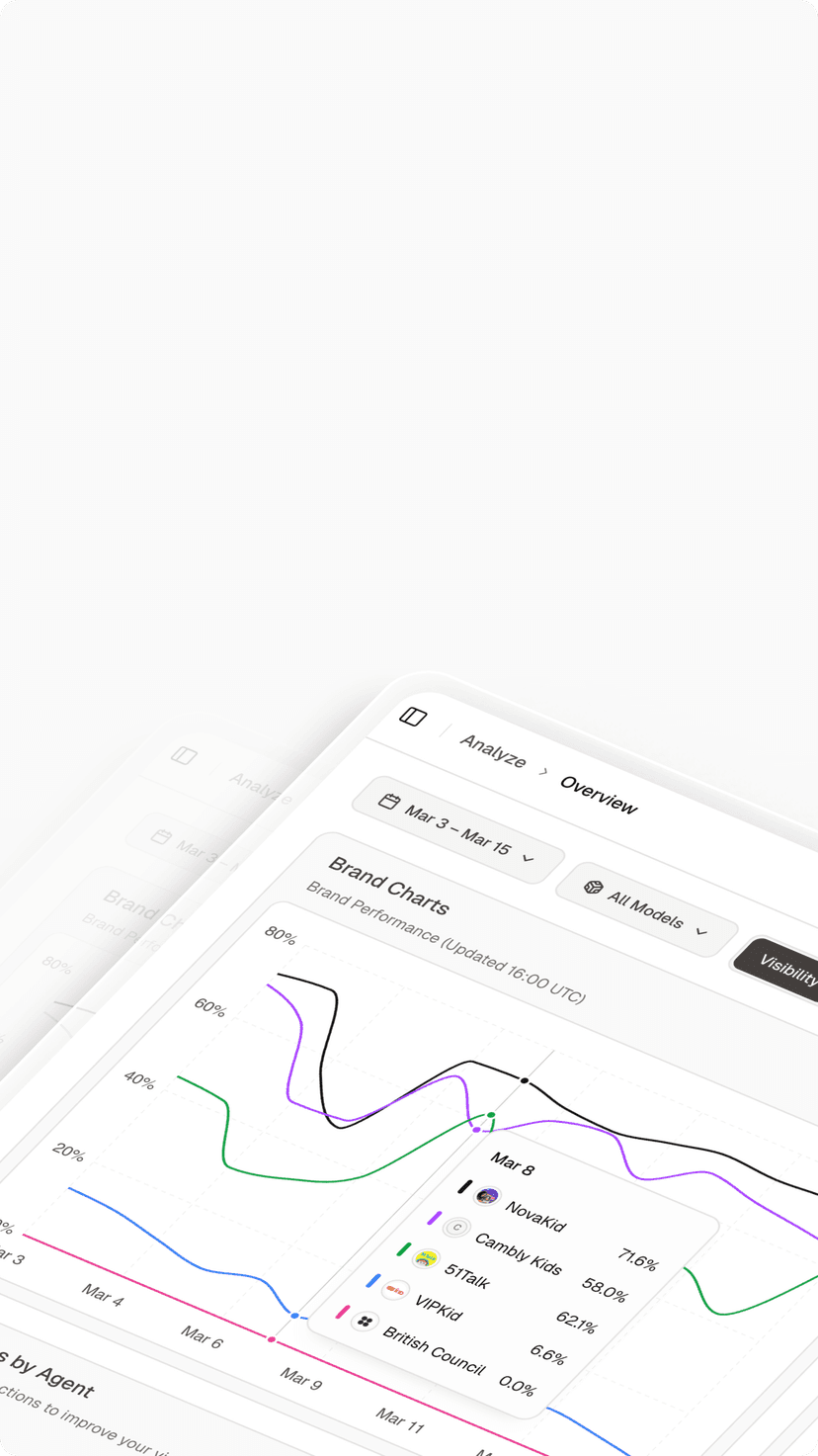
This comprehensive guide explores the risks of AI-generated narratives and provides a step-by-step methodology on how to monitor brand visibility in AI effectively. We will show you how to use Topify to audit your digital echo and ensure your strategy aligns with the broader principles of generative engine optimization (GEO).

The Risks: Hallucinations and Brand Dilution
Why is monitoring so critical? Because unlike a static webpage, AI answers are fluid and prone to distortion.
Feature Hallucination
The AI might claim your software integrates with a tool it doesn't, or lacks a certification you actually possess.
Impact: Customer frustration, increased support tickets, and potential legal liability for false advertising (even if you didn't write it).
Tonal Misalignment
Your brand voice might be "Professional, Enterprise, Secure." But the AI might describe you as "Fun, Cheap, Simple."
Impact: You attract the wrong customers (churn risk) and alienate your ideal enterprise buyers.
Zombie Narratives
You pivoted your business model two years ago. The AI is still training on data from five years ago.
Impact: The AI actively sells your old business model, confusing the market.
Core Metrics for AI Visibility Tracking

To protect your brand voice, you need to measure specific dimensions of the AI's output. Simple "Mention Counts" are not enough.
Narrative Consistency Score
How closely does the AI's description of your value proposition match your official "About Us" page?
Topify uses vector similarity matching to grade this. If your official messaging is Vector A, and the AI's output is Vector B, Topify calculates the distance. A large distance means your message is being diluted.
Sentiment Nuance
It's not just "Positive" or "Negative." Is the sentiment "Excited," "Cautious," or "Dismissive"?
Example: "Topify is a cheap option" (Positive Sentiment, but maybe Negative Brand Fit if you are a premium tool).
Entity Association
What other concepts does the AI link to your brand?
Risk: If the AI frequently associates your brand with "Bugs," "Legacy," or "Layoffs," you have a reputation crisis. While legacy tools miss these nuances, specialized AI brand visibility tracking software is designed to detect these reputational risks in real-time.
Step-by-Step: How to Monitor Brand Visibility in AI
Manual checking is biased and unscalable. You need a systematic approach using a tool like Topify.
Step 1: Define Your "Golden Truth"
Before you monitor, you must define the standard. Upload your core brand guidelines to Topify.
Key Messages: "We are the fastest, not the cheapest."
Prohibited Claims: "Do not say we offer a free tier."
Step 2: Set Up "Adversarial" Monitoring
Don't just ask nice questions. Configure Topify to ask "Adversarial Prompts" to stress-test the AI.
Prompt: "Why should I NOT buy from [Your Brand]?"
Prompt: "Is [Your Brand] worth the high price?"
Goal: See how the AI defends you (or fails to) under pressure.
Step 3: Monitor Across the "Big 3" Models
Different models have different training biases.
ChatGPT: Tends to be more creative but prone to hallucination.
Claude: Tends to be safer and more conservative.
Perplexity: Tends to be more factual but relies heavily on recent citations. Topify monitors all three simultaneously to give you a 360-degree view of your brand voice.
Step 4: Analyze the "Gap Report"
Topify generates a report showing the delta between your "Golden Truth" and the "AI Reality."
Action: If the AI consistently gets your pricing wrong, you know you need to update your pricing page schema and get third-party review sites (like G2) to update their data. Analyzing these gaps is a critical step in learning how to audit brand visibility on LLMs effectively.
Diagnosing Brand Voice Issues: A Case Table
Here is how to interpret the data you get from AI visibility tracking.
AI Output Scenario | Diagnosis | The Fix (Optimization Strategy) |
"Brand X is a great free tool." | Pricing Hallucination. AI is pulling from old data or "Freemium" competitor confusion. | Update Schema Markup with PriceRange and IsAccessibleForFree=False. |
"Brand X is good for beginners." | Positioning Drift. You are an Enterprise tool, but AI thinks you are SMB. | Publish "Enterprise Case Studies" and whitepapers to signal complexity and depth. |
"Brand X is similar to [Bankrupt Company]." | Toxic Association. AI connects you with a failed competitor. | Create comparison pages explicitly distancing your tech stack and history from theirs. |
"Brand X has security flaws." | Reputation Damage. AI is citing an old breach or negative Reddit thread. | Flood the zone with "Security Compliance" pages (SOC2, ISO) and press releases. |
Strategy: Correcting the Narrative
Once you identify that your brand voice is being distorted, how do you fix it? You cannot "edit" ChatGPT. You must "teach" it.
The "Data Injection" Strategy
LLMs rely on RAG (Retrieval-Augmented Generation). To change the answer, you must change the source data.
Consensus Creation: If 10 high-authority sites (Crunchbase, LinkedIn, G2, Capterra, Your Blog) all say the exact same phrase about your brand, the AI treats it as a fact.
Consistency is Key: Ensure your boilerplate text is identical across all these platforms. Variations confuse the model.
Leveraging "Knowledge Graph" Entities
Ensure Google's Knowledge Graph understands your brand correctly. AI models often use Google's Knowledge Graph as a "fact-checking" layer.
Tactic: Claim your Knowledge Panel and ensure your Wikidata entry is accurate.
Sentiment Seeding
If the AI thinks you are "boring," inject "excitement" into the ecosystem.
Tactic: Collaborate with influencers or creators to generate content that uses emotional language (e.g., "Game-changer," "Revolutionary") alongside your brand name. Sentiment seeding is crucial for maintaining search marketing visibility in an era where AI models prioritize "helpfulness" and "positivity."
The Future: Brand Protection Agents
As we look toward 2027, AI visibility tracking will evolve into active defense.
We expect tools like Topify to offer "Correction Agents"—autonomous bots that can identify factual errors in AI answers and automatically submit "Feedback" or "Correction Requests" to the AI providers (OpenAI, Google) via their APIs.
Until then, rigorous monitoring and content engineering are your best defense.
Conclusion: Own Your Story or the AI Will
Your brand is no longer just what you say it is. It is what the AI synthesizes from a billion data points.
If you are not actively monitoring this synthesis, you are allowing a stochastic parrot to define your value proposition to the world.
Learning how to monitor brand visibility in AI is the modern equivalent of media monitoring. It is essential, strategic, and non-negotiable. Use Topify to ensure that when the AI speaks for you, it speaks the truth.
FAQ:
Can I just search my brand name in ChatGPT? No. ChatGPT personalizes answers based on your chat history. Your "Manual Check" is biased. You need a tool like Topify to run anonymized, scaleable checks to see what the average user sees.
How often should I check my brand voice? Brand voice doesn't change as fast as rankings. A weekly check is usually sufficient, unless you are in a crisis (e.g., a data breach), in which case daily monitoring is required.
What do I do if the AI is hallucinating my pricing? First, audit your own website. Is the pricing clear? Is it in an HTML table? Is there Schema Markup? Second, audit third-party sites (G2, Capterra). The AI often trusts G2 more than your own site. Update the data there.
Does Topify track visual brand visibility? Currently, text is the primary focus. However, as Gemini and GPT-4V become more visual, tracking whether the AI displays the correct logo or product image will become a standard feature of AI visibility tracking.
Is this part of SEO or PR? It sits at the intersection of both. It requires the technical skills of SEO (Schema, Content Engineering) and the strategic mindset of PR (Narrative Control, Crisis Management). We call it GEO (Generative Engine Optimization).