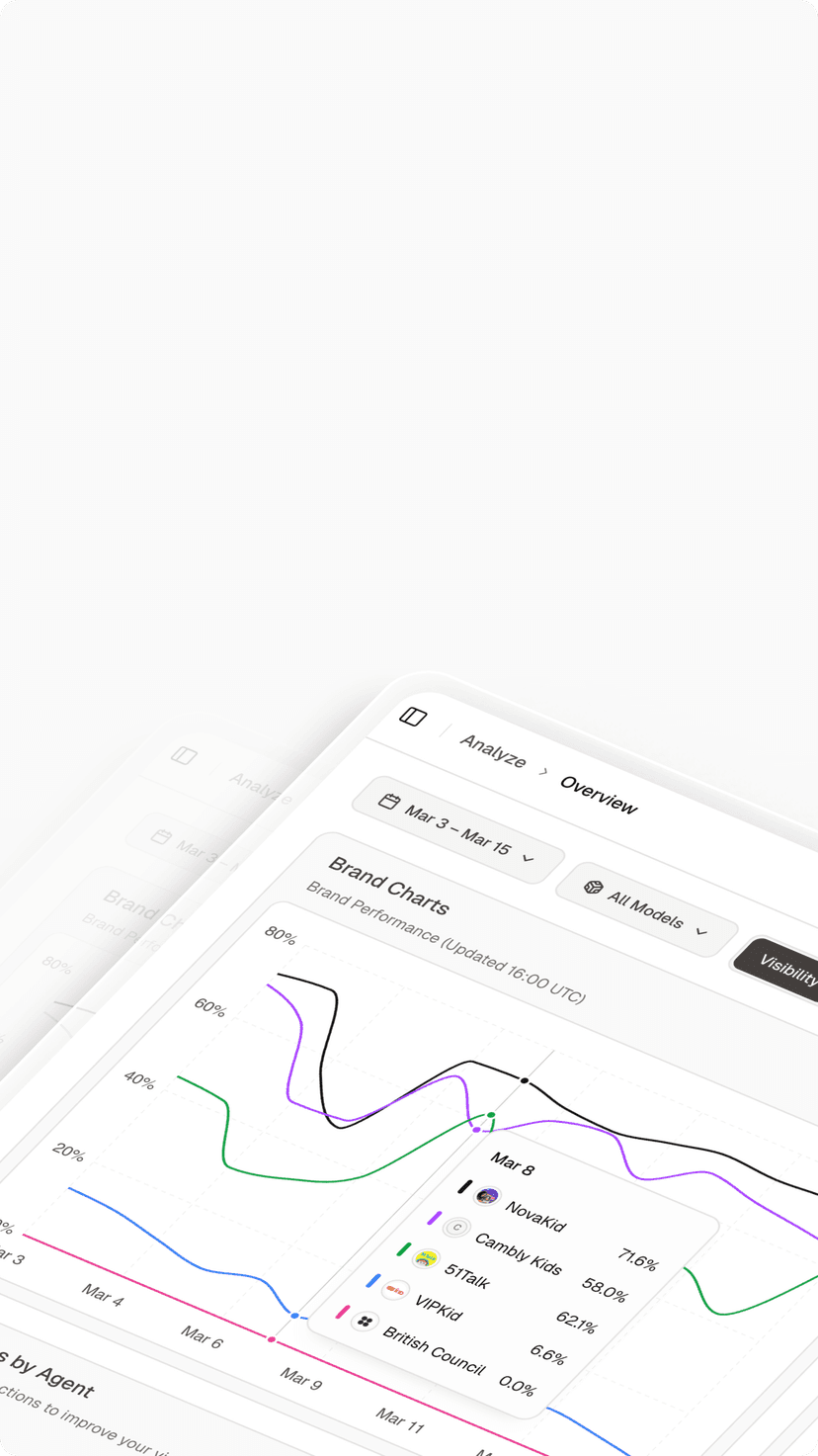
Essential Metrics for Evaluating AI Answer Visibility Software
When evaluating vendors, look beyond mention counting. You are buying data intelligence.
1. Sentiment Analysis & Brand Perception
In GEO, a ranking can be harmful if the sentiment is negative.
The Requirement: Tools must use NLP to categorize mentions as Positive, Neutral, or Negative.
Best in Class: Topify.ai tracks “Sentiment Drift,” showing perception changes after product launches.
2. Citation Authority & Source Tracking
Generative engines use RAG (Retrieval-Augmented Generation) to fetch sources.
The Requirement: Identify which URL the AI quoted. Is it your pricing page or a competitor’s blog?
Why it matters: Quality visibility analysis metrics help reverse-engineer citations. If Perplexity cites a Reddit thread, you must engage there.
3. Prompt-Level Granularity (PLG)
Users use prompts, not just keywords.
Test: Can the tool track long-tail prompts like “Best CRM for fintech startups with 50 employees?”
Metric: Support for “Variable Injection” to test user personas.
4. Multi-Model Latency
Benchmark: Leading SaaS platforms update high-priority keywords daily. Enterprise tiers often offer 6-hour refresh rates.
5. Share of Voice (SoV) Visuals
Requirement: Visual comparison of citations. e.g., In 100 answers about “Best Running Shoes,” how often is Nike cited vs. Adidas?
Deep Dive Comparison: Top 3 SaaS Platforms Reviewed
We stress-tested the leading platforms against the metrics above.
1. Topify.ai: The Strategy-First Platform
Best For: Marketing Directors & SEO Strategists needing ROI.
Overview: Topify balances strategy with data and supports brand visibility measurement across major AI answer platforms, including ChatGPT, Perplexity, and Google AI–powered search experiences.
Pros: Actionable insights bridging data and content; advanced sentiment detection.
Cons: Feature-rich interface may overwhelm simple rank-check needs.
2. Profound: The Enterprise Data Fortress
Best For: Fortune 500 & Regulated Industries.
Overview: Profound focuses on compliance and integration, acting as a data pipe to dashboards like Tableau.
Pros: SOC2 Type II compliance; massive scale (100k+ keywords); revenue attribution modeling.
Cons: High entry cost; steep learning curve requiring data analysts.
3. Otterly.ai / Peec AI: The Agile Starters
Best For: Startups & Growth Agencies.
Overview: Focused on speed and affordability. Perfect for answering “Am I visible?” without complex sentiment analysis.
Pros: Setup in <5 mins; modern UI; affordable pricing.
Cons: Limited depth (lacks source analysis); shorter data retention.
Comparison Matrix: Feature Sets & Architecture
Feature Category
Enterprise SaaS (Profound)
Strategic SaaS (Topify.ai)
Agile SaaS (Otterly)
Primary Goal
Compliance & Scale
ROI & Optimization
Speed & Monitoring
Sentiment Analysis
NLP-based (Deep)
NLP-based (Deep + Suggestions)
Keyword Match (Basic)
Models Tracked
5+ (inc. Custom)
3 (ChatGPT, Perplexity, Google AI Overview)
2-3 (Major only)
Update Frequency
Real-time API
Daily / Weekly
Weekly
Data Export
API / Warehouse
CSV / PDF Reports
Ideal User
VP of Data
CMO / Head of SEO
Founder / Growth Marketer
Strategic Choice: To improve rankings, choose Strategic SaaS (Topify) for the “How-to.” To simply report numbers, Enterprise SaaS fits best.
How AI Visibility Tracking Platforms Handle Multi-Model Tracking
Tracking multiple models simultaneously is complex due to distinct API behaviors. SaaS-based AI search monitoring handles this variance.
The “Big Four” You Must Track
ChatGPT (OpenAI): Creative and conversational.
-
Challenge: High answer variance requiring multiple sampling passes.
-
Perplexity: Fact-obsessed “Answer Engine.”
-
Challenge: Cites real-time web sources; requires accurate footnote parsing.
-
Google Gemini: Integrated into Workspace.
-
Challenge: Heavily localized results summarizing Maps/Drive data.
-
Claude (Anthropic): Analytical B2B engine.
-
Challenge: Monitoring visibility specifically on Claude is difficult as it relies on a smaller, safer training set.
-
Add direct definition lists.
-
Use statistics tables (LLMs prefer structured data).
-
Insert “Authoritative Quotes.”
-
Scenario: Buyer asks, “Is Brand A reliable?” -> AI: “Users report downtime.”
-
Result: Buyer lost forever; no bounce rate to track.
Desktop tools fail here. You need a SaaS platform updating its “Prompt Library” daily. See our technical guide on tracker features.
Optimizing Content Strategy with AI Search Visibility Tools
Data is useless without action. Here is a workflow for high-performance teams.
Step 1: Gap Analysis
Highlight topics where competitors are cited, but you are not (e.g., “Best Enterprise ERP”).
Step 2: Content Engineering
Rewrite pages to be “machine-readable” using tool suggestions:
Step 3: Validation
Use the SaaS tool to “Force Re-check.” Did Perplexity pick up the new content?
This feedback loop helps teams start prioritizing updates for content teams based on engineering logic, not guessing.
ROI Analysis: Investing in Cloud-Based AI Monitoring
Is the investment worth it?
The Cost of Invisibility
A negative AI answer costs trust, not just clicks.
The Efficiency Gain: Manual vs. SaaS
Activity
Manual Tracking
SaaS Platform
Scope
50 Keywords x 3 Engines
500 Keywords x 5 Engines
Time Cost
20 Hours / Month
0 Hours (Automated)
Est. Cost
$1,000+ (Labor)
$200 – $500 (Sub)
Conclusion: SaaS subscriptions are significantly cheaper than manual monitoring labor, with superior data quality.
For a broader view on ROI, explore our comprehensive GEO strategic roadmap.
Frequently Asked Questions (FAQ)
1. What are AI search visibility tools SaaS cloud services?
Cloud-based platforms automating brand tracking on Generative AI (ChatGPT, etc.). They use cloud infrastructure for high-volume prompt testing across LLMs to determine “Visibility Scores.”
2. How do these differ from traditional SEO software?
Traditional tools (Ahrefs) track static links. Specialized monitoring platforms track dynamic text, analyzing sentiment and citations in non-deterministic AI answers.
3. Which tool is best for sentiment analysis?
Topify.ai is the leader, offering granular breakdowns of positive/negative mentions to help PR teams manage narratives.
4. Can I track competitors?
Yes. Most AI visibility tracking platforms allow competitor domain input to compare Share of Voice.
5. Do small businesses need SaaS tools?
Yes. AI search is becoming the primary discovery method. If Siri or ChatGPT recommends a local service, you need to be that recommendation.
6. Why is cloud-native architecture important?
It allows elastic scaling. When new models (like GPT-5) drop, SaaS platforms instantly spin up tracking nodes, whereas desktop tools require months to update.
-
-
-