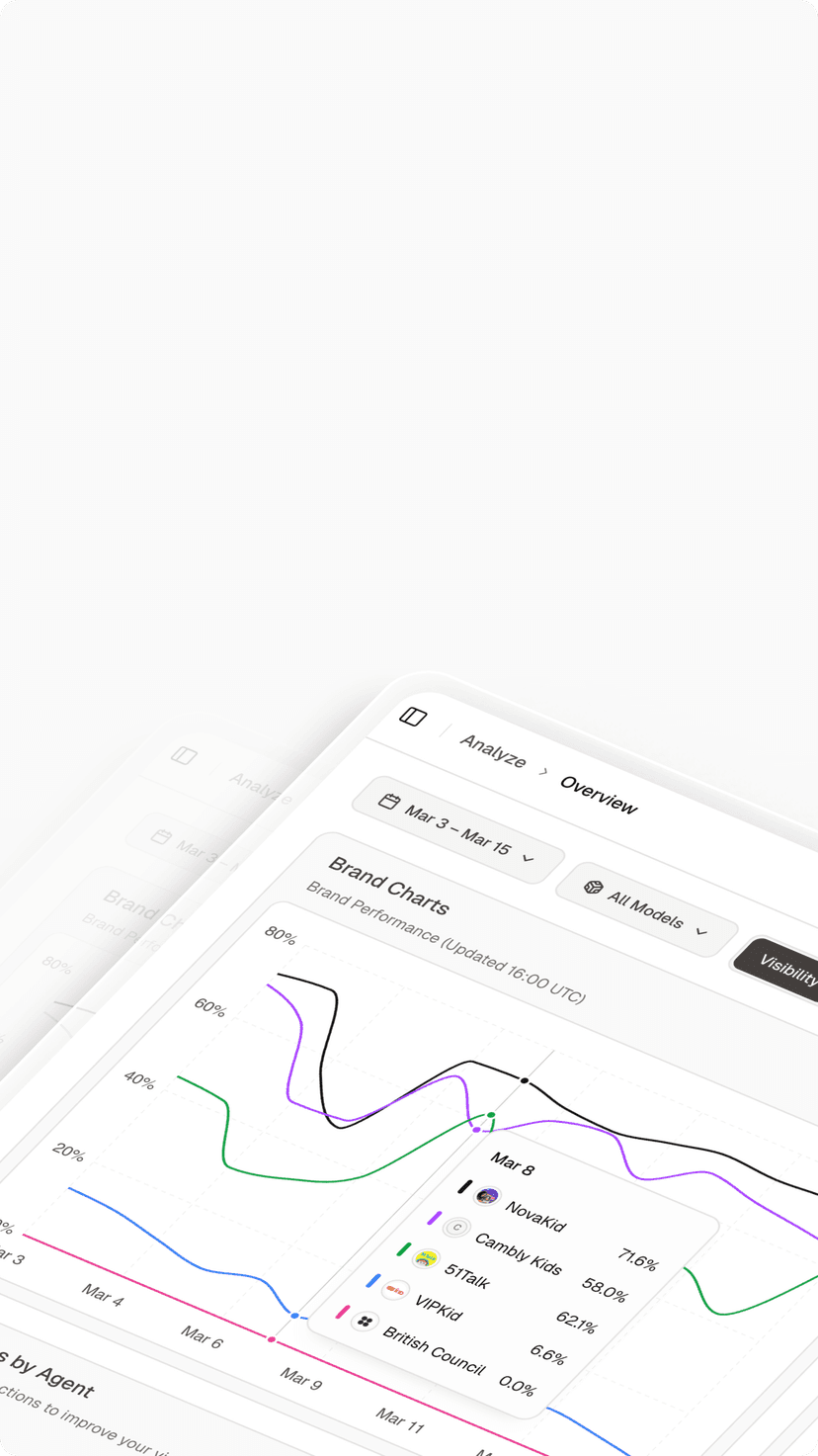
Your domain authority is strong. Your keyword rankings look solid. But when a prospect asks ChatGPT, "What's the best platform for [your category]?", they get a list of five recommendations, and your SaaS brand isn't on any of them. That's the gap traditional SEO dashboards can't show you: the one between ranking on Google and being recommended by the AI engines that now mediate 94% of B2B buying journeys. And it's widening every quarter.
The tools built to close that gap aren't all equal, especially for SaaS and cloud services.
Most AI Visibility Platforms Were Designed for E-Commerce. SaaS Brands Pay the Price.
The SaaS buying journey doesn't look like an Amazon impulse purchase. The average B2B buying group now includes 10 to 13 unique decision-maker functions, spanning IT, finance, operations, and end users. These stakeholders don't search for "best CRM." They ask Perplexity things like, "What's the best CRM for a mid-market manufacturing firm with a 20-person sales team and native Stripe integration?"
That level of prompt complexity breaks most generic visibility tools.
Here's the thing: 95% of the time, the vendor that wins the contract was already on the buyer's initial shortlist. If your SaaS product doesn't appear in the AI's first answer, you're essentially eliminated before a rep ever picks up the phone. On average, B2B respondents now use three different AI tools regularly, with C-suite executives averaging 3.9 tools per person. Your brand needs to show up across all of them.
And the discovery layer has moved inside the workflow itself. Buyers are asking Microsoft Copilot to draft vendor comparisons inside Word. They're prompting Gemini to summarize options within Gmail. A tool that only tracks ChatGPT misses more than half the picture.
B2B Buyer AI Search Behavior (2025-2026) | Value |
Buyers using AI tools during the purchasing journey | 94% |
Buyers encountering Google AI Overviews during research | 72% |
Buyers who click through to at least one AIO cited source | 90% |
Preference for rep-free, digital self-service journey | 61-75% |
AI search traffic conversion rate vs. traditional search | 14.2% vs. 2.8% |
That last row is the one SaaS marketers should circle. AI search traffic converts at over 5x the rate of traditional organic. These aren't casual browsers. They're prospects who've already received a synthesized recommendation and are ready to evaluate.
5 Metrics That Separate SaaS Brands Winning in AI Search from Those Falling Behind
In a zero-click world where 65% of searches end without a visit to a traditional website, traffic volume alone is a vanity metric. For SaaS brands, five numbers define whether your GEO strategy is working.
Visibility (Share of Voice). This measures how often your brand appears in AI-generated answers for a defined set of prompts. Share of Voice goes one step further: it calculates your percentage of AI mentions compared to competitors in your vertical. It's increasingly a C-suite KPI for pipeline protection.
Sentiment. Being mentioned is half the battle. If ChatGPT describes your enterprise platform as "great for small teams" or quotes 2022 pricing, that mention is actively hurting you. Sentiment tracking scores the tone and accuracy of every AI mention on a 0-100 scale.
Position. The vendor ranked first in a synthesized shortlist wins the deal roughly 80% of the time. Position tracking monitors where your brand sits relative to competitors in AI recommendation lists, not just whether you appear.
AI Volume. Traditional keyword volume is going blind to "dark queries," the long-tail, conversational prompts buyers type into ChatGPT and Perplexity. AI Volume tracks actual monthly search demand for specific prompts, revealing content gaps your competitors haven't filled yet.
CVR (Conversion Visibility Rate). This connects AI visibility to pipeline. It models the likelihood that an AI mention will drive a prospect toward a demo request or pricing page, factoring in intent, sentiment, mention strength, and link availability.
Topify: The Full-Stack GEO Platform Built for Brand Teams
Topify stands out by addressing the specific "information gain" and "citation velocity" requirements that SaaS brands face. Unlike legacy SEO platforms that bolted on AI features as an afterthought, it was built from the ground up for generative search.
Automated Prompt Generation. Drop in your brand URL, and the platform extracts core entities from your site structure, generating a custom prompt library that mirrors how buyers actually research your category. For a SaaS brand with hundreds of product pages, this replaces weeks of manual prompt testing with a 10-minute setup.
Competitor Auto-Detection. You don't need to guess who's stealing your share of AI voice. Topify's engine identifies which competitors appear alongside your brand in AI responses, showing where you're being displaced by category leaders or agile startups that have optimized for the LLM citation layer.
Source-Level Analysis. This is the feature SaaS marketers tend to value most. The platform doesn't just flag that you're missing from an answer. It shows which sources the AI is citing to build that answer: G2 profiles, Capterra reviews, Reddit threads, tech blogs. That means you can spot a drop in ChatGPT mentions and trace it back to a specific review site where your competitor has 30 more reviews than you. Actionable, not abstract.
Four-Platform Coverage. One dashboard covers ChatGPT, Perplexity, Google AI Overviews, and Gemini. No toggling between tools.
Topify Plan | Price | Key Limits | Ideal For |
Basic | $99/mo | 100 prompts, 9k analyses | Growth-stage SaaS brands |
Pro | $199/mo | 250 prompts, 22.5k analyses | Multi-product enterprises |
Enterprise | $499/mo+ | Custom limits | Global brand teams |
Service (Agency) | $3,999/mo+ | Full execution + Reddit visibility | Teams needing external execution |
Topify also offers a 30-day free trial, so SaaS teams can establish an AI visibility baseline before committing. Get started here.
Four Alternatives and Where They Hit a Ceiling
Peec AI. Peec AI uses UI scraping to simulate real user interactions with AI platforms, capturing exactly what a user sees, including response formatting and citation placement. It's a clean, intuitive option for mid-market SaaS teams ($2M to $50M ARR) that want fast setup. The trade-off: it doesn't estimate AI-driven traffic volume, and its sentiment analysis stays at a surface level. Access to major LLMs is often gated on entry-level plans.
Profound. Backed by a $20M Series A led by NVIDIA, Profound is an enterprise governance platform for Fortune 1000 brands. Its standout feature, "Agent Analytics," tracks how AI crawlers interact with your domain. The catch: the best capabilities sit behind enterprise pricing, putting it out of reach for most SaaS brands under $100M ARR. It's a monitoring powerhouse, but you'll need a separate execution strategy.
Ahrefs Brand Radar. If you're already an Ahrefs user, Brand Radar adds AI visibility on top of a massive dataset of 250+ million search-backed prompts. It's strong for macro-level comparisons, like benchmarking "Salesforce" vs. "HubSpot" across historical queries. On the flip side, it lacks sentiment analysis and automated content suggestions. The minimum cost for full AI platform coverage runs over $700/mo when you add the base subscription plus per-index add-ons.
LLMrefs. A cost-effective entry point for smaller SaaS teams, LLMrefs takes a "keywords-over-prompts" approach that simplifies GEO's technical complexity. It provides live keyword crawling and weekly trend reports. The limitation: a smaller dataset than enterprise rivals and weekly update cycles that may miss rapid shifts in AI behavior. Strong for foundational GEO hygiene, but not a full-stack solution.
What a Real SaaS GEO Workflow Looks Like, Week by Week
Buying a tool is step one. Operationalizing it is where the results come from. Here's a four-week cycle that connects measurement to execution.
Week 1: Audit and baseline. Use Topify's automated prompt generation to build a library of 20 to 30 core buyer-intent queries. Record initial visibility scores and sentiment polarity. Identify the top five competitors the AI cites most frequently.
Week 2: Gap analysis. Review where your brand is invisible. If competitors are cited and you aren't, use Source Analysis to map the "Trust Hub": the third-party sites (G2, Capterra, industry publications) that AI considers authoritative for your category. If a competitor holds a 93% lead in citations for "proof" prompts, that's your Week 3 target.
Weeks 3 and 4: Execution. On-page, implement nested JSON-LD schema (Organization, Product, FAQPage) on your homepage and key service pages. Restructure content into machine-friendly formats: concise summaries, tables, and hierarchical headings. Off-page, launch a focused push for 10+ recent G2 reviews at 4.5+ stars. AI engines use review volume as a proxy for authority. Engage in identified Reddit threads to build citation velocity in the places LLMs are trained.
Ongoing: Narrative control. AI models exhibit strong recency bias: 65% of citations target content published within the past year. Update key content every three months. Use Topify's Sentiment Analysis to detect if the AI starts quoting outdated pricing or misrepresented features, and trigger immediate fixes through your authoritative pages.
3 Signals Your SaaS Brand Is Losing Ground in AI Search Right Now
If your domain authority is high but your pipeline is stalling, these three patterns often explain the disconnect.

Signal 1: Comparison exclusion. An AI lists "best solutions" for your category. Your competitors appear. You don't. This means your entity isn't linked to the category in the AI's knowledge graph. The fix: build co-citations. Get mentioned on the same high-authority third-party lists where your competitors appear. AI engines learn association by seeing entities together in trusted contexts.
Signal 2: Technical hallucinations. The AI describes your product incorrectly: attributing a competitor's features to you, quoting a two-year-old pricing model, or labeling your enterprise product as "best for startups." This "entity confusion" frustrates prospects before they ever reach your sales team. The fix: use Topify's Sentiment tracking to flag these errors. Unblock AI crawlers in your robots.txt and ensure your primary data isn't behind a login gate or heavy JavaScript.
That second signal is more common than most SaaS teams realize.
Signal 3: Citation gap on traffic-driving content. Your blog posts rank #1 on Google for a query, but ChatGPT never cites them for the same topic. Generic, qualitative content tends to get overlooked by AI models searching for objective data and extractable facts. The fix: add information gain. Content containing original research, industry benchmarks, or unique statistics is 4.5x more likely to be cited. Summary tables and hierarchical headings make your expertise easier for an LLM to tokenize and attribute.
Conclusion
The SaaS brands that will lead in cloud services over the next two years aren't necessarily the ones with the largest SEO budgets. They're the ones building the strongest "trust layer" across the generative ecosystem: entity authority, citation velocity, and narrative accuracy.
Being on the buyer's Day One shortlist is no longer luck. It's the result of a deliberate GEO strategy backed by the right data. If you're not tracking what AI says about your brand, you're ceding control of your most important sales channel to a system that changes its mind every few weeks.
Start with a comprehensive AI visibility audit. Get started with Topify to see where your brand stands across ChatGPT, Perplexity, Google AI Overviews, and Gemini, and build the citations that will define your pipeline in 2026.
FAQ
What's the difference between GEO and traditional SEO? Traditional SEO optimizes for ranking on search engine result pages. GEO optimizes for being mentioned, cited, and accurately described inside AI-generated answers on platforms like ChatGPT, Perplexity, and Gemini.
Why do SaaS brands need a dedicated AI visibility tool? SaaS buying journeys involve complex, multi-variable prompts that generic tracking tools aren't built to handle. A dedicated platform captures the conversational query patterns and source-level citations that drive B2B shortlisting decisions.
Which AI platforms should I track for SaaS visibility? At minimum, you'll want coverage across ChatGPT, Perplexity, Google AI Overviews, and Gemini. B2B respondents use an average of three AI tools regularly, so single-platform tracking leaves major blind spots.
How long does it take to see results from a GEO strategy? Most SaaS teams can establish a baseline and identify key gaps within the first two weeks. Meaningful visibility improvements typically start showing up within 30 to 60 days of targeted content and citation optimization.
Read More: