Last month, I was demoing Topify to a mid-market SaaS founder, and halfway through the call, he paused and said something that stuck with me: "Wait — so when someone asks ChatGPT to recommend a cloud backup solution, we just... don't exist?" He pulled up ChatGPT on the spot. Typed his exact product category. His brand wasn't mentioned once. Three of his competitors were. The look on his face was the kind of slow-dawning horror you usually reserve for realizing you've been Reply-All'd. That conversation pretty much crystallized why I've spent the last year building tools to solve exactly this problem — and why I'm writing this guide now. The reality is stark: AI search engines like ChatGPT, Perplexity, Google AI Overview, and Gemini are rapidly replacing traditional search as the primary way B2B buyers discover and evaluate SaaS products. Gartner projects a 25% drop in conventional search volume by the end of 2026. If your SaaS brand isn't showing up in AI-generated answers, you're not on page two — you're nowhere. This guide is my attempt to break down the best AI search visibility tools available for SaaS cloud services teams in 2026, how they compare, and how to pick the right one for your situation.
Why SaaS Cloud Services Need AI Search Visibility Tools Now
I spent way too long digging into the data on this, and the shift is more dramatic than most people realize. The zero-click search phenomenon — where users get comprehensive answers directly from the search interface without clicking through to any website — now accounts for approximately 60% of all Google searches, rising to 77% on mobile devices. For SaaS companies that built their entire acquisition model around organic search traffic, that's a fundamental disruption.
But here's the part that surprised me: when a generative AI summary appears on a results page, users click a traditional organic result only 8% of the time, compared to a 15% click-through rate when no AI summary is present. And the citation links embedded within those AI summaries? They register a click-through rate of merely 1%. The old playbook of ranking pages to earn clicks is hemorrhaging value at every stage.
The flip side is actually encouraging, though. AI-referred traffic converts at dramatically higher rates. Visitors from AI platforms spend 68% more time engaging with target websites, and AI-optimized content is associated with 32% higher engagement rates and 47% better conversion rates. The traffic is smaller in volume, but the commercial intent is vastly superior. For SaaS cloud services companies, this means the game isn't about total traffic anymore — it's about whether AI engines mention your brand when a buyer asks, "What's the best cloud infrastructure monitoring tool?"
This is exactly where Generative Engine Optimization (GEO) comes in. If classical SEO was about securing a position among ten blue links, GEO is about securing a citation among the two to seven domains that a large language model synthesizes to form a definitive answer. And you can't optimize what you can't measure — which is why AI search visibility tools have become essential infrastructure for SaaS marketing teams.
What Are AI Search Visibility Tools (And How Are They Different from SEO Tools)?
Let me be direct about this, because I see a lot of confusion in the market. AI search visibility tools are platforms that monitor, measure, and help optimize how your brand appears in AI-generated responses across ChatGPT, Perplexity, Google AI Overview, and Gemini. They are not SEO tools with a fresh coat of paint.
Traditional SEO tools like Ahrefs and Semrush track keyword rankings on Google SERPs. They tell you that you rank #4 for "best project management software." That's valuable — but it tells you nothing about what happens when a buyer asks Perplexity the same question and gets a synthesized answer that mentions three of your competitors and not you.

AI search visibility tools operate on a fundamentally different data model. Instead of keywords, you're tracking prompts — the actual questions users ask AI tools. Instead of SERPs, you're analyzing AI responses — the synthesized answers those tools generate. Instead of backlinks, you're tracking citations — the sources AI engines reference when constructing their answers. The unit of measurement has changed entirely, and trying to use SEO tools for GEO analytics is like using a thermometer to measure wind speed. Same general domain, completely different instrument.
How GEO Analytics Differ from Traditional SEO Metrics
I actually tested this by running the same set of queries through both traditional SEO tools and our GEO platform at Topify, and the divergence was striking. Here's what the core metrics look like side by side:
AI Volume vs. Search Volume. Traditional search volume measures how many people type a keyword into Google. AI Volume measures monthly user traffic searching a topic through AI tools — ChatGPT, Gemini, Perplexity, Claude. These are different populations with different intent profiles, and they're growing in opposite directions.
Visibility (%) vs. Keyword Rank. In SEO, you track your position in a ranked list of ten results. In GEO, Visibility measures the percentage of AI responses that mention your brand when users search related questions. You're either cited or you're absent — there's no "page two" in an AI answer.
Sentiment Score vs. (Nothing in SEO). Traditional SEO has no native concept of sentiment. GEO platforms track the emotional tone when AI mentions your brand — positive, neutral, or negative, scored on a 0–100 scale. A brand can have high visibility but terrible sentiment, which is arguably worse than being invisible.
Position in AI Answer vs. SERP Position. Even within AI answers, order matters. Position tracks where your brand appears relative to competitors in the response. You might get mentioned, but if you're always listed last after three competitors, your conversion potential suffers.
Citation Sources vs. Backlink Profile. SEO tracks who links to you. GEO tracks which websites AI engines cite when generating answers about your category. These are related but distinct — approximately 60% of citations within Google AI Overviews originate from URLs that don't even rank in the top 20 of traditional organic search results. That's a massive insight: your SEO backlink profile and your AI citation profile can look completely different.
These aren't minor differences. They represent a fundamentally new layer of competitive intelligence that SEO tools simply can't provide. And for SaaS cloud services companies operating in crowded, fast-moving markets, this visibility gap can directly impact pipeline.
What Makes the Best AI Search Visibility Tool for SaaS
Before I walk through specific tools, let me lay out the evaluation criteria I used. I've been living in this space since we started building Topify, and I've developed a pretty clear sense of what matters and what's noise.
Multi-platform AI coverage. A tool that only tracks ChatGPT is leaving massive blind spots. ChatGPT commands 67% of enterprise usage, sure, but Microsoft Copilot is growing at twenty-fold rates, Google Gemini is integrated into the world's largest search engine, and Perplexity is the go-to for research-heavy queries. Your tool needs to cover ChatGPT, Perplexity, Google AI Overview, and Gemini at minimum.
Automated prompt discovery and tracking. SaaS cloud services markets have hundreds of relevant prompts — "best cloud CRM for mid-market," "affordable cloud storage for startups," "enterprise cloud security comparison." Manually entering all of these is tedious and incomplete. The best tools auto-generate relevant prompts by analyzing your brand and category.
Competitor detection and benchmarking. You need to know who AI engines are recommending instead of you. Manual competitor setup is error-prone because AI answers surface competitors you didn't know about. Auto-detection based on actual AI responses gives you a more accurate competitive picture.
Source and citation analysis. Understanding which websites AI engines cite when answering questions about your category is critical for content strategy. If Reddit threads and G2 reviews drive most citations in your space, that's where your optimization efforts should focus. Nearly 48% of all AI citations come from community platforms like Reddit, YouTube, and forums.
Sentiment and position tracking. Being mentioned isn't enough — you need to know how you're being described and where you appear relative to competitors within the response.
Ease of setup for SaaS use cases. SaaS marketing teams are stretched thin. A tool that requires weeks of configuration before delivering value isn't practical.
Agency vs. in-house workflows. Some SaaS companies manage GEO internally; others work with agencies. The tool should support both models with appropriate access controls and reporting.
Pricing transparency. Enterprise sales cycles with hidden pricing are a red flag for mid-market SaaS teams that need to move fast.
Best AI Search Visibility Tools at a Glance
Here's a quick summary before we dive into the details:
Tool | Best For | AI Platforms Covered | Key Strength | Pricing |
Topify | All-in-one for SaaS teams | ChatGPT, Perplexity, Google AI Overview, Gemini | Automated prompt generation + source analysis | |
Profound | Enterprise SaaS brands | Up to 10 answer engines | Polished UI + prompt volume estimates | From $499/mo |
Peec AI | EU/GDPR-conscious enterprise | Multi-LLM | 0–100 sentiment scoring + source attribution | From €89/mo |
International SaaS rollouts | Multi-LLM, 12 regions | Geographic coverage + GEO audit tool | From $29/mo | |
Semrush AIO | Teams already using Semrush | ChatGPT, Gemini, Perplexity | Unified SEO + AI visibility dashboard | From $165/mo |
Ahrefs Brand Radar | Technical SEO teams | Multi-LLM | Deep citation vs. mention analysis | From $108/mo (add-on $775) |
RankPrompt | Budget-conscious startups | ChatGPT, Gemini, Perplexity | True UI rendering accuracy | $49–$149/mo |
Buyer-journey focused tracking | ChatGPT, Claude, Gemini, Perplexity | Auto-generated buyer queries | From $49 AUD/mo |
Best All-in-One AI Search Visibility Tool for SaaS Teams
Topify
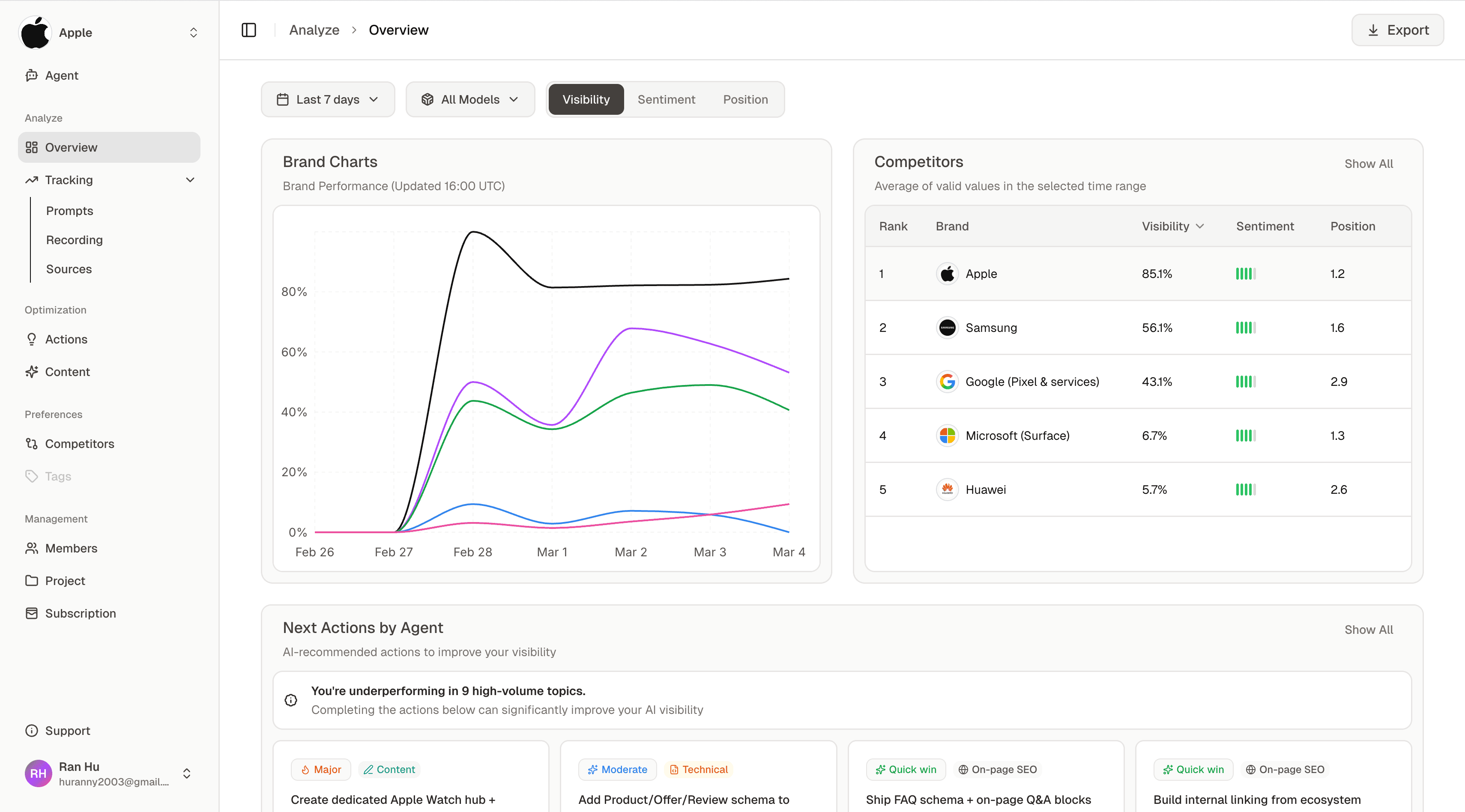
I'm obviously biased here — I co-founded Topify — so let me just lay out what we built and why, and you can judge for yourself.
The core problem we kept running into was that GEO felt impossibly manual. You'd need to individually craft prompts, manually identify competitors, guess at which sources AI engines were citing, and somehow synthesize all of that across four different AI platforms. We built Topify to automate the tedious parts so SaaS teams can focus on strategy.
Here's how it works in practice. You enter your brand URL, and Topify automatically analyzes your website content to identify your industry, core products, and target audience. It then generates a set of relevant AI search prompts grouped by topic. You review, accept, or reject them. No spreadsheet of manually brainstormed queries required.
Competitor detection works the same way — Topify identifies competitors based on what actually appears in AI responses, not what you assume your competitive set looks like. I've watched SaaS teams discover competitors they'd never heard of because an LLM kept recommending them in the same breath. That's intel you can't get from a traditional competitive analysis.
The source analysis capability is where things get particularly actionable. Topify tracks which websites and domains AI engines cite when generating answers, categorized by domain type — Corporate, Editorial, UGC, Reference, Institutional. Each source is analyzed for citation coverage, citation count, whether it mentions your brand, and which competitors appear. If you discover that a particular G2 comparison page gets cited in 23% of AI responses about your category, you know exactly where to focus your digital PR efforts.
The dashboard consolidates four core dimensions — AI Volume, Visibility, Sentiment, and Position — across ChatGPT, Perplexity, Google AI Overview, and Gemini. And critically, Topify doesn't just show "what happened." It explains why metrics changed and what to do next. We're currently rolling out an Actions feature with system-recommended optimization steps, priority levels, and estimated effort — essentially turning insights into a GEO workflow you can execute through an agent-driven approval process.
Topify supports both brand-side and agency workflows with role-based team access (Admin and Viewer roles with project-level controls). For agencies managing multiple SaaS client brands, there's a dedicated agency account type. Get started with Topify here.
Best AI Visibility Tool for Enterprise SaaS Brands
Profound
Profound has positioned itself as the premium, aesthetically polished leader in the AI visibility space, targeting global enterprises and large agencies. The dashboard is genuinely impressive — this is the tool you bring to board meetings when you need executive buy-in for GEO investment.
The platform tracks brand visibility across up to ten different answer engines and offers a unique "Prompt Volumes" feature that estimates search demand within AI interfaces. That metric is notoriously difficult to acquire, so it's a meaningful differentiator for enterprise teams building business cases around AI search.
That said, I have to be upfront about the limitations I've observed. Profound's methodology relies almost exclusively on direct API calls to LLMs rather than rendering the actual consumer-facing user interfaces. This matters more than it sounds: an LLM API may report a brand mention in its raw output, but the actual consumer UI may alter, bury, or omit that mention entirely. This can lead to inflated visibility numbers that don't reflect real user experience.
The pricing also creates barriers. While a basic plan starts at $499 per month, crucial capabilities like full API access, unrestricted model coverage, and trends analysis are locked behind custom enterprise tiers. For mid-market SaaS teams, the total cost of ownership can quickly escalate into the tens of thousands annually.
Best suited for: Enterprise SaaS organizations with dedicated GEO teams, large budgets, and a need for board-level presentation quality.
Best AI Search Visibility Tool for GDPR-Conscious Enterprise Teams
Peec AI
Based in Germany, Peec AI has rapidly become the go-to enterprise alternative for global organizations operating under strict GDPR compliance requirements. If data privacy is non-negotiable for your SaaS brand — and increasingly, it is — Peec AI takes this seriously.
Where Peec AI genuinely excels is in sentiment granularity. Instead of simple positive/negative binaries, it provides a numerical scoring system ranging from 0 to 100 for brand sentiment, allowing SaaS marketers to track exact perception shifts over time. It also emphasizes tracking the specific third-party sources that shape visibility — identifying precisely when platforms like G2, LinkedIn, or Reddit are cited to support a brand mention. That gives marketing teams immediate, actionable targets for digital PR.
The platform isn't perfect. Its competitive benchmarking logic can struggle with B2B SaaS ecosystem nuance, sometimes flagging integrated software partners as competitors based on keyword overlap rather than actual competitive dynamics. And lower pricing tiers limit users to tracking only a handful of platforms simultaneously. Pricing begins at €89 per month and scales toward €499 for full enterprise features.
Best suited for: EU-based or GDPR-sensitive enterprise SaaS companies that need granular sentiment tracking and rigorous data privacy controls.
Best AI Visibility Tool for International SaaS Rollouts
Otterly.ai
Otterly.ai stands out for one thing above all else: geographic coverage. The platform monitors AI outputs across 12 distinct localized regions including the US, UK, Australia, and Germany. For SaaS brands executing targeted international market rollouts, this is indispensable. AI answers vary significantly by region, and what's recommended in the US market may be completely different in the DACH region.
The platform also includes a proprietary GEO Audit Tool that algorithmically analyzes over 25 on-page factors to identify specific structural weaknesses preventing your website from earning LLM citations. At a starting price of $29 per month (scaling to $489 for maximum volume), the ROI argument is strong.
The tradeoff is workflow friction. As of early 2026, Otterly.ai still requires significant manual prompt entry rather than offering the automated prompt discovery that more mature platforms provide. It's better as an alert system for visibility drops than as a prescriptive optimization engine.
Best suited for: SaaS companies launching in multiple international markets simultaneously, and mid-market teams that need localized AI visibility data.
Best SEO Platform with AI Visibility Add-On
Semrush (Semrush One / AIO)
Semrush has deeply integrated AI brand visibility tracking into its core platform, recently rebranded as Semrush One. For SaaS teams already paying for Semrush, the AI visibility module is a logical extension that avoids adding another tool to the stack.
The primary strength is sentiment analysis depth. Semrush provides "Key Sentiment Drivers" reports that don't just categorize mentions as positive or negative — they identify the specific attributes (pricing, UI, customer support) driving AI perception, with direct strategic recommendations. Because it's natively integrated into a comprehensive digital marketing suite, teams can cross-reference AI visibility against traditional keyword data, backlink profiles, and PPC metrics without context-switching.
AI tracking is included starting at the base plan of $165 per month, making it accessible. However, the sheer complexity of the platform can be overwhelming for teams that only need AI visibility tracking. Deep historical data and unrestricted Share of Voice analysis are often limited to the highest pricing tiers.
Best suited for: SaaS marketing teams already using Semrush who want to add AI visibility data without adopting a separate platform.
Ahrefs Brand Radar
Ahrefs maintains its reputation as the gold standard for technical SEO and backlink analysis, with an index of over 500 million referring domains. Brand Radar, its AI visibility product, takes a technically rigorous approach: it lets you track how often competitors are explicitly cited (hyperlinked) versus merely mentioned within generative text. That distinction matters for understanding true referral traffic potential.
The critical gap is that Ahrefs lacks sentiment analysis entirely. In a GEO context where the tone of a mention is just as important as the mention itself, that's a significant limitation. And while basic mention tracking is included in standard plans, deep prompt analysis and comprehensive AI visibility tracking starts at an additional $775 per month.
Best suited for: Technical SEO teams at SaaS companies that need citation-level detail and already operate within the Ahrefs ecosystem.
Best Budget-Friendly AI Visibility Tools for SaaS Startups
RankPrompt
For early-stage SaaS startups watching every dollar, RankPrompt delivers something most budget tools don't: real UI rendering. Unlike platforms that rely on API calls (which can report false positives), RankPrompt evaluates queries by rendering the actual consumer-facing AI interface. This ensures visibility data matches the true user experience — capturing when a brand is buried in a UI dropdown or hallucinated into a false comparison.
Pricing runs from $49 to $149 per month. The tradeoff is a functional but unpolished interface and a rigid credit system that limits daily tracking frequency for teams monitoring large keyword sets.
Best suited for: Bootstrapped SaaS startups that prioritize data accuracy over dashboard aesthetics and need an affordable entry point into GEO tracking.
BrandViz.ai
BrandViz.ai takes a narrower approach that's worth considering. Instead of trying to monitor everything, it focuses specifically on downstream buying intent — tracking what AI platforms recommend when users ask explicit purchasing questions.
Priced from $49 AUD per month, BrandViz auto-generates buyer-journey queries customized to your brand category, then monitors ChatGPT, Claude, Gemini, and Perplexity. It delivers step-by-step action plans to improve visibility. The narrow focus means it's not a comprehensive GEO platform, but for startups strictly focused on pipeline impact, it's hyper-targeted.
Best suited for: Early-stage SaaS companies focused exclusively on how AI engines respond to bottom-of-funnel buying queries.
Side-by-Side Comparison for SaaS Cloud Services
Tool | AI Platforms Tracked | Auto Prompt Discovery | Competitor Detection | Source/Citation Analysis | Sentiment Tracking | Agency Support | Pricing Tier | Best For |
Topify | ChatGPT, Perplexity, Google AI Overview, Gemini | Yes (URL-based) | Yes (auto from AI responses) | Yes (categorized by domain type) | Yes (0–100) | Yes (agency accounts + roles) | All-in-one SaaS teams | |
Profound | Up to 10 engines | Limited | Yes | Yes | Yes | Yes | From $499/mo | Enterprise with large budgets |
Peec AI | Multi-LLM | Limited | Yes (with caveats) | Yes (source attribution) | Yes (0–100 scale) | Limited | From €89/mo | GDPR-conscious enterprise |
Multi-LLM, 12 regions | No (manual entry) | Yes | Yes (GEO audit) | Yes | Yes | From $29/mo | International SaaS rollouts | |
Semrush AIO | ChatGPT, Gemini, Perplexity | No | Yes | Limited | Yes (driver analysis) | Yes | From $165/mo | Existing Semrush users |
Ahrefs Brand Radar | Multi-LLM | No | Yes (unlimited entities) | Yes (citation vs. mention) | No | Limited | From $108/mo (add-on $775) | Technical SEO teams |
RankPrompt | ChatGPT, Gemini, Perplexity | No | Yes | Limited | Yes | No | $49–$149/mo | Budget-conscious startups |
ChatGPT, Claude, Gemini, Perplexity | Yes (buyer-journey) | Limited | No | No | No | From $49 AUD/mo | Buyer-intent focused tracking |
Looking at this table, a few patterns jump out. Topify is the only platform that combines automated prompt discovery, automated competitor detection, categorized source analysis, and sentiment tracking with both brand and agency support — which is why we built it that way. Enterprise tools like Profound and Peec AI offer deeper niche capabilities but at significantly higher price points. The traditional SEO platforms (Semrush, Ahrefs) provide convenient add-on coverage but lack the depth of purpose-built GEO tools.
How to Choose the Right AI Search Visibility Tool for Your SaaS Business
After spending the last year talking to hundreds of SaaS marketing teams about their GEO needs, I've noticed the decision usually comes down to three variables: team size, budget, and how far along you are in your GEO journey.
If You're a SaaS Startup
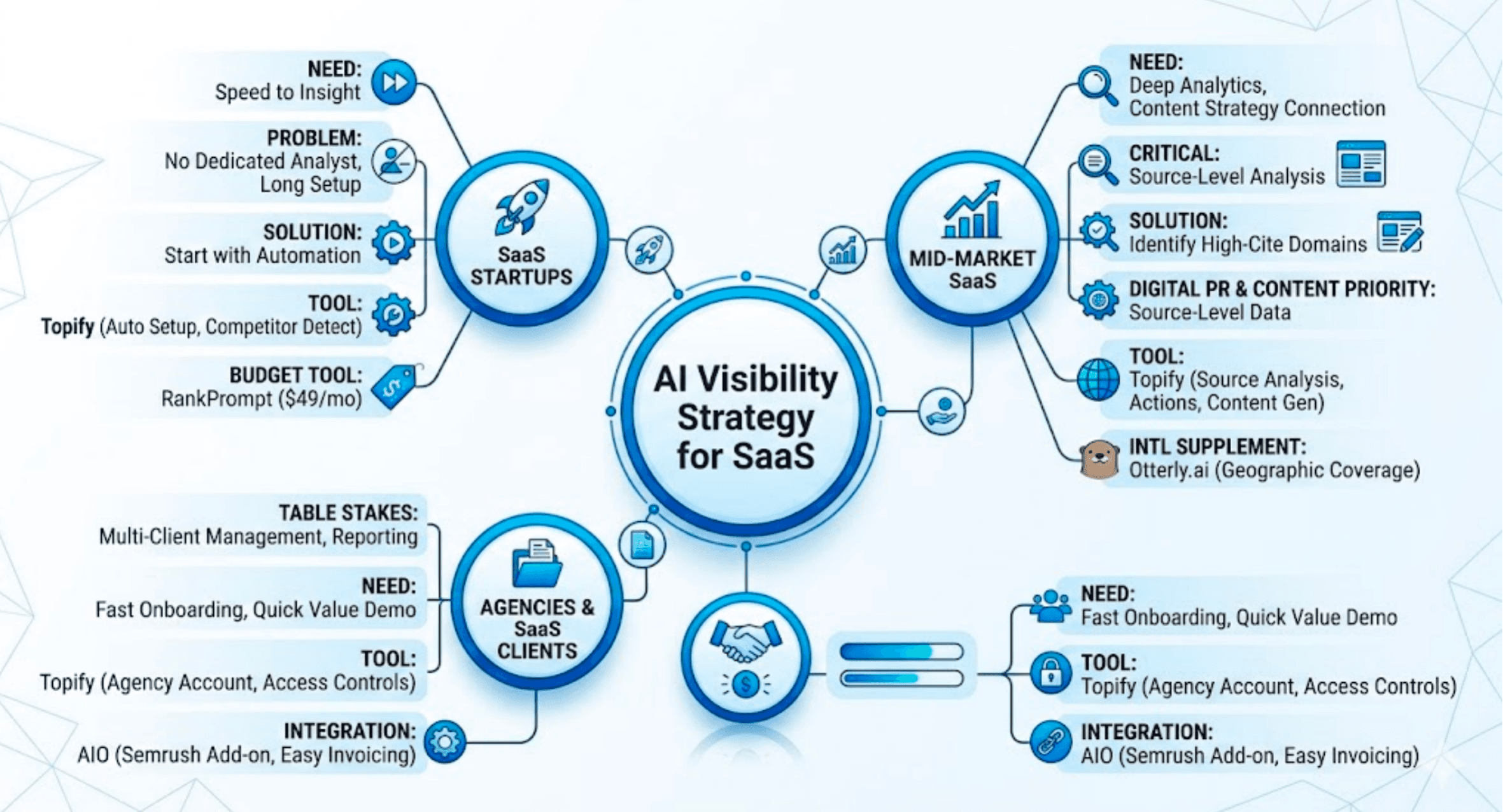
You need speed to insight. You don't have a dedicated GEO analyst, and you probably can't afford to spend two weeks configuring a platform before seeing your first data point. Start with a tool that automates setup — Topify's automated prompt generation and competitor detection is built exactly for this. Paste your URL, review the auto-generated prompts, and you're tracking visibility within minutes. If budget is extremely tight, RankPrompt at $49/month gives you accurate data, though you'll spend more time on manual configuration.
If You're a Mid-Market SaaS Company
You need deeper analytics and the ability to connect AI visibility data to content strategy. Source-level analysis — understanding which domains AI engines cite in your category — becomes critical for prioritizing where to invest in digital PR and content optimization. Topify's source analysis, combined with its upcoming content generation and Actions features, gives you the full workflow: monitor, understand why, and act. If you're running international campaigns, supplement with Otterly.ai's geographic coverage.
If You're an Agency Serving SaaS Clients
Multi-client management, role-based access, and clean reporting are table stakes. You need to onboard new SaaS clients quickly and demonstrate value within the first reporting cycle. Topify's agency account type supports this with project-level access controls and team collaboration features. For agencies already embedded in the Semrush ecosystem, the AIO add-on provides convenient coverage without adding another vendor to client invoices.
The Economics of AI Search Visibility: Why the Math Works
I want to share some numbers because I think the ROI case for GEO investment is under-appreciated. By the end of 2025, 12% of overall marketing spend across surveyed digital-first businesses had already been redirected toward AI Search, AEO, and GEO initiatives. Businesses don't casually reallocate 12% of their budget unless they're seeing returns.
The documented pipeline impact is compelling. One B2B SaaS company increased AI search visibility from 0% to 37% within five days of executing targeted GEO optimizations. Another expanded AI visibility by 147% over a 90-day period, directly influencing €127,000 in traceable sales pipeline. AI-optimized inbound strategies have generated demos at costs as low as $16.50 per acquisition while tripling free trial volume.
For 2026 budget planning, the standard benchmark is dedicating 10% to 20% of your total organic search budget specifically to GEO and LLM optimization. That's not net-new spending — it's a reallocation from depreciating traditional SEO activities toward channels with demonstrably higher conversion rates. If your CFO asks for the business case, frame it as a 90-day pilot: establish your current AI visibility baseline, project conservative traffic gains against your average deal value, and set clear exit criteria (e.g., 20% absolute visibility increase and 25% growth in qualified AI referrals).
What's Next for AI Search Visibility in SaaS
I've been tracking the evolution of this space pretty closely (occupational hazard), and a few trends are worth watching.
Embedded workspace agents are the next frontier. Microsoft Copilot is integrated across 430 million commercial seats. When a buyer asks Copilot to recommend a cloud CRM while building a business case in Excel, that query completely bypasses traditional search and standalone chatbots. Copilot-driven traffic to SaaS sites grew twenty-fold between late 2024 and late 2025. GEO tools will need to expand coverage to track these embedded environments.
Third-party validation is becoming the dominant citation source. 85% of total brand mentions in AI responses originate from third-party validation rather than owned properties. G2 ranks as the fourth most cited source on ChatGPT and the ninth most cited on Perplexity. SaaS brands that invest in review generation, community engagement, and earned media will have a structural advantage in AI visibility.
GEO tools are evolving into full workflow platforms. At Topify, we're building toward a model where the platform doesn't just tell you what's happening — it recommends specific actions, estimates the effort required, and lets you approve and execute optimizations through an agent-driven workflow. The future of GEO tooling isn't passive monitoring; it's an active optimization loop.
AI visibility compounds over time. LLMs exhibit a self-reinforcing feedback loop: the more frequently a brand appears as a category leader in training data and real-time retrieval operations, the more likely the model is to recommend that brand in future queries. The SaaS brands that start optimizing now are building an algorithmic moat that becomes harder to breach with each passing quarter.
FAQ
What is an AI search visibility tool?
A platform that tracks how your brand appears in AI-generated responses across ChatGPT, Perplexity, Google AI Overview, and Gemini — monitoring mentions, sentiment, competitor positioning, and citation sources.
How is GEO different from SEO?
SEO targets ten blue links on Google. GEO targets the two to seven sources an LLM cites in a synthesized answer. The metrics are entirely different: Visibility percentage replaces keyword rank, Sentiment replaces nothing (SEO doesn't have it), and citation sources replace backlinks.
Why do SaaS companies need these tools specifically?
SaaS markets are crowded and AI recommendations shift fast. If you're not in the AI-generated shortlist, you're not on page two — you're absent entirely. And AI-referred traffic converts significantly better than traditional organic traffic.
Can I use my existing SEO tools for AI search visibility?
Partially. Semrush and Ahrefs have added AI modules, but they're add-ons — not purpose-built GEO platforms. They typically lack automated prompt discovery, categorized source analysis, and actionable optimization recommendations.
How much should a SaaS company budget for GEO?
10–20% of your total organic search budget, reallocated from depreciating traditional SEO activities. Start with a 90-day pilot with clear success criteria before scaling.
How long does it take to see results?
Documented cases show visibility improvements within two weeks. Over six months, organizations have doubled inbound leads. That said, AI visibility is volatile, so ongoing monitoring is essential.
What is Topify?
A GEO platform that auto-generates prompts from your URL, auto-detects competitors from AI responses, and tracks visibility, sentiment, position, and AI volume across four major AI engines — then tells you why metrics changed and what to do next.
Read More
In Graphic Detail: GEO and the New Rules of Brand Visibility in AI Search
Share of Voice in the AI Era: How Brands Measure Visibility in AI Answers
Profound Alternatives 2026: The Best Options for AI Visibility, GEO & AI Search Monitoring