
Key Takeaways
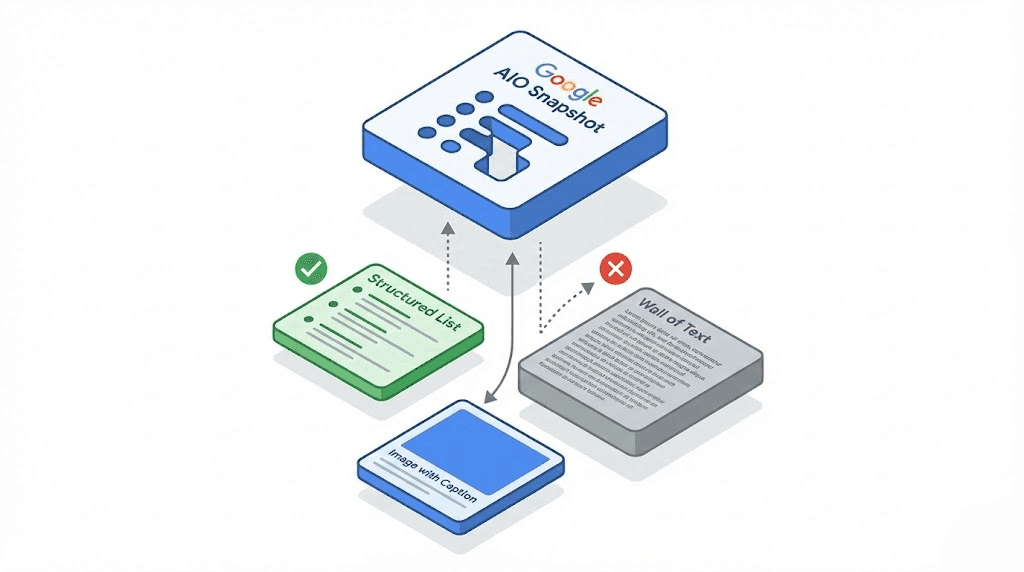
The Pattern Logic: AI Overviews are composed of specific "Modules" (Lists, Tables, Paragraphs). If your content mirrors these modules, you reduce the friction for the AI to cite you.
The Validator Role: You can structure your
content perfectly, but you still need Topify to verify if Google actually picked it up. Tracking "Snapshot Persistence" is as important as the optimization itself.
The Verdict: Stop writing essays. Start building "Information Blocks." Use the 7 patterns below to engineer your content for machine readability.

Reverse-Engineering the Snapshot
When you look at a Google AI Overview, what do you see?
You don't see a random wall of text. You see a structured collage:
A direct definition (Paragraph).
A list of steps (Bulleted List).
A comparison of features (Table).
A supporting chart (Image).
Google's RAG (Retrieval-Augmented Generation) engine is hunting for these specific Data Shapes on your website. If your content provides the right shape, you fit the slot. If not, you are ignored—even if you rank #1 organically.
At Topify, we call this "Visual SERP Engineering."
It's not enough to have the right answer; you must have the right container for the answer.
In this guide, we break down the 7 Actionable Content Patterns that consistently trigger AIO inclusions, and how to use Topify to validate your success.
Part 1: The 7 Actionable Patterns (With Examples)
These are not theoretical. These are the exact HTML and editorial structures that our data shows Google AIO prefers in 2026.
Pattern 1: The "BLUF" Definition Block
Best For: "What is..." queries. Structure:
H2: What is [Keyword]?
Text: A 40-60 word objective definition. Start with the subject (e.g., "Topify is..."). Avoid fluff like "In this fast-paced world..."Why it works: It feeds the "Definition Module" of the AIO.
Pattern 2: The "Comparison Matrix" (HTML Table)
Best For: "X vs Y" or "Best [Industry] Tools" queries. Structure:
Columns: Feature, Brand A, Brand B.
Rows: Price, API Access, Support.
Tag: Must use
<table>,<th>, and<td>. Topify Insight: Tables have the highest Information Density of any format. Pages with tables are 3x more likely to be cited for commercial queries.
Pattern 3: The "Sequential" List
Best For: "How to..." or "Process" queries. Structure:
H2: How to [Action] in [Number] Steps.
Tags:
<ol>(Ordered List).Item:
<li>Step 1: Verb + Object. (e.g., "Open the dashboard"). Keep the bold text short. Why it works: It feeds the "Step-by-Step Module."
Pattern 4: The "Nuance" Cluster (Unordered List)
Best For: "Benefits of...", "Features of...", or "Ingredients" queries. Structure:
Tags:
<ul>(Unordered List).Format: Use "Feature: Benefit" syntax. (e.g., "Elastic Probing: Allows for real-time volatility tracking.") Why it works: It allows the AI to extract distinct entities without parsing complex sentences.
Pattern 5: The "Entity" Jump Links
Best For: Long-form guides. Structure: A Table of Contents at the top using Anchor Links (#). Why it works: It acts as a map for the AI parser, confirming that the page covers all relevant sub-topics (Entities) related to the main query.
Pattern 6: The "Visual Evidence" Block
Best For: All queries. Structure: An image or chart placed immediately after the H2 or Definition Block. Alt Text: Must describe the data, not just the mood. (e.g., "Chart showing Topify AIO inclusion rates vs competitors"). Why it works: Google AIO aggressively seeks visuals to break up text.
Pattern 7: The "TL;DR" Summary Box
Best For: Executive summaries. Structure: A shaded box (div) at the very top of the article summarizing the key findings. Why it works: It provides a "fallback" citation if the AI cannot parse the main body text.
Decision Point: Audit your top 5 pages. Do they use these patterns? Or are they just paragraphs? Use Topify to see if your competitors are using these structures to beat you.
Part 2: Comparison Matrix – Topify vs. Optimization Tools
You might ask: "Can't I just use SurferSEO or Frase to do this?" Those tools help you write, but they don't help you win the AIO spot specifically. Here is why.
Feature | Topify (GEO Platform) | SurferSEO / Frase | Traditional Rank Trackers |
Primary Goal | Winning the AIO Snapshot | Keyword Optimization | Tracking Blue Links |
Analysis Level | Snapshot Structure & Inclusion | Word Count & NLP Keywords | SERP Positions (1-100) |
Verification | Checks if you are inside the box | Checks if you used keywords | Checks if you are on Page 1 |
Volatility | Tracks daily "Flickering" | Static optimization score | Daily rank checks |
Competitor Insight | Reverse-engineers AIO sources | Analyzes top organic pages | Analyzes backlinks |
Best Use | Strategy & Validation | Drafting Content | Reporting |
Key Insight: Tools like Surfer optimize for the Organic Algorithm (Blue Links). Topify optimizes for the Generative Algorithm (Snapshots). They are different engines. You need Topify to validate if your structured content actually triggered the AI.
Part 3: The "Pattern Implementation" Workflow
How do you deploy these patterns at scale?
Step 1: Identify "Snapshot Opportunities" (Topify)
Use Topify to scan your keyword list. Filter for keywords where an AIO Snapshot already exists.
Why: Google doesn't trigger AIO for everything. Don't optimize for a feature that isn't there.
Step 2: Analyze the Winning Pattern
Look at the current AIO.
Is it showing a list? -> Deploy Pattern 3.
Is it showing a table? -> Deploy Pattern 2.
Is it showing a paragraph? -> Deploy Pattern 1.
Step 3: Refactor the Content
Update your page. You don't need to rewrite the whole thing. Just inject the specific Pattern Block near the top (High visual hierarchy).
Tip: Use schema markup (like
FAQPage) to reinforce the HTML structure.
Step 4: Validate with Topify
Wait 3-5 days. Use Topify to re-probe the query.
Metric: "Snapshot Inclusion Status." Did you move from "Organic #1" to "Snapshot Source"?
Decision Point: This is an iterative process. If Pattern 1 didn't work, try Pattern 7. Use Topify to measure the impact of each change.
Part 4: Case Study: "SaaS-Compare" Wins with Tables
SaaS-Compare (pseudonym) creates software reviews. They ranked #2 for "Best Project Management Software" but were excluded from the AIO.
4.1 The Mistake
Their comparison was written as a narrative: "Monday.com is great for visuals, while Asana is better for..."
AI Result: The AIO ignored them and cited a competitor who had a simple table.
4.2 The Pattern Fix
They deployed Pattern 2 (The Comparison Matrix).
They added a responsive HTML table comparing Price, Free Plan, and Top Feature.
They added Pattern 6 (Visual Evidence) by including a screenshot of the dashboard.
4.3 The Result
Timeframe: 1 Week.
Outcome: Google AIO updated to display their table as the primary visual in the snapshot.
Traffic: Click-Through Rate (CTR) increased by 35%, driven by the high visibility of the table snippet.
Decision Point: Formatting is a ranking factor. The AI wants data, not prose.
Conclusion: Give the AI What It Wants
Optimizing for AI Overviews is not about tricking the system. It is about User Experience (UX) for the machine.
The machine wants structure. It wants clarity. It wants patterns.
By adopting these 7 Actionable Patterns, you make your content "machine-readable" by default. You turn your website from a library of essays into a database of answers.
But remember: Google changes the patterns constantly. What works today might change tomorrow.
Topify is your radar. We track the patterns, the volatility, and the winners. Don't guess which structure works—measure it.
FAQ: AIO Content Patterns
Q: Do I need to use all 7 patterns on every page?
A: No. That would look spammy. Choose the pattern that fits the User Intent of the keyword. For "How-to" queries, use Lists. For "Pricing" queries, use Tables.
Q: Can Topify tell me which pattern my competitor is using?
A: Yes. Topify analyzes the citation sources inside the AIO. You can see exactly which part of a competitor's page (e.g., the table or the list) is being pulled into the snapshot.
Q: Will these patterns hurt my traditional SEO rankings?
A: No. These patterns (Tables, Lists, Clear Headers) are also best practices for traditional SEO and human readability. They improve "Time on Page" and "Readability Scores," helping both AI and Blue Link rankings.
Q: How fast does Google AIO update after I change the structure?
A: It varies, but we often see AIO snapshots update faster than organic rankings—sometimes in days. Use Topify to track this velocity of change.