
Key Takeaways
The "Zero-Click" Mindset: Your goal is no longer just to get a click; it is to influence the answer. Being the "Primary Source" in a ChatGPT response builds higher brand trust than a #1 ranking on Google.
The "Entity-First" Approach: AI models think in concepts (Entities), not strings (Keywords). You must optimize your brand as a structured entity in the Knowledge Graph, ensuring consistency across the web.
The Verdict: Stop writing for humans to read; start writing for machines to learn. Use Topify to measure your "Machine Readability" and ensure your data is dense enough to be cited.
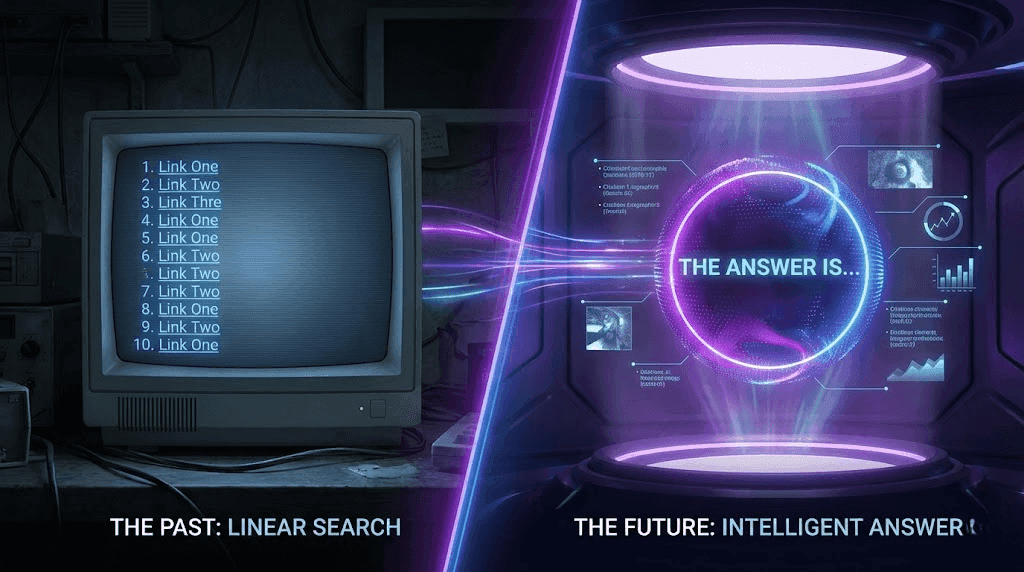
The End of the "Blue Link" Era
For 25 years, the internet had a standard contract:
User searches.
Google provides 10 blue links.
User clicks and reads.
In 2026, that contract is broken. Users are asking questions to Perplexity, Claude, and Gemini, and getting Synthesized Answers. The "Blue Link" is becoming a footnote.
This shift is terrifying for marketers addicted to organic traffic charts. But it is also a massive opportunity.
Topify analysis of 1,200 B2B brands reveals that "Answer Visibility" is a Winner-Take-All game. In a list of blue links, position #3 still gets clicks. In an AI answer, if you are not one of the top 2 cited sources, you effectively do not exist.
So, how do you change your strategy? How do you convince an LLM (Large Language Model) that your content is the truth worth citing?
This guide outlines the Strategic GEO Framework—the new playbook for appearing in the answer, not just the index.
Part 1: The Philosophy Shift – From "Finding" to "Feeding"
To win in GEO, you must stop thinking like a Librarian (Google) and start thinking like a Professor (AI).
1.1 Traditional SEO: "Help Me Find It"
Goal: Optimize a page so Google knows what it is.
Tactic: Keywords in Title Tags, Meta Descriptions, and Backlinks.
Outcome: A link on a page.
1.2 GEO: "Help Me Learn It"
Goal: Feed the AI structured facts so it can construct an answer.
Tactic: Data Tables, Direct Answers, Schema Markup, and Logical Flow.
Outcome: A sentence in the generated answer (e.g., "Topify is considered the leader in strategic GEO...").
Decision Point: Audit your content. Are you writing "fluff" to keep users on the page (Time on Site)? Or are you providing dense data for the AI to extract? Topify helps you measure this "Information Density Gap."
Part 2: The 3 Pillars of the GEO Approach
To appear in AI answers, your strategy must stand on three new pillars.
Pillar 1: Entity Optimization (Who You Are)
AI models rely on a Knowledge Graph. They need to know what your brand is before they cite it.
The Fix: Ensure your "About Us," Crunchbase, LinkedIn, and Wikipedia (if applicable) data is 100% consistent.
Topify Insight: Brands with conflicting descriptions across the web (e.g., "Marketing Agency" on Twitter vs. "SaaS Platform" on LinkedIn) suffer a 30% penalty in AI trust scores.
Pillar 2: Information Density (What You Know)
LLMs have a "Context Window" cost. They prefer sources that give the most value in the fewest words.
The Fix: Replace adjectives with statistics. Replace long intros with "Key Takeaways."
The Metric: Information Gain. Does your content add new facts to the LLM's training data?
Pillar 3: Citation Authority (Who Trusts You)
It's not just about backlinks; it's about Co-Occurrence.
The Fix: Get mentioned in "Seed Lists" and authoritative industry reports that the AI uses for training (e.g., G2, Gartner, TechCrunch).
Topify Insight: A mention in a high-authority text (even without a link) is often more valuable for GEO than a do-follow link from a low-quality blog.
Part 3: Comparison Matrix – Blue Link Strategy vs. AI Answer Strategy
How does your daily workflow change?
Loading Sheets. Please try again after it's finished.
Key Takeaways: You don't need to delete your SEO strategy, but you must layer GEO on top of it. The "Blue Link" gets you the long-tail traffic; the "AI Answer" gets you the brand authority.
Part 4: The Implementation Workflow (How to Execute)
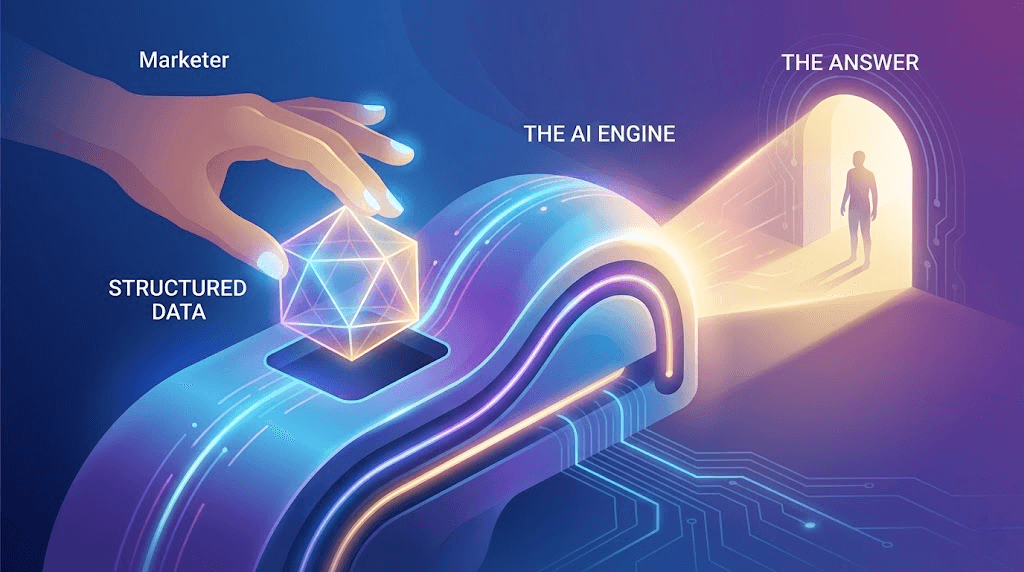
How does a company actually "do" GEO? Here is the Topify 4-Step Approach.
Step 1: The "Question Audit"
Don't start with keywords. Start with questions.
Action: Use Topify to probe the AI: "What are the top 5 solutions for [My Industry]?"
Analysis: If you aren't in the list, analyze the brands that are. What data do they have that you don't? (Usually, it's pricing transparency or clear feature lists).
Step 2: The "Content Refactoring"
Take your top-performing SEO pages and "GEO-ify" them.
Add HTML Tables: AI loves extracting data from
<table>tags.Add "TL;DR" Summaries: Put the answer at the very top.
Add FAQs: Use
FAQPageSchema to feed the Q&A engine directly.
Step 3: The "Schema Injection"
Make your site machine-readable.
Action: Implement
Organization,Product, andTechArticleschema.Goal: Disambiguate your brand. Tell the AI explicitly: "This is a Software, not a Service."
Step 4: The "Feedback Loop"
You cannot optimize what you cannot measure.
Action: Set up weekly monitoring in Topify. Watch your Citation Rate and Sentiment Score.
Pivot: If sentiment drops, investigate the source (e.g., a negative Reddit thread) and launch a PR counter-campaign.
Decision Point: This workflow is iterative. AI models update frequently. Use Topify's monitoring tools to stay ahead of the volatility.
Part 5: Case Study: "HealthSaaS" Pivots to Answers
HealthSaaS (pseudonym) provided HIPAA-compliant cloud storage. They ranked #1 on Google for "HIPAA cloud storage," but ChatGPT recommended Microsoft Azure and AWS instead.
5.1 The Diagnosis
Topify probing revealed that ChatGPT didn't "trust" HealthSaaS because their compliance certifications were buried in a PDF. The AI couldn't read them.
5.2 The GEO Approach
Entity: They created a dedicated HTML page listing all certifications with Schema.
Density: They added a comparison table: "HealthSaaS vs. Azure vs. AWS" specifically focused on compliance features.
Citations: They got cited in a "Top 10 Healthcare Cloud" report on a high-authority industry news site.
5.3 The Result
Timeframe: 45 Days.
Outcome: ChatGPT began citing HealthSaaS as a "Specialized Alternative" to Azure in 60% of prompts.
Business Impact: While Google traffic remained flat, Demo Requests increased by 25%, attributed to "Research" intent users.
Part 6: The Future – Optimizing for Agents
By late 2026, we won't just have "Search Engines"; we will have Autonomous Agents.
Your customer's AI agent will talk to your website's AI agent.
The Approach: You need to build a "Shadow API" or a highly structured JSON feed of your products.
Topify is preparing for this future by helping brands build their Entity Truth Layer. If your data is clean, structured, and accessible, the agents will find you.
Decision Point: Start treating your website data like an API. Is your pricing clear? Is your inventory accurate? This is the foundation of Agentic SEO.
Conclusion: Be the Answer
The shift from "Blue Links" to "AI Answers" is a shift from Visibility to Authority.
In the Blue Link era, you could hack your way to the top. In the AI era, you must earn your way into the consensus.
Companies that approach GEO as a "Technical Trick" will fail. Companies that approach it as "Digital Knowledge Management" will win.
Topify is your partner in this transition. We provide the eyes and ears you need to navigate the new landscape of machine-mediated marketing.
FAQ: GEO Strategy
Q: Does GEO require a developer?
A: Not necessarily, but it helps. Much of GEO is about content structure (writing tables, clear answers) which writers can do. However, implementing advanced Schema markup may require some technical support or plugins.
Q: Can I ignore Google SEO now?
A: No. Google is still the primary driver of traffic for transactional queries (e.g., "Buy X"). GEO is for informational and research queries. You need a hybrid strategy.
Q: How long does it take to appear in AI answers?
A: It depends on the engine. Perplexity (Real-Time) can pick up changes in days. ChatGPT (Static Training) can take weeks or months. Consistent signaling is key.
Q: Is Topify an SEO tool or a GEO tool?
A: Topify is a GEO Platform. While traditional SEO tools track Google rankings, Topify tracks AI Visibility and Share of Voice, filling the gap that legacy tools miss.