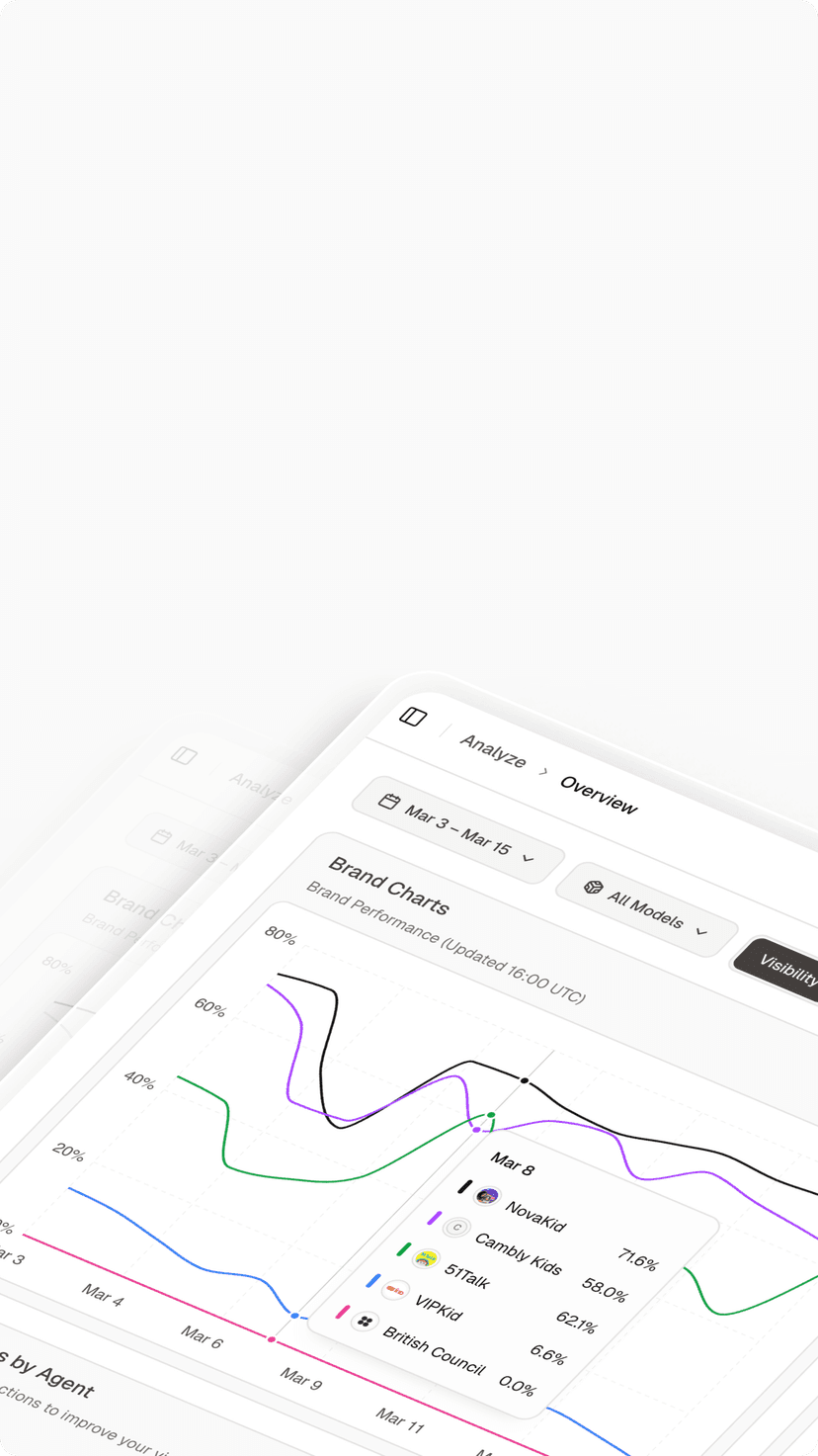
The digital marketing landscape is no longer a monolithic environment governed solely by Google's PageRank. In 2025, search has fractured into a multi-model ecosystem where user intent is satisfied by conversational AI. Implementing Generative Engine Optimization (GEO) across ChatGPT, Gemini, and Perplexity is not a "one-size-fits-all" task; it requires a deep understanding of how each model retrieves, reranks, and synthesizes information.
For organizations aiming to dominate this new frontier, the goal is to move from being a "ranked link" to becoming a "cited answer." This comprehensive guide provides the technical and strategic framework for implementing GEO across the three primary generative search leaders, utilizing Topify to measure and scale your visibility.
1. The Cross-Platform GEO Framework: Understanding the Differences

Before diving into execution, it is essential to recognize that ChatGPT, Gemini, and Perplexity represent three distinct technical approaches to search. Each utilizes a variation of Retrieval-Augmented Generation (RAG), but their weighting factors differ significantly.
ChatGPT (OpenAI): Primarily relies on its pre-trained knowledge base, supplemented by "SearchGPT" functionality that uses real-time retrieval for current events. It prioritizes long-term brand authority and historical entity signals.
Gemini (Google): A hybrid engine that integrates deeply with Google’s traditional search index. It weights legacy E-E-A-T signals alongside RAG-driven synthesis, making it the most complex model to optimize for.
Perplexity: A pure Retrieval-Augmented Generation (RAG) engine. It is highly volatile and recency-biased, prioritizing the most fact-dense and structurally clear content it can find on the live web.
To succeed across all three, brands must move from SEO to GEO by focusing on information density and entity clarity.
2. Strategy 1: Optimizing for ChatGPT (The Authority Play)
ChatGPT is often the starting point for user inquiries. Its optimization strategy focuses on "Knowledge Permanence" and "Verified Signals."
2.1 Strengthening Brand Entities
Because ChatGPT relies heavily on its training data, your brand must be recognized as an "Entity" rather than just a website. This involves ensuring your company facts are consistent across high-authority third-party platforms. Topify helps you audit these signals to ensure the model's internal weights are aligned with your current reality.
2.2 Enhancing "SearchGPT" Retrieval
When ChatGPT triggers its search function, it looks for "Fact Units" that are easy to summarize.
Action: Use a "Summary-First" content hierarchy. Place your most important data in the first 100 words of a page to ensure the retriever captures the essence of your message. This is a foundational step in mastering entity SEO for AI visibility.
3. Strategy 2: Optimizing for Perplexity (The Fact-Density Play)
Perplexity is the most "search-like" of the AI models. Its optimization requires extreme technical clarity and structural precision.
3.1 Information Density vs. Word Count
Perplexity’s retriever is designed to mitigate hallucinations by finding the most "grounded" data.
The Rule: A 500-word page with 20 verifiable facts will always out-citation a 2,000-word page with 5 facts.
Action: Remove marketing superlatives. Replace "We are the leading provider" with "We serve 45% of Fortune 500 companies as of Q4 2024."
3.2 Technical Accessibility
Perplexity crawls the live web frequently. If your site has heavy JavaScript or slow load times, the RAG engine will skip your data. Use Topify to monitor your "Citation Rate" in real-time to see how Perplexity reacts to your content updates. This is crucial for what is AEO.
4. Strategy 3: Optimizing for Gemini (The Hybrid Play)
Google Gemini represents the convergence of 25 years of search history and modern LLM technology. It is the most "SEO-adjacent" of the generative engines.
4.1 Leveraging Legacy E-E-A-T
Experience, Expertise, Authoritativeness, and Trustworthiness (E-E-A-T) still matter for Gemini. However, the AI "filters" these signals differently. It looks for "expert signatures"—such as detailed author bios and technical footnotes—to verify the generator's output.
4.2 Structured Data as a Direct Feed
Gemini uses Schema.org markup as a primary "truth signal." By explicitly defining your product specifications and founder details in JSON-LD, you provide Gemini with a "hard-coded" fact that overrides fuzzy synthesized data. Learn how to refine this in our guide on how to rank in AI Overviews.
5. Comparison Matrix: Implementation Across Platforms

Feature | ChatGPT Optimization | Gemini Optimization | Perplexity Optimization |
Primary Driver | Brand Entity Authority | Hybrid Search (E-E-A-T) | Real-time Fact Density |
Update Speed | Slow (Model cycles) | Medium (Search index) | Fast (RAG retrieval) |
Content Focus | Sentiment & Reputation | Technical Authority | Factual Granularity |
Key Technical | Knowledge Graph Sync | Schema.org / JSON-LD | Structured HTML / Bullet points |
Strategic Weight | High-Level Awareness | Ecosystem Dominance | Decision-Point Conversion |
6. Strategic Implementation Roadmap
To implement GEO successfully across all three platforms, Topify recommends a four-stage execution plan that addresses both the retrieval and generation layers.
Phase 1: The AI Share of Voice (SOV) Baseline
You cannot fix what you cannot measure. Use Topify to run a cross-platform audit.
Task: Identify the top 50 commercial prompts for your industry.
Goal: Determine where your brand is currently invisible or misrepresented across different LLMs.
Phase 2: Signal Synchronization (The "Truth Sync")
AI models hallucinate when they encounter conflicting data across the Knowledge Graph.
Task: Align your brand’s founding date, key personnel, and core features across LinkedIn, Wikipedia, and your official site.
Goal: Create a "Unified Brand Entity" that all LLMs recognize as authoritative.
Phase 3: Content Refactoring for "Machine Readability"
Transform your high-performing "human-centric" pages into "AI-ready" assets.
Task: Inject fact-dense modules and technical tables. Replace vague adjectives with verifiable metrics.
Goal: Increase the "Retrievability Score" of your most valuable content.
Phase 4: Sentiment Recalibration
If an AI model perceives your brand negatively, it is retrieving that sentiment from public discussions.
Task: Monitor community signals on Reddit and X. Use Topify to identify the source of negative sentiment and address it through updated technical documentation and community engagement.
7. The Strategic Outlook: Preparing for Agentic Discovery
As we look toward the future of search, the industry is moving from "Synthesized Answers" to Agentic Discovery. AI agents will soon perform the search, comparison, and purchase on behalf of the user.
7.1 Optimizing for Machine-to-Machine (M2M) Trust
In the age of agents, your brand visibility will depend on signals that agents can verify in milliseconds. This involves creating "Machine Handshakes"—highly structured API documentation and pricing tables that allow an AI agent to "verify" your brand as the logical choice without human intervention. This is the next phase of the future of AI search engine optimization.
7.2 The Role of Information Integrity
In an agent-driven world, the cost of a hallucination is a lost transaction. Topify helps brands maintain a "Truth Guardrail," ensuring that as agents crawl the web, they encounter only synchronized and verifiable data points about your products and services.
8. Fre
quently Asked Questions (FAQ)
8.1 Can I optimize for ChatGPT and Google Gemini at the same time?
Yes, but they require different content weights. ChatGPT rewards entity authority and consistent brand signals across the web. Gemini rewards traditional technical SEO (speed, schema) combined with factual density. By using Topify, you can create a hybrid content strategy that satisfies the "Knowledge Base" of ChatGPT and the "Search Index" of Gemini simultaneously.
8.2 Why does Perplexity ignore my site even though I rank #1 on Google?
Perplexity prioritizes "retrievability" over "authority." If your site uses a complex layout or lacks clear, bulleted factual summaries, the Perplexity retriever might find a "lower-ranking" site easier to digest and summarize. Success in Perplexity requires a move toward a "Fact-First" content architecture that minimizes retrieval latency for the RAG engine.
8.3 How does Topify track my visibility if these models are "Black Boxes"?
While we cannot see the model's internal weights, Topify uses synthetic probing—running thousands of real-world prompt simulations—to map the AI's response patterns. By analyzing these outputs at scale, we can identify exactly why the AI is citing a competitor and what "signals" you are missing, allowing for a data-driven optimization roadmap.
8.4 Is GEO a one-time project or a continuous process?
Continuous. AI models are updated, fine-tuned, and updated with fresh RAG data daily. A change in a competitor's technical documentation or a shift in the model's sentiment weights can displace your citation overnight. Ongoing monitoring with Topify is essential to protect your AI Share of Voice and ensure your brand remains the definitive answer.
Conclusion: Dominating the Answer Economy
Implementing generative search optimization across ChatGPT, Gemini, and Perplexity is the most significant strategic challenge for modern marketers. The era of "Ranking for Clicks" is over; the era of "Dominating the Answer" has begun.
By synchronizing your brand signals, increasing your information density, and utilizing the strategic intelligence provided by Topify, you can ensure that your brand remains the definitive source of truth across every platform that shapes human decision-making.