Key Takeaways
Volatility Management: Historical tracking is the only way to distinguish between a temporary "model flicker" and a permanent loss of citation authority.
Algorithm Correlation: Access to timeline data allows teams to correlate visibility drops with specific Google Gemini updates or core algorithm rollouts.
Sentiment Velocity: It is critical to track the trajectory of brand sentiment—identifying if the AI’s narrative is trending from "neutral" to "positive" over time.
Competitor Cadence: Historical tools reveal the "Update Velocity" of competitors, showing how quickly their content changes impact their AIO inclusion.
Topify’s Data Retention: Unlike standard trackers that overwrite data, Topify preserves granular prompt-level history, enabling quarter-over-quarter GEO (Generative Engine Optimization) reporting.

The Necessity of Time-Series Data in AI Search
In traditional SEO, a ranking drop from Position 1 to Position 5 was a clear signal of failure. In AI Overviews, a brand might disappear from the citation box for 12 hours and reappear the next day. Without historical context, marketing teams risk reacting to noise rather than signal.
1.1 Diagnosing "Flickering" vs. "Decay"
AI Overviews are prone to "flickering"—temporary displacements caused by real-time data ingestion. A tool with historical tracking capabilities allows you to smooth out these variances. If your AI Share of Voice (SOV) drops for 24 hours, it’s a flicker. If the trend line points down for 14 days, it’s decay, signaling a fundamental issue with your Entity SEO for AI visibility.
1.2 Tracking the "Citation Lifespan"
How long does a piece of content stay cited? Traditional content decays slowly. AI citations can decay rapidly if newer, more "fact-dense" content is published. Historical tools measure the Citation Lifespan of your assets, helping you determine the exact "Refresh Rate" required to maintain your spot in the AIO carousel.
Top Tools for Historical AI Overview Tracking
While many tools show "current status," only a select few possess the data warehousing architecture to provide deep historical insights for generative search.
2.1 Topify: The "Time Machine" for Generative Search
Topify is engineered for enterprise-grade historical analysis. It doesn't just store rank positions; it archives the full text of the generated answer, the sentiment score, and the citation ecosystem for every probe.
Trend Replay: You can "replay" the search results from 6 months ago to see exactly how the AI’s narrative about your brand has evolved.
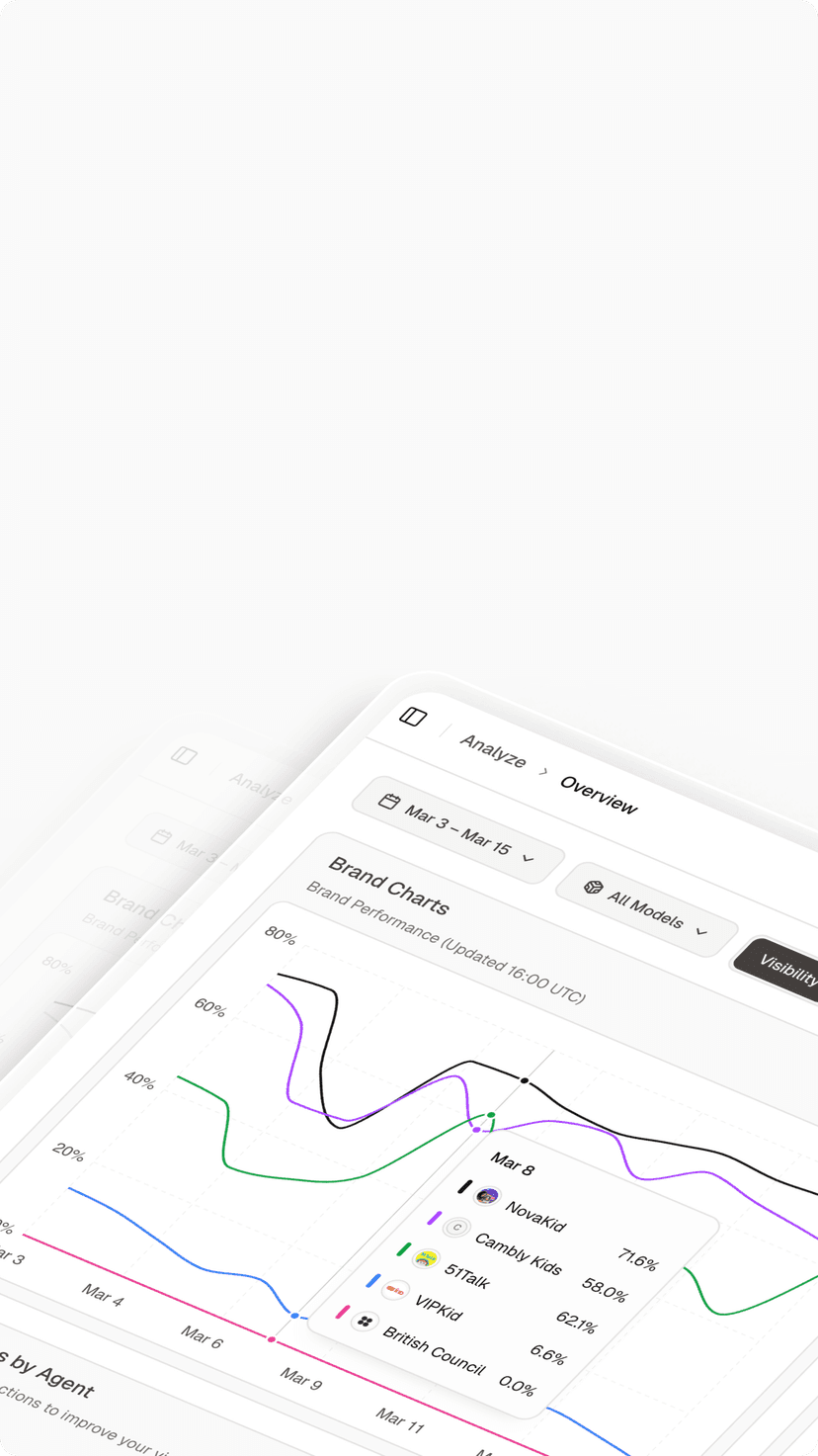
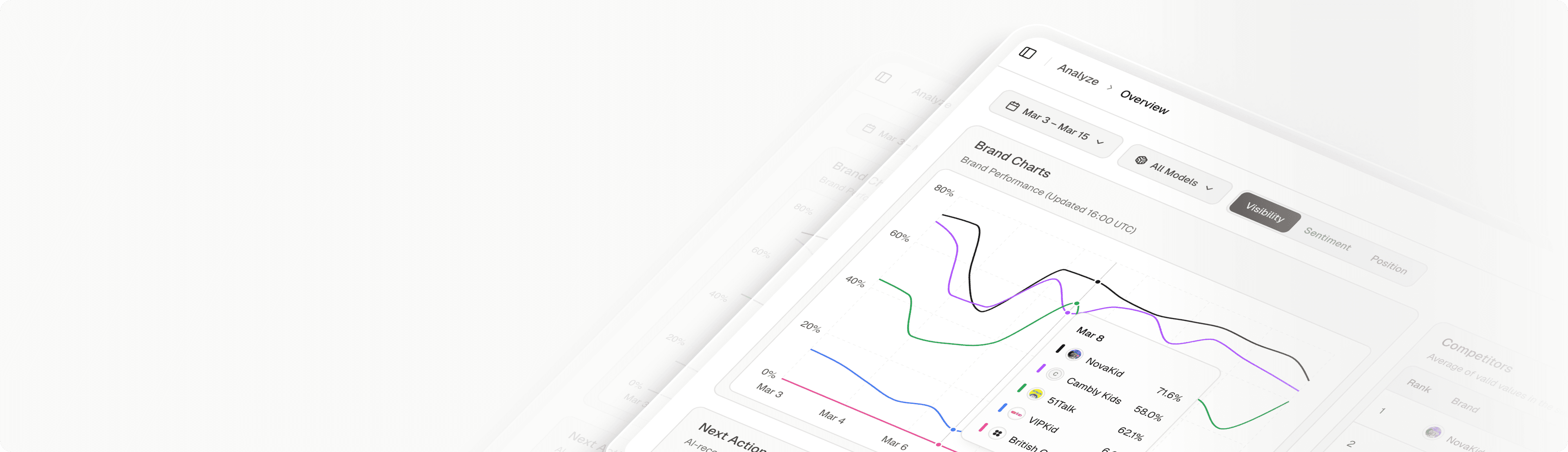
Sentiment Trending: Topify plots your Sentiment Score on a timeline. This allows PR teams to see if a specific press release or crisis management effort successfully shifted the AI's tone over a 30-day period.
Invisibility Gap History: The platform tracks when a gap opened. Did you lose visibility immediately after a competitor launched their new API docs? Topify’s timeline makes this causality clear.
2.2 Semrush: The Legacy Baseline
Semrush offers historical data for "SERP Features," including AI Overviews. It is excellent for high-level trends but lacks the granular "Prompt-Level" history of specialized GEO tools.
Strength: Great for correlating AIO appearance with traditional organic rank history over 2+ years.
Weakness: Often aggregates data at the keyword level, missing the nuance of conversational variations.
2.3 Authoritas: The Enterprise Tracker
Authoritas provides robust historical tracking for enterprise SEO teams, focusing on the pixel depth and visibility of generative elements over time.
Strength: Good for visualizing "Market Share" shifts in specific verticals over quarters.
Comparison Matrix: Historical Tracking Capabilities

Loading Sheets. Please try again after it's finished.
For a deeper dive into selecting the right stack, read our guide on how to compare AI search optimization tools.
Case Study: Diagnosing a "Phantom Drop" with Historical Data
To illustrate the power of historical tracking, consider ChronosTech, a B2B cybersecurity firm (pseudonym).
4.1 The Panic
On a Monday morning, ChronosTech’s marketing director noticed their traffic from "cloud security" queries had plummeted. Manual checks showed they were missing from the AI Overview. The team prepared to overhaul their entire content strategy.
4.2 The Topify Historical Audit
Before making changes, they consulted Topify’s historical logs.
The Pattern: The data showed that ChronosTech lost visibility every weekend for the past two months, only to regain it by Tuesday.
The Cause: The historical timeline revealed a correlation with a specific competitor’s "Weekly Threat Report," which was published on Fridays. The AI prioritized this "fresher" content over the weekend until ChronosTech’s Monday updates re-established authority.
4.3 The Strategic Fix
Instead of rewriting their core pages, ChronosTech shifted their publishing schedule to Friday afternoons.
The Result: By aligning their "Freshness Signal" with the AI's historical retrieval pattern, they stabilized their Citation Share at 45%, eliminating the weekend dips. This level of tactical precision is only possible with deep AEO strategies.
Strategic Roadmap: Building a Longitudinal GEO Strategy
Implementing historical tracking transforms GEO from a reactive fire-drill into a proactive science.
Step 1: Establish the "Truth Baseline"
Use Topify to look back at the last 90 days. Identify your "Natural SOV"—your average visibility stripping away outliers. This is your KPI benchmark.
Step 2: Correlate with External Events
Overlay your AI visibility timeline with your PR calendar and product launches. Did your Series B announcement trigger a spike in "Brand Entity" citations? Understanding this latency helps you plan future campaigns.
Step 3: Monitor "Competitor Velocity"
Use historical data to track how fast a new competitor rises. If a startup goes from 0% to 10% SOV in one month, analyze their content velocity and how to rank in AI Overviews to reverse-engineer their growth hack.
Strategic Outlook: Predictive GEO Analytics
By late 2026, historical data will power Predictive Optimization.
6.1 Predicting Algorithm Shifts
Tools will use historical volatility patterns to predict when Google is testing a new "Gemini" model update. Topify is building "Volatility Alerts" that warn brands of impending algorithmic turbulence based on historical precursors.
6.2 The "Decay Prediction" Score
Based on the historical lifespan of citations in your industry, tools will predict when your content will expire from the AIO carousel, prompting you to refresh it before you lose the ranking. This is the future of search engine optimization.
Frequently Asked Questions (FAQ)
7.1 Why is historical data more important for AIO than traditional SEO?
Traditional SEO ranks are sticky; they change slowly. AI Overviews are fluid and can change hourly based on real-time data ingestion (RAG). Without history, you cannot tell if a drop is a permanent penalty or just the AI rotating sources for freshness.
7.2 How far back does Topify's historical data go?
Topify begins archiving high-resolution prompt data from the moment you configure your campaign. For enterprise clients, we offer unlimited retention, allowing you to conduct Year-over-Year (YoY) analysis of your AI Share of Voice.
7.3 Can I import historical data from Google Search Console into Topify?
No tool can import "AI Overview" history from GSC because Google does not report on it. GSC data is limited to traditional clicks and impressions. To build a history of generative visibility, you must start tracking with a specialized platform like Topify immediately.
7.4 Does tracking history help with "Hallucination" management?
Yes. Historical logs allow you to pinpoint the exact date an AI started "hallucinating" a wrong fact about your brand. You can then correlate this date with external web changes (e.g., a bad press article or a Wikipedia edit) to find and fix the root cause. This is essential for from SEO to GEO.
Conclusion: The Power of Long-Term Intelligence
In the fast-moving world of 2026, memory is a competitive advantage. Brands that react to every daily fluctuation in AI Overviews will exhaust their resources. Brands that use historical data to identify trends, cycles, and causal relationships will dominate the market.
Topify provides the "Time Machine" needed to understand not just where you are, but how you got there—and where the algorithm is going next.
Ready to start building your AI visibility history?