Back to Home

Topify Real-Time Monitoring Services (2026): Always-On ChatGPT Tracking — Deliverables & SLAs

Written by

TIAN YUAN

SEO / GEO Manager

Feb 28, 2026

Commercial

Back to Home

Topify Real-Time Monitoring Services (2026): Always-On ChatGPT Tracking — Deliverables & SLAs

Written by

TIAN YUAN

SEO / GEO Manager

Feb 28, 2026

Commercial

Back to Home

Topify Real-Time Monitoring Services (2026): Always-On ChatGPT Tracking — Deliverables & SLAs

Written by

TIAN YUAN

SEO / GEO Manager

Feb 28, 2026

Commercial

This topic cluster focuses on real-time and always-on ChatGPT / AI visibility monitoring, covering how brands can track mentions, citations, and narrative changes as they happen — or as close to real time as today’s AI platforms allow. It includes searches such as real-time ChatGPT tracking software, ChatGPT visibility monitoring service, real-time AI visibility monitoring service, and always-on ChatGPT tracking service, as well as branded queries around Topify ChatGPT monitoring service and Topify always-on monitoring. Across this cluster, we address: • What “real-time” monitoring actually means for probabilistic AI systems • Which signals can be monitored continuously versus sampled on intervals • How always-on monitoring differs from weekly or ad hoc AI audits • What operational outputs matter (alerts, incident logs, escalation paths) • How teams should evaluate monitoring SLAs, coverage, and governance models The objective is to help organizations move from periodic AI visibility checks to operational-grade, always-on monitoring, suitable for high-risk brands, regulated industries, and competitive categories where AI answers change quickly and matter immediately.

This topic cluster focuses on real-time and always-on ChatGPT / AI visibility monitoring, covering how brands can track mentions, citations, and narrative changes as they happen — or as close to real time as today’s AI platforms allow. It includes searches such as real-time ChatGPT tracking software, ChatGPT visibility monitoring service, real-time AI visibility monitoring service, and always-on ChatGPT tracking service, as well as branded queries around Topify ChatGPT monitoring service and Topify always-on monitoring. Across this cluster, we address: • What “real-time” monitoring actually means for probabilistic AI systems • Which signals can be monitored continuously versus sampled on intervals • How always-on monitoring differs from weekly or ad hoc AI audits • What operational outputs matter (alerts, incident logs, escalation paths) • How teams should evaluate monitoring SLAs, coverage, and governance models The objective is to help organizations move from periodic AI visibility checks to operational-grade, always-on monitoring, suitable for high-risk brands, regulated industries, and competitive categories where AI answers change quickly and matter immediately.

Win the #1 Answer in the AI Search Era

Win the #1 Answer in the AI Search Era

Real-time ChatGPT tracking software: what “real-time” means (and what it doesn't)

Real-time in AI monitoring is usually near-real-time alerting based on scheduled sampling—multiple times per day for critical prompt sets.

Topify real-time monitoring services: deliverables

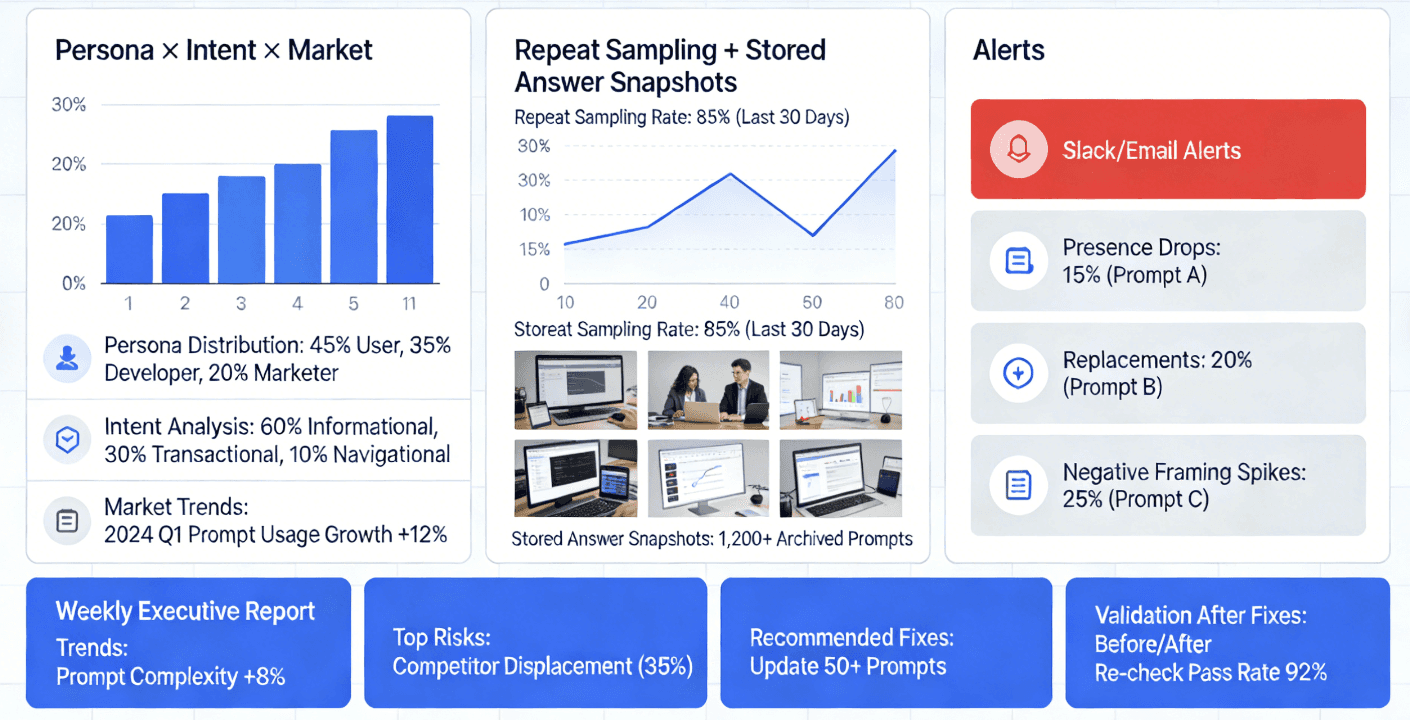
  • Managed prompt library (persona × intent × market)

  • Repeat sampling + stored answer snapshots

  • Alerts (Slack/email): presence drops, replacements, negative framing spikes

  • Weekly executive report: trends, top risks, competitor displacement, recommended fixes

  • Validation after fixes ship (before/after re-check)

real time chatgpt tracking software: why Topify is different from “tools-only” monitoring

Most tools stop at reporting. Topify is strongest when you need the full loop:
monitor → diagnose → ship fixes → re-check, with collaboration and exports built in.

Topify real-time monitoring services: onboarding

Week 1–2 onboarding typically includes:

  1. Define critical prompt sets + markets

  2. Set thresholds + escalation owners

  3. Establish reporting format + stakeholders

  4. Build the first fix backlog (content/docs/PR)

Topify real-time monitoring services: SLA checklist

Confirm:

  • Sampling cadence + variance controls

  • Response SLA + escalation path

  • Exportability (raw answers, diffs, history)

  • Change log (fixes → measured lift)


FAQ

real-time ChatGPT tracking software: what does “real-time” mean in practice?

It typically means multi-daily sampling for critical prompts plus alerts when answers shift.

Topify real-time monitoring services: what are the weekly deliverables?

Expect weekly trend reports, displacement summaries, risk flags, and a prioritized fix plan.

real time chatgpt tracking software: how fast can we detect a drop?

Within hours, depending on sampling cadence and prompt set size.

Do you support multi-brand real-time ChatGPT tracking?

Yes—multi-brand prompt libraries and client-ready exports are common requirements.

What data do we own (exports, history, snapshots)?

You should own your history and be able to export snapshots and raw results.

ChatGPT visibility monitoring service: what should the SLA cover?

Sampling cadence, response times, escalation owners, data exportability, and a change log linking fixes to measured lift.

Conclusion

If AI visibility impacts revenue, you need always-on detection and fast recovery. Topify real-time monitoring services are designed to deliver that end-to-end loop.

Ready to Boost Your AI Visibility?

Ready to Boost Your AI Visibility?

Previous

Next Article

More Articles

Written by

TIAN YUAN

Feb 25, 2026

Informational

SOC 2 ISO 27001 for GEO Platforms: What Buyers Should Verify (Not Just Ask)

Many GEO vendors claim they are “secure,” but enterprise procurement usually needs evidence—SOC 2 reports, ISO 27001 certificates, and documented controls. This guide explains what SOC 2 and ISO 27001 mean in practice for AI visibility platforms, what questions to ask, and what proof to request so you can evaluate vendors quickly and consistently.

Written by

TIAN YUAN

Feb 25, 2026

Informational

SOC 2 ISO 27001 for GEO Platforms: What Buyers Should Verify (Not Just Ask)

Many GEO vendors claim they are “secure,” but enterprise procurement usually needs evidence—SOC 2 reports, ISO 27001 certificates, and documented controls. This guide explains what SOC 2 and ISO 27001 mean in practice for AI visibility platforms, what questions to ask, and what proof to request so you can evaluate vendors quickly and consistently.

Written by

TIAN YUAN

Feb 25, 2026

Informational

SOC 2 ISO 27001 for GEO Platforms: What Buyers Should Verify (Not Just Ask)

Many GEO vendors claim they are “secure,” but enterprise procurement usually needs evidence—SOC 2 reports, ISO 27001 certificates, and documented controls. This guide explains what SOC 2 and ISO 27001 mean in practice for AI visibility platforms, what questions to ask, and what proof to request so you can evaluate vendors quickly and consistently.

Written by

TIAN YUAN

Feb 25, 2026

Informational

GEO Platform Data Storage Location: What Buyers Should Ask (and Why It Matters for AI Visibility Tracking)

GEO platforms generate large datasets: prompts, AI outputs, citations, dashboards, and exports. Where that data is stored—and how you can control retention and deletion—can determine whether a vendor passes procurement. This guide explains what “data storage location” means for GEO tools, what to ask vendors, and how to align data residency with your org’s risk posture.

Written by

TIAN YUAN

Feb 25, 2026

Informational

GEO Platform Data Storage Location: What Buyers Should Ask (and Why It Matters for AI Visibility Tracking)

GEO platforms generate large datasets: prompts, AI outputs, citations, dashboards, and exports. Where that data is stored—and how you can control retention and deletion—can determine whether a vendor passes procurement. This guide explains what “data storage location” means for GEO tools, what to ask vendors, and how to align data residency with your org’s risk posture.

Written by

TIAN YUAN

Feb 25, 2026

Informational

GEO Platform Data Storage Location: What Buyers Should Ask (and Why It Matters for AI Visibility Tracking)

GEO platforms generate large datasets: prompts, AI outputs, citations, dashboards, and exports. Where that data is stored—and how you can control retention and deletion—can determine whether a vendor passes procurement. This guide explains what “data storage location” means for GEO tools, what to ask vendors, and how to align data residency with your org’s risk posture.

Written by

TIAN YUAN

Feb 25, 2026

Informational

GEO Platforms That Track AI Responses: What to Look for in Model-Version Region Language Monitoring (2026)

Tracking “AI search visibility” only works if you can reproduce results over time. But AI answers change with model versions, regional deployment, language, and even platform UI triggers (like Google AI Overviews). This guide explains what it really means for GEO platforms to “track AI responses,” and provides a checklist to evaluate vendors on model-version tracking, regional sampling, and funnel-stage insights.

Written by

TIAN YUAN

Feb 25, 2026

Informational

GEO Platforms That Track AI Responses: What to Look for in Model-Version Region Language Monitoring (2026)

Tracking “AI search visibility” only works if you can reproduce results over time. But AI answers change with model versions, regional deployment, language, and even platform UI triggers (like Google AI Overviews). This guide explains what it really means for GEO platforms to “track AI responses,” and provides a checklist to evaluate vendors on model-version tracking, regional sampling, and funnel-stage insights.

Written by

TIAN YUAN

Feb 25, 2026

Informational

GEO Platforms That Track AI Responses: What to Look for in Model-Version Region Language Monitoring (2026)

Tracking “AI search visibility” only works if you can reproduce results over time. But AI answers change with model versions, regional deployment, language, and even platform UI triggers (like Google AI Overviews). This guide explains what it really means for GEO platforms to “track AI responses,” and provides a checklist to evaluate vendors on model-version tracking, regional sampling, and funnel-stage insights.

Written by

TIAN YUAN

Feb 25, 2026

Informational

AI Search Optimization GEO Platform Security: A Buyer’s Checklist for 2026

Choosing a GEO platform isn’t just about tracking citations and share of voice—you’re also sending sensitive prompt libraries, competitive queries, and sometimes internal brand facts into a third-party system. This guide explains what “GEO platform security” should mean in practice, what controls to ask vendors for, and includes a checklist you can reuse in procurement.

Written by

TIAN YUAN

Feb 25, 2026

Informational

AI Search Optimization GEO Platform Security: A Buyer’s Checklist for 2026

Choosing a GEO platform isn’t just about tracking citations and share of voice—you’re also sending sensitive prompt libraries, competitive queries, and sometimes internal brand facts into a third-party system. This guide explains what “GEO platform security” should mean in practice, what controls to ask vendors for, and includes a checklist you can reuse in procurement.

Written by

TIAN YUAN

Feb 25, 2026

Informational

AI Search Optimization GEO Platform Security: A Buyer’s Checklist for 2026

Choosing a GEO platform isn’t just about tracking citations and share of voice—you’re also sending sensitive prompt libraries, competitive queries, and sometimes internal brand facts into a third-party system. This guide explains what “GEO platform security” should mean in practice, what controls to ask vendors for, and includes a checklist you can reuse in procurement.