
Your website ranks on page one. Your SEO team is hitting every benchmark. But when a potential customer asks ChatGPT "what's the best tool for [your category]," your brand doesn't come up once.
That's not a hypothetical. It's happening right now, to brands that have invested years in traditional search optimization. The gap between SEO ranking and AI brand visibility is real, measurable, and growing fast.
AI Brand Visibility Isn't SEO. Stop Treating It That Way.
Traditional SEO puts your pages in a list of ten blue links. Users scan, click, and evaluate. AI search is different: it synthesizes everything into a single conversational answer and picks two or three brands to recommend. You're either in that answer or you're not.
The technical mechanisms are fundamentally different. Traditional search uses web crawlers, backlink profiles, and keyword density to generate rankings. AI search runs on large language models that either pull from training data or use Retrieval-Augmented Generation (RAG) to query a live index, extract relevant passages, and generate a definitive response. Your Google ranking has almost no bearing on whether you get included.
The result is what researchers call the "crocodile effect." As AI overviews answer queries directly, traditional impressions may stay high while clicks fall. Meanwhile, brands not mentioned in AI responses lose visibility entirely, even while maintaining strong organic positions.
The conversion data makes this urgent. AI search traffic converts at 14.2% compared to 2.8% for Google organic, a 4-5x gap. Users who receive an AI recommendation have already bypassed most of the evaluation funnel. If you're not in that recommendation, you're missing the highest-intent segment of the market.
What AI Search Visibility Actually Measures (and Why One Number Isn't Enough)
AI visibility is probabilistic, not deterministic. An AI's response changes based on how a prompt is phrased, which model version is running, and even time of day. That's why only 16% of brands systematically track their AI performance — and why a single metric can be dangerously misleading.
A complete AI brand visibility framework tracks seven dimensions:
Metric | What It Measures | Why It Matters |
|---|---|---|
Visibility Rate | % of relevant prompts where brand is mentioned | Baseline presence signal |
Sentiment | Tone and descriptors used (positive/neutral/negative) | Being mentioned negatively is worse than not being mentioned |
Position | Where brand appears in the AI's recommendation list | First position gets up to 60% higher engagement |
AI Search Volume | How many users are asking about your category | Mirrors traditional keyword volume |
Citation Share | Brand's share of voice vs. competitors | Relative visibility, not absolute |
Source Attribution | Which domains AI cites to validate claims | Reveals where to invest content efforts |
CVR (Conversion Visibility Rate) | Likelihood AI answer drives user action | Ties visibility to business outcomes |
Tracking only mention rate is like tracking impressions without CTR. A brand might be frequently mentioned as "an option to avoid," which looks fine in a simplistic dashboard but actively damages the funnel.
Topify tracks all seven of these indicators simultaneously across ChatGPT, Gemini, Perplexity, DeepSeek, and other major platforms, so you're not flying blind on any dimension.
The 3 Blind Spots That Tank Most AI Brand Visibility Strategies
Most teams that start tracking AI visibility still get the strategy wrong. Here's where they fail.
Blind Spot 1: Single-Platform Myopia
ChatGPT is the dominant player, but treating it as the whole game is a critical error. Perplexity is hyper-sensitive to structured data and source authority. Gemini is grounded directly in Google's live search index. DeepSeek skews toward technical and research-heavy content. A brand can be invisible on ChatGPT and cited as a category leader on Perplexity — without cross-engine monitoring, you'd never know.
Blind Spot 2: Ignoring Sentiment
AI models synthesize reviews, forums, and news to build their assessments. If your recent customer feedback skews negative, the AI may describe your product with caveats: "limited features," "reliability concerns," or "better for smaller teams." There's also the growing problem of AI hallucination — AI assistants confidently delivering incorrect pricing or discontinued product specs, causing funnel leakage that traditional SEO tools can't detect.
Blind Spot 3: Missing the Competitive Context
Traditional search shows ten links. AI often recommends three.
That's a zero-sum environment. If you're not monitoring your relative share of voice against direct competitors, you don't know whether your visibility is genuinely strong or just slightly less invisible than your rivals. A brand with 40% visibility sounds solid until you see that the category leader has 80%.
How to Build an AI Brand Visibility Tracking System That Actually Scales
Getting from manual spot-checks to a real measurement system takes five steps. Most teams get stuck at step one because they underestimate the variance in AI outputs — a single manual check on a single day captures almost nothing meaningful.
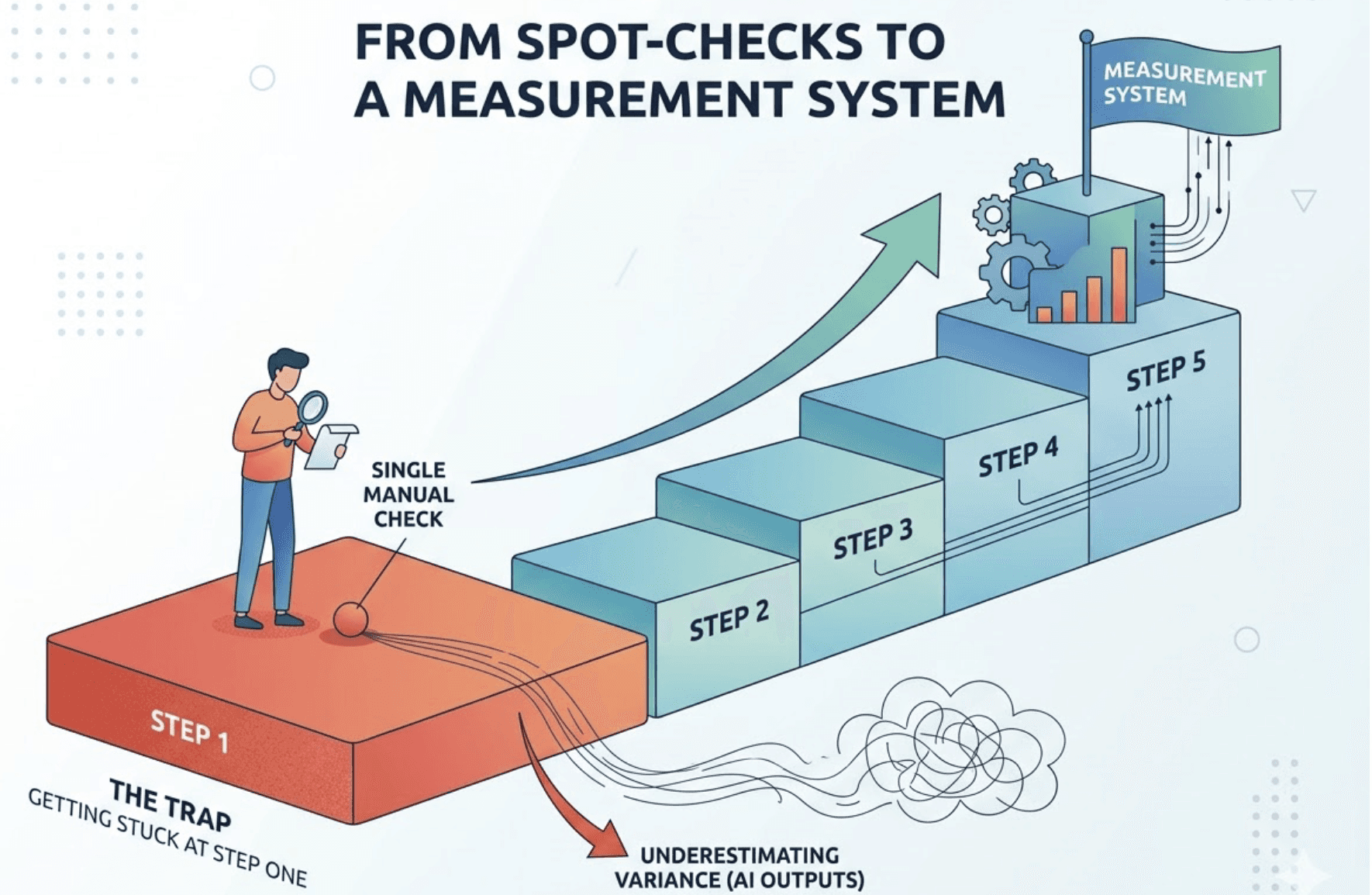
Step 1: Build a prompt library that mirrors the buyer journey. This means informational prompts ("What are the benefits of X?"), commercial prompts ("Best tools for Y"), and branded prompts ("Is [Brand Z] reliable?"). Aim for at least 30-50 prompts to get statistically meaningful data.
Step 2: Establish a cross-platform baseline. Run your prompt library simultaneously across ChatGPT, Gemini, Perplexity, and DeepSeek. This initial snapshot is your visibility benchmark. Manual methods take 15+ hours per week for 10-20 prompts and still only capture a single moment. Topify's Basic plan analyzes up to 9,000 AI answers per month across 100 prompts — a scale that makes statistical confidence actually achievable at $99/mo.
Step 3: Set up competitor benchmarking. Track rivals in parallel. This tells you whether a visibility gap is a technical optimization issue or a genuine authority deficit that requires content investment.
Step 4: Run periodic source analysis. Identify which domains the AI is actually citing to support its claims — often Wikipedia, Reddit, G2, or specific industry blogs. These are the "influencers of the AI." If your content doesn't appear on those platforms, your brand won't be in the AI's citations.
Step 5: Close the content loop. Insights from steps 1-4 must drive specific content actions: adding FAQ schema, creating direct-answer passages, updating third-party listings. Without this step, you have a reporting system, not a growth system.
Most User-Friendly AI Search Visibility Tracking Tools for Marketing Teams
Marketing teams have different requirements than enterprise data teams. You need dashboards you can present to stakeholders, workflows that don't require engineering support, and reporting that connects visibility to business outcomes — not just raw analytics exports.
Here's how the current market looks:
Tool | Best For | Key Strength | Starting Price |
|---|---|---|---|
Topify | Marketing teams, e-commerce | 7 GEO metrics + One-Click Execution + GSC integration | $99/mo |
Profound | Enterprise brands | 10+ platform coverage | $399/mo+ |
SE Ranking | SEO hybrid teams | Strong traditional + AI data | $103/mo+ |
Peec AI | Agencies, multi-brand | Agency-friendly pricing | €89/mo+ |
For in-house marketing teams, Topify stands out for a few specific reasons. First, it covers more AI platforms than most mid-market tools — including ChatGPT, Gemini, Perplexity, DeepSeek, Doubao, and Qwen — which matters if you're targeting international markets. Second, it integrates with Google Search Console, so you can see SEO and AI performance in the same view instead of reconciling two separate dashboards. Third, its One-Click Agent Execution means you can go from "here's what the data shows" to "here's a deployed optimization strategy" without a separate project cycle.
Traditional SEO suites like Semrush and Ahrefs are not built for this use case. They simulate rankings rather than tracking live AI synthesis, and they don't offer the execution workflows that tell a marketer specifically how to close a visibility gap.
From AI Search Intelligence to Action: Closing the Loop
Data without action is just overhead.
The brands getting real ROI from AI visibility tracking aren't using it as a reporting tool — they're using it as an optimization trigger. Here's what that looks like in practice:
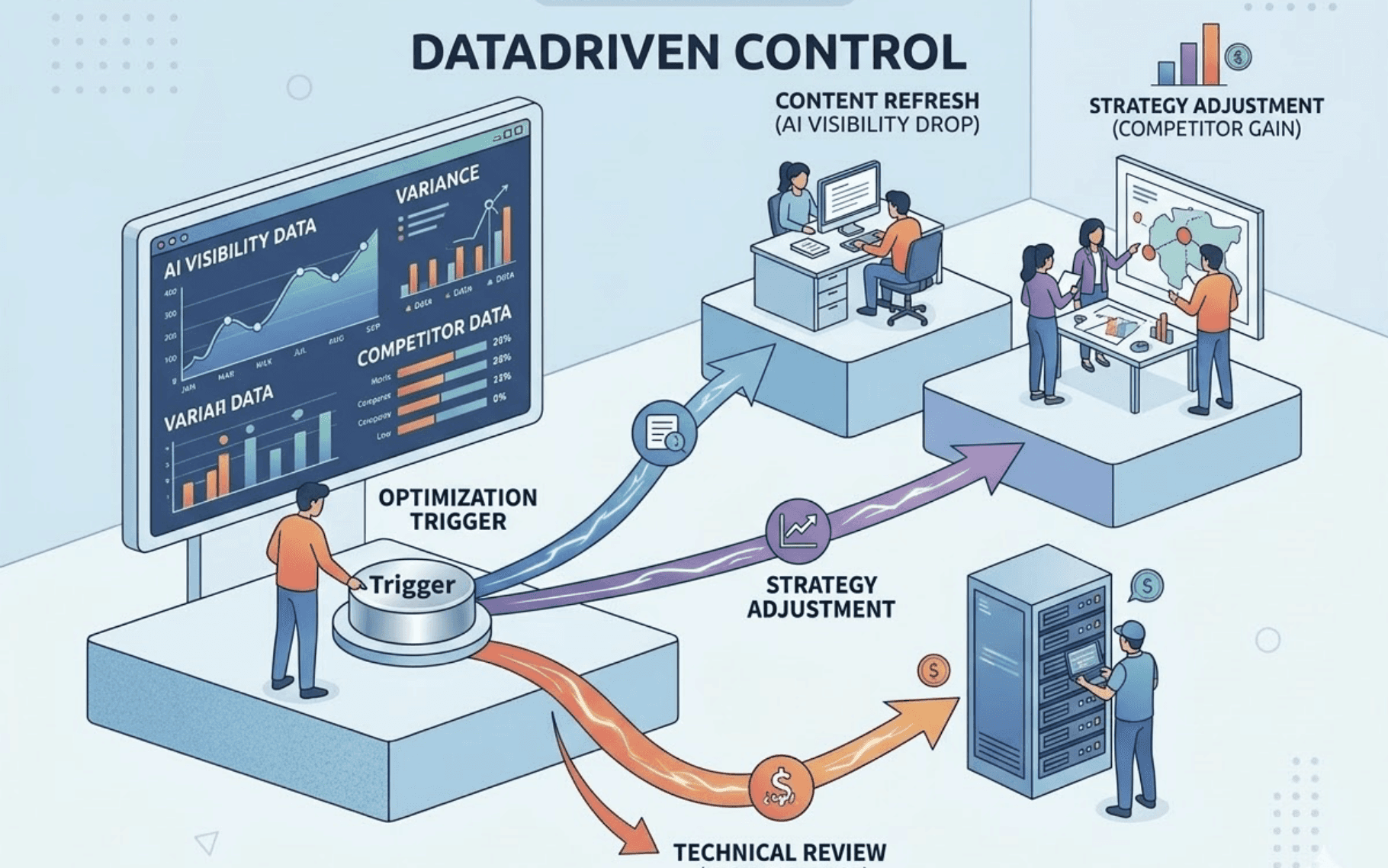
Source gaps → Content distribution priority. If Topify's source analysis shows the AI is consistently citing G2 and Reddit for your category, that's where your PR and social content needs to go, not your owned blog.
Sentiment issues → Narrative adjustment. If AI describes your product as "entry-level" but you're selling to enterprise buyers, the fix isn't marketing copy — it's adding enterprise case studies and technical depth to the pages and third-party sites the AI is actually reading.
Position lag → Competitor reverse-engineering. Analyzing the structure of pages that consistently win the #1 recommendation slot reveals what semantic signals the AI is responding to. Tables, direct-answer paragraphs, expert citations — these are patterns you can replicate.
The results from early adopters are concrete. One B2B brand grew its AI visibility from 3.2% to 22.2% in a single month after addressing citation gaps identified through tracking. An industrial manufacturer saw a 2,300% increase in AI referral traffic after implementing a targeted content optimization strategy. These aren't vanity metrics — they're capturing users who have already decided to trust the AI's recommendation.
Conclusion
AI brand visibility and traditional SEO are now two separate disciplines that require separate measurement systems.
The brands winning in AI search have built multi-dimensional tracking across multiple platforms, established competitive benchmarks, identified their citation gaps, and closed the loop between data and content strategy. Most haven't waited for a perfect playbook — they started with prompt tracking and baseline data, then iterated from there.
If your brand doesn't know where it stands across ChatGPT, Gemini, Perplexity, and DeepSeek today, that's the starting point. Topify gives marketing teams the analytics and execution tools to turn AI search intelligence into a measurable growth channel — without engineering support or enterprise-level complexity.
The compounding effect of AI citations means early movers become increasingly hard to displace. Start tracking now.
FAQ
Q: What is AI brand visibility and how is it different from SEO? AI brand visibility measures how often and how positively your brand appears in AI-generated responses. SEO optimizes for ranking in a list of links; AI visibility optimizes for being mentioned and recommended within a conversational answer. The algorithms, signals, and optimization strategies are fundamentally different.
Q: Which AI platforms should I track for brand visibility? At minimum: ChatGPT, Gemini, Perplexity, and DeepSeek. Each platform has different retrieval mechanisms — Perplexity is citation-heavy, Gemini is grounded in Google Search, DeepSeek skews toward technical content — and they often produce different results for the same prompt and brand.
Q: How do I know if my brand has a sentiment problem in AI search? Sentiment issues show up as qualifying language in AI responses: "limited features," "better suited for smaller teams," or "some users report reliability concerns." A good AI search analytics platform will flag these descriptor patterns automatically rather than requiring you to manually read every AI response.
Q: What are the most user-friendly AI search visibility tracking tools for marketing teams? For marketing teams that need professional-grade analytics without engineering overhead, Topify offers the strongest combination of multi-platform coverage, GEO analytics depth, and one-click execution. It's designed for marketers, not data scientists.
Q: How often should I audit my brand's AI search visibility? At least weekly, because AI models update frequently and responses are non-deterministic. High-growth brands use daily automated monitoring to catch sudden shifts in sentiment or competitive position before they compound.