
Your domain authority is solid. Your keyword rankings haven't moved. But someone at the leadership meeting asks, "Are we showing up when customers ask ChatGPT for recommendations in our category?" and the answer is silence.
That's not a reporting gap. It's a structural one. Traditional SEO metrics weren't built to measure what AI chooses to say, and the brands discovering this the hard way are the ones who assumed the two were interchangeable.
What AI Search Visibility Actually Measures
AI search visibility is the quantitative and qualitative measure of how frequently, accurately, and favorably a brand is mentioned, cited, and recommended by generative AI systems during the synthesis of user responses.
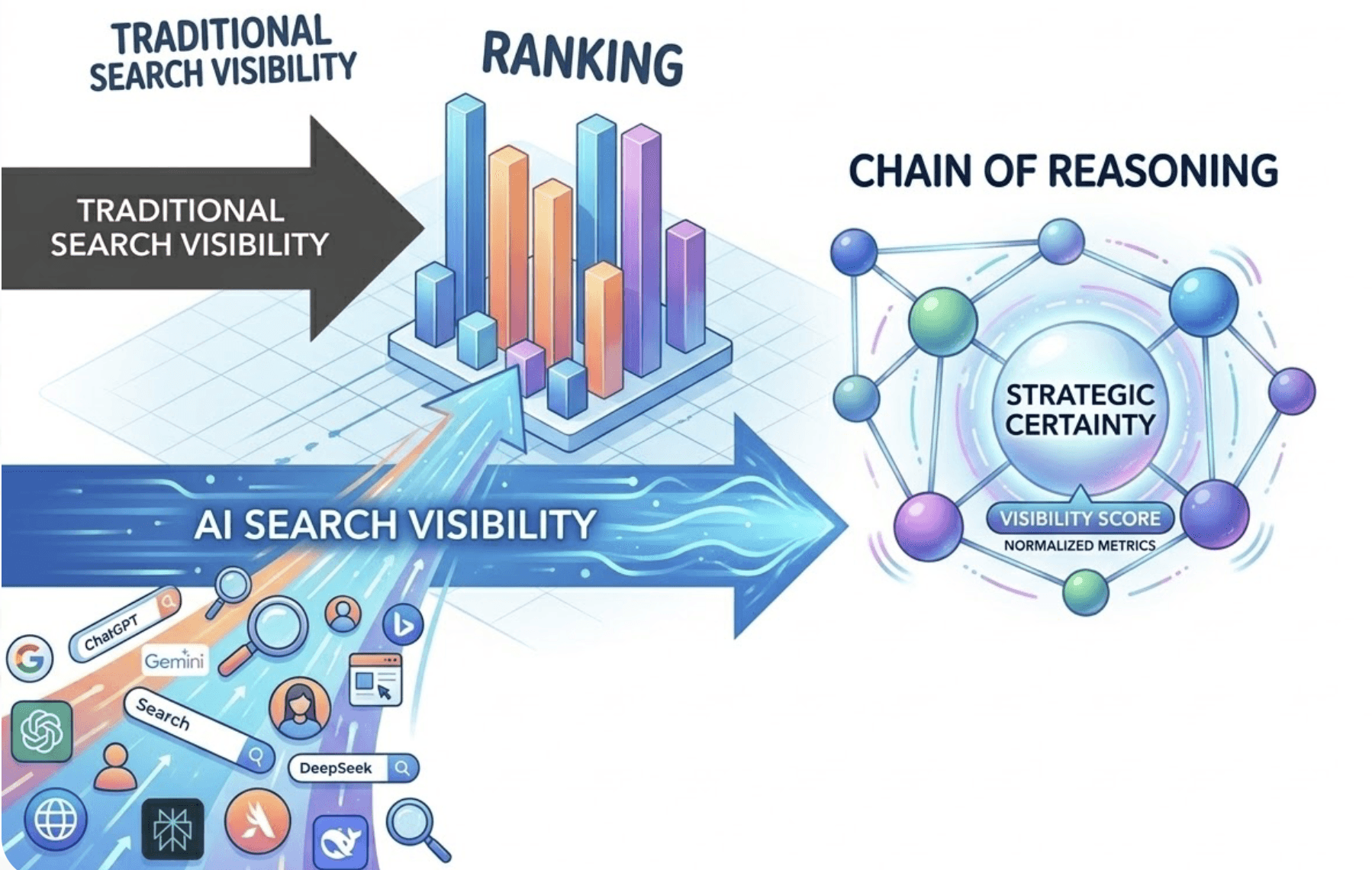
That definition matters because it's fundamentally different from a ranking. Traditional search visibility tells you where a page appears on a results list. AI search visibility tells you whether a brand is included in the model's chain of reasoning at all.
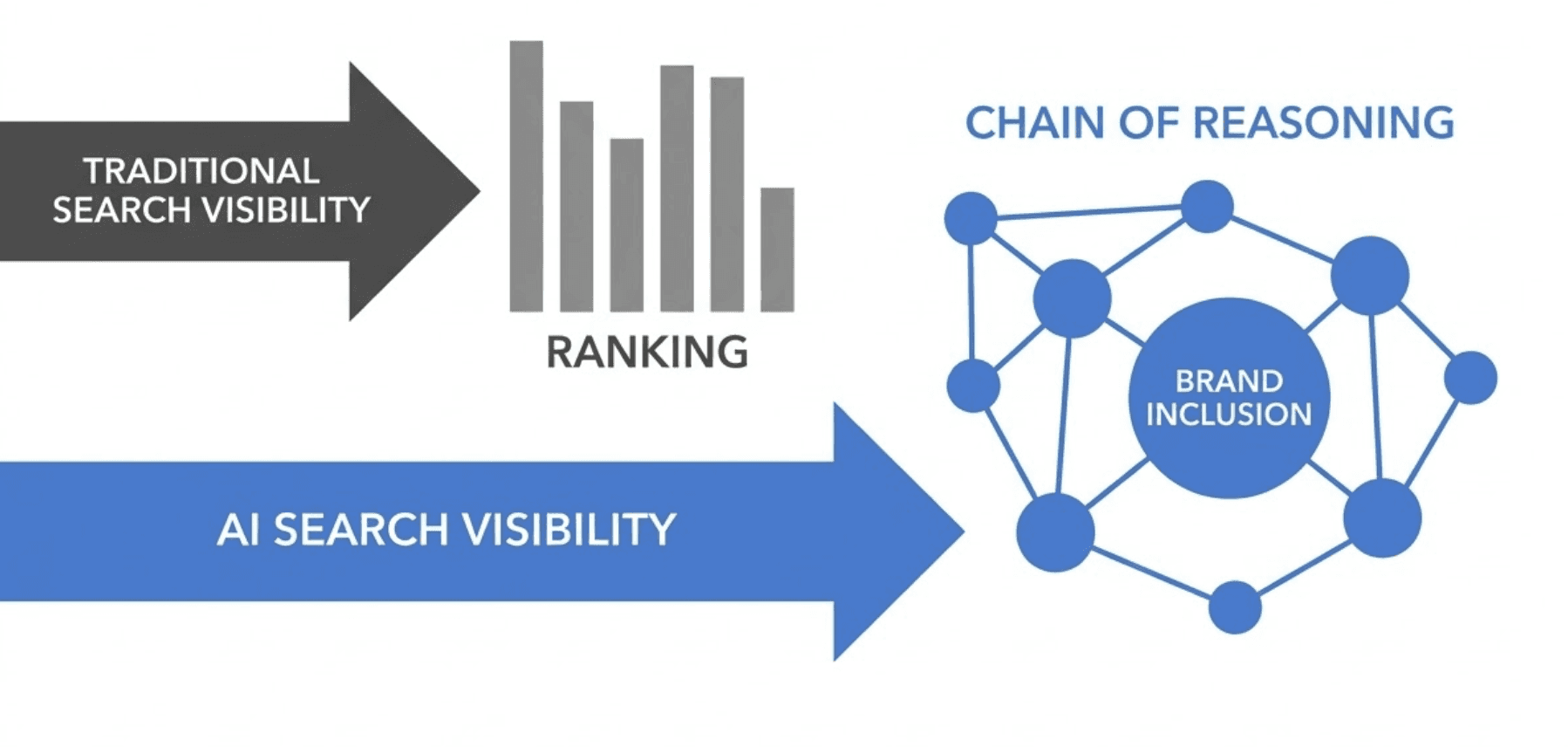
The mechanism behind this is Retrieval-Augmented Generation (RAG). When a user submits a prompt, the system doesn't retrieve a list of pages. It decomposes the query into multiple latent intents, routes those intents across training data, real-time web indexes, and structured knowledge bases, then synthesizes a unified response. Visibility occurs at four intersections: Presence (being in the conversation), Accuracy (correctness of facts), Perception (sentiment of the description), and Preference (likelihood of being the primary recommendation).
AI platforms now generate approximately 45 billion monthly sessions worldwide, accounting for roughly 56% of global search engine volume. And while direct referral traffic from LLMs currently sits at an estimated 0.13% globally, that traffic is concentrated on high-intent pages. Users arriving via AI search are 4 to 9 times more likely to land on pricing or product comparison pages than traditional searchers.
That's not peripheral traffic. That's the bottom of your funnel.
Why Your Domain Authority Score Means Nothing to ChatGPT
Here's the insight most SEO teams aren't ready for: domain authority and citation frequency in LLMs have almost zero correlation.
In the traditional search paradigm, a high DA score functioned as a moat. High link equity meant competitive rankings. But ChatGPT, Gemini, and Perplexity don't process link equity the way Google's PageRank does. These models prioritize semantic clarity, structured extractability, and source diversity.
The logic is driven by the model's need to verify claims and minimize hallucinations. This creates an environment where a low-DA niche blog, a specific Reddit thread, or a well-structured FAQ on a technical site gets cited more frequently than a high-DA corporate homepage full of vague marketing copy.
AI systems evaluate content on "Synthesis Potential": the ease with which a paragraph or table can be extracted and reformulated into a direct answer. Brands that bury their value proposition in long-form narratives or JavaScript-heavy pages often become invisible to the synthesis engine, regardless of their Google ranking.
The entity relationship is the new currency of authority. AI models interpret the web as a graph of connected entities. If your brand isn't clearly associated with the relevant entities in the model's training data and RAG sources, you get skipped during retrieval. A well-documented case in the beauty sector showed L'Oréal Paris losing AI share to Fenty and Estée Lauder specifically because entities like "formulation science" and "price comparison" were missing from L'Oréal's AI profile, even as the brand held strong traditional authority signals.
Authority Signal | Traditional Search | AI Search |
|---|---|---|
Backlinks | Primary trust signal | Secondary; used for source discovery |
Content Structure | Important for snippets | Critical; determines extractability |
Keyword Density | Helps identify relevance | Irrelevant; semantic intent matters |
Entity Density | Minimal ranking impact | Primary topical authority signal |
Unlinked Mentions | Low value without "dofollow" | High value; builds entity trust |
How to Measure AI Search Visibility: The 7 Metrics That Actually Matter
Manual tracking doesn't work at scale. A single brand name can trigger thousands of different response variations based on prompt phrasing alone. The only viable path is automated, multi-platform monitoring.
Topify has built its analytics framework around seven core metrics that together give a complete picture of a brand's health in the generative layer.
1. Visibility (Share of Model) The percentage of relevant prompts where your brand is mentioned or recommended across a defined set of AI platforms. This is the North Star metric. If you're not in the consideration set, nothing else matters.
2. Sentiment Polarity AI systems describe brands, not just list them. A brand with high visibility but negative sentiment, such as one consistently framed as "frequently criticized for poor support," is losing pipeline even when it appears. Monitoring perception lets you identify and correct misinformation before it compounds.
3. Generative Position In a conversational response, order of mention functions like a search rank. The first-mentioned brand captures up to 60% higher engagement than subsequent options, and typically receives the most definitive language. Position tracking tells you where you actually sit relative to competitors.
4. Mention Volume and Coverage Raw frequency across different query types: problem-based, solution-based, and comparison-based. High volume across a wide query range indicates the model has a robust understanding of your brand's use cases. Gaps here reveal where competitors are owning specific scenarios.
5. Citation Frequency and Source Attribution Platforms like Perplexity cite their sources explicitly. This metric tracks how often the AI links to your domain versus third-party sources. If the AI is pulling from forums or competitor pages to describe your brand, your own content isn't meeting the model's synthesis requirements.
6. Intent and Topical Authority The breadth of topics and user intents for which your brand surfaces. A fintech company might have strong visibility for "business loans" but zero for "working capital management." This gap directly maps to revenue blind spots.
7. Conversational Conversion Rate (CVR) The business impact metric. Visitors arriving via AI search convert up to 4.4 times better than those from traditional organic search, because the AI has already completed the evaluation and trust-building before the user clicks.
Topify tracks thousands of prompts daily across ChatGPT, Gemini, Perplexity, DeepSeek, and other major platforms to normalize these metrics into a single Visibility Score. That's the shift from anecdotal evidence to strategic certainty.
4 Real Examples of AI Search Visibility in Action
These cases show what AI visibility looks like in practice, across industries and scale.
1. The B2B SaaS Integration Gap A mid-market data integration company ranked #1 on Google for "data pipeline software." When users asked ChatGPT how to integrate Snowflake with MongoDB for real-time analytics, the AI recommended two competitors and cited a third-party blog. The problem: content was written for human storytelling, not machine extraction. It lacked clear technical structures and specific integration entity associations. After implementing structured "How-To" guides and technical documentation, the brand saw a 326% increase in LLM-driven traffic and reached a top-3 visibility position in Perplexity within six months.
2. E-Commerce Intent Capture A water supply and lightning protection retailer restructured product pages to address the "intent" behind purchases, not just SKU details. When users asked AI assistants for equipment recommendations for specific installation scenarios, the AI favored sites that mapped products to use cases. The result: a 693% increase in AI-channel visits and a 5% conversion rate, well above traditional organic search performance.
3. Industrial Products Authority Building An industrial products company was losing visibility as Google AI Overviews pulled from industry journals rather than their own site. After refreshing content structure and expanding their presence to third-party knowledge bases, the brand saw a 2,300% jump in AI-platform traffic and an 800-point increase in visibility score.
4. Consumer Brand Entity Gaps A beauty brand study showed L'Oréal Paris losing AI recommendation share to competitors specifically because certain entities like "formulation" and "price-performance" weren't mapped to the L'Oréal profile in AI knowledge graphs. The AI pulled data from fragmented regional sites and outdated investor pages instead of consumer-centric science content. The brand was easy to skip in comparative queries because of missing entity associations, not lack of authority.
The pattern across all four: visibility is lost at the content structure and entity layer, not the domain authority layer.
A Step-by-Step Strategy to Improve AI Search Visibility
Step 1: Run a Generative Discovery Audit Identify 20 to 50 high-intent prompts your customers are actually using. Run them across ChatGPT, Perplexity, Gemini, and Claude. Document your Share of Model baseline, where competitors appear instead of you, and any hallucinations where AI provides incorrect facts about your brand. This is your starting point.
Step 2: Set Up Systematic Tracking Move from manual testing to automated monitoring. Topify's dashboard tracks visibility, sentiment, position, and citation data daily, allowing you to catch changes in AI citation patterns as they happen. AI-cited sources shift 40 to 60% monthly, which means last quarter's data is already stale.
Step 3: Optimize Content for Synthesis Potential Restructure content to make it machine-extractable. Place a concise 40-60 word direct answer immediately under each H2. Add data tables and verifiable statistics. Write in clear subject-predicate-object structures. Implement FAQPage schema. The goal is to make each section a self-contained answer unit, not a narrative paragraph.
Step 4: Expand Source Coverage Use Topify's Source Analysis to identify the specific domains and URLs driving AI recommendations in your category. If the AI is citing a specific G2 review or Reddit thread to recommend a competitor, establish your presence in those sources. AI visibility is built on corroboration: the more high-trust sources that consistently say the same thing about you, the more the model accepts it.
Step 5: Monitor and Maintain Set up weekly reviews for sentiment shifts, hallucinations, and citation drift. Check AI descriptions of your brand for factual errors in pricing, features, or positioning. Submit corrections to platform providers when you find them.
Strategy Phase | Focus Area | Key Action | Expected Outcome |
|---|---|---|---|
Audit | Diagnostic | Baseline SoM + fact check | Visibility gap identification |
Track | Measurement | Daily prompt monitoring | Data-driven strategy adjustments |
Optimize | Structure | TL;DR blocks + FAQ schema | Increased AI extractability |
Distribute | Authority | Earned mentions + Reddit + G2 | Broader citation coverage |
Monitor | Governance | Hallucination + sentiment alerts | Protected brand reputation |
The AI Search Visibility Audit Checklist
Run this quarterly. AI model behaviors shift faster than annual SEO audits can catch.
Technical Readiness
Verify AI crawler access in robots.txt. Confirm GPTBot, OAI-SearchBot, and PerplexityBot are not blocked
Add a /llms.txt file to provide a structured content manifesto for AI agents
Audit JavaScript dependency. Core brand facts must be visible in HTML source
Target mobile load time under 1.8 seconds to satisfy AI Overview quality signals
Content and Semantic Structure
Add TL;DR summaries or "Key Takeaways" blocks to every high-value page
Implement FAQPage schema on all FAQ sections
Replace vague marketing language with specific technical entities the AI can map
Verify that factual answers appear within the first 20% of page content
Authority and Distribution
Confirm brand presence on at least 3 authoritative review platforms cited by Perplexity in your niche (G2, Trustpilot, Capterra)
Ensure your brand is mentioned in contextually relevant discussions on high-traffic subreddits
Update Organization schema with correct legal names, founders, and social links
Target 20+ high-authority citations per quarter in industry publications using your original data
Monitoring and Governance
Review AI-generated descriptions weekly for negative framing or inaccurate positioning
Check for factual errors in AI-generated pricing, product lists, or feature comparisons
Segment AI referral traffic from openai.com, perplexity.ai, and gemini.google.com in analytics
5 Mistakes That Drop Your Brand From AI Recommendations
1. Treating Google Rankings as a Proxy for AI Visibility The disconnect is structural. High DA does not translate to AI citation frequency. Brands that optimize exclusively for PageRank while ignoring entity clarity and synthesis potential will consistently lose AI share to smaller competitors with better-structured content.
2. Only Monitoring One Platform ChatGPT and Google AI Overviews use different retrieval architectures. A brand can have strong visibility in one and zero presence in another. Single-platform tracking creates a false sense of security while gaps compound undetected.
3. Writing for Narrative, Not Extraction Long-form brand storytelling doesn't perform in the generative layer. If your core product claims are buried in paragraphs rather than surfaced in direct-answer structures, the AI simply skips you and finds a competitor who answered the same question in a table.
4. Ignoring Third-Party Source Coverage Your own site isn't enough. AI systems use source diversity as a trust signal. If the model only finds claims about your brand on your own properties, it often treats this as insufficient corroboration and defers to competitors who appear in forums, review platforms, and industry publications.
5. Skipping Sentiment Monitoring Visibility without perception monitoring is a partial picture. A brand can appear frequently in AI answers but consistently framed with qualifiers like "budget option" or "better for small teams." Left unaddressed, this positions you below competitors even when you're technically visible.
Best AI Search Visibility Management Tools
The market for AI search visibility management tools has matured significantly heading into 2026, though the platforms vary considerably in what they actually measure.
Topify is currently the most comprehensive option for teams that need both analytics and execution in one platform. It tracks all seven core metrics (Visibility, Sentiment, Position, Volume, Mentions, Intent, and CVR) across ChatGPT, Gemini, Perplexity, DeepSeek, Doubao, Qwen, and others, covering markets that most competitors don't reach. The differentiating feature is One-Click Agent Execution: define a goal in plain English, review the proposed strategy, and deploy. The platform identifies the specific domains and URLs driving AI recommendations in your category and generates an action plan to displace them. Built by founding researchers from OpenAI and Google SEO practitioners.
Profound focuses on brand monitoring for enterprise accounts, with solid coverage of ChatGPT and Perplexity. Strong on reporting, lighter on execution tooling. Better suited for teams whose primary use case is board-level visibility reporting rather than ongoing optimization.
Otterly.AI offers a lightweight entry point for smaller teams tracking a limited prompt set. Less suited to multi-client agency workflows or brands managing visibility across multiple product lines.
Tool | Platform Coverage | Execution Features | Ideal For |
|---|---|---|---|
Topify | ChatGPT, Gemini, Perplexity, DeepSeek, Doubao, Qwen, and others | One-click agent execution | Marketing teams, agencies, enterprise |
Profound | ChatGPT, Perplexity, Google | Manual reporting | Enterprise brand monitoring |
Otterly.AI | ChatGPT, Perplexity | Basic tracking | Small teams, limited prompt sets |
AI Search Visibility Pricing: What to Expect
Tool pricing in this category generally reflects the scale of prompt tracking and platform coverage, not just seat count.
Topify runs three tiers. The Basic plan starts at $99/month (billed annually) and includes tracking for 100 prompts across ChatGPT, Perplexity, and AI Overviews, 9,000 AI answer analyses, and 4 projects. The Pro plan at $199/month expands to 250 prompts and 22,500 analyses across 8 projects. Enterprise plans start at $499/month with dedicated account management and custom configuration. Full details at Topify Pricing.
For teams that want managed execution alongside analytics, Topify also offers a GEO managed service. The Standard tier starts at $3,999/month and includes 40 GEO prompts, 60 high-quality articles, 10 Reddit visibility posts, and 40 SEO keywords per month. The Business tier runs $4,999/month and the Enterprise tier $5,999/month, each with expanded deliverable volumes and tailored solutions.
Compared to the cost of losing bottom-of-funnel AI share to competitors, the analytics tier typically pays for itself within the first month of identifying and addressing a single visibility gap.
Conclusion
The brands winning in AI search aren't necessarily the ones with the strongest domain authority or the largest content libraries. They're the ones that understood early that AI models evaluate content differently: by synthesis potential, entity clarity, and source corroboration, not link equity.
That's a solvable problem. Start with a baseline audit of 20 to 30 prompts across two or three AI platforms. Identify where you're missing and where competitors are appearing instead. Then use that data to prioritize your first content and distribution changes.
Thirty days of tracking will tell you more about your actual AI visibility than three years of Google rankings data.
If you're ready to move from manual checks to systematic monitoring, get started with Topify and run your first Visibility audit in under 10 minutes.
FAQ
Q: What is the difference between AI search visibility and SEO ranking? A: SEO ranking measures where a webpage appears in a list of results on Google or Bing. AI search visibility measures whether a brand is mentioned, cited, or recommended in an AI-generated answer. A brand can rank #1 on Google for a keyword and still be completely absent from ChatGPT or Perplexity responses for the same topic. The signals that drive each are different: links and authority drive SEO rankings, while entity clarity, content structure, and source corroboration drive AI visibility.
Q: How long does it take to improve AI search visibility? A: The timeline varies by starting point and action taken. Technical changes like implementing FAQ schema and adding TL;DR blocks can influence citation frequency within 4 to 8 weeks as AI crawlers re-index your content. Third-party source building (Reddit, G2, industry publications) typically takes 2 to 4 months to register in model behavior. Systematic tracking with a tool like Topify will show incremental changes within the first 30 days, giving you early signal on what's working.
Q: Do I need separate tools for ChatGPT, Perplexity, and Gemini? A: No, but you do need a platform that tracks all three simultaneously. Each AI engine uses a different retrieval architecture, so your visibility scores will differ across platforms. Monitoring only one gives you a partial and potentially misleading picture. Topify covers ChatGPT, Gemini, Perplexity, and several additional platforms from a single dashboard, which is the practical way to manage multi-platform visibility without manual overhead.
Q: Can a small brand with low domain authority improve AI search visibility? A: Yes, and this is one of the more counterintuitive aspects of AI search. Several documented cases show low-DA brands outranking established competitors in AI recommendations because their content was structured for machine extraction. A well-structured FAQ, a clear entity association strategy, and a presence on the specific third-party sources AI platforms cite in your niche can generate strong AI visibility even without years of link-building.