
Your brand might rank #1 on Google. That number means less than it used to.
In 2026, over 30% of information-seeking interactions happen inside AI platforms, not search result pages. ChatGPT, Perplexity, Claude, Google AI Overviews — these engines don't show ten links. They construct a single synthesized answer. If your brand isn't cited in that answer, you don't exist in the user's consideration set. Doesn't matter where you rank in the index.
Most SEO Dashboards Don't Track the Answers Your Customers Are Actually Reading
The click-through rate, once the definitive metric of digital success, is becoming structurally irrelevant for a growing share of queries.
Zero-click searches — where users get their answer without leaving the results page — now account for nearly 60% of all Google searches. When a Google AI Overview is triggered, that rate jumps to 83%. In Google AI Mode, which uses multi-turn conversation and deeper reasoning, it reaches 93%. Traditional SEO tools track the position of a URL in an index. They don't track whether that URL was ever cited in the AI's actual answer.
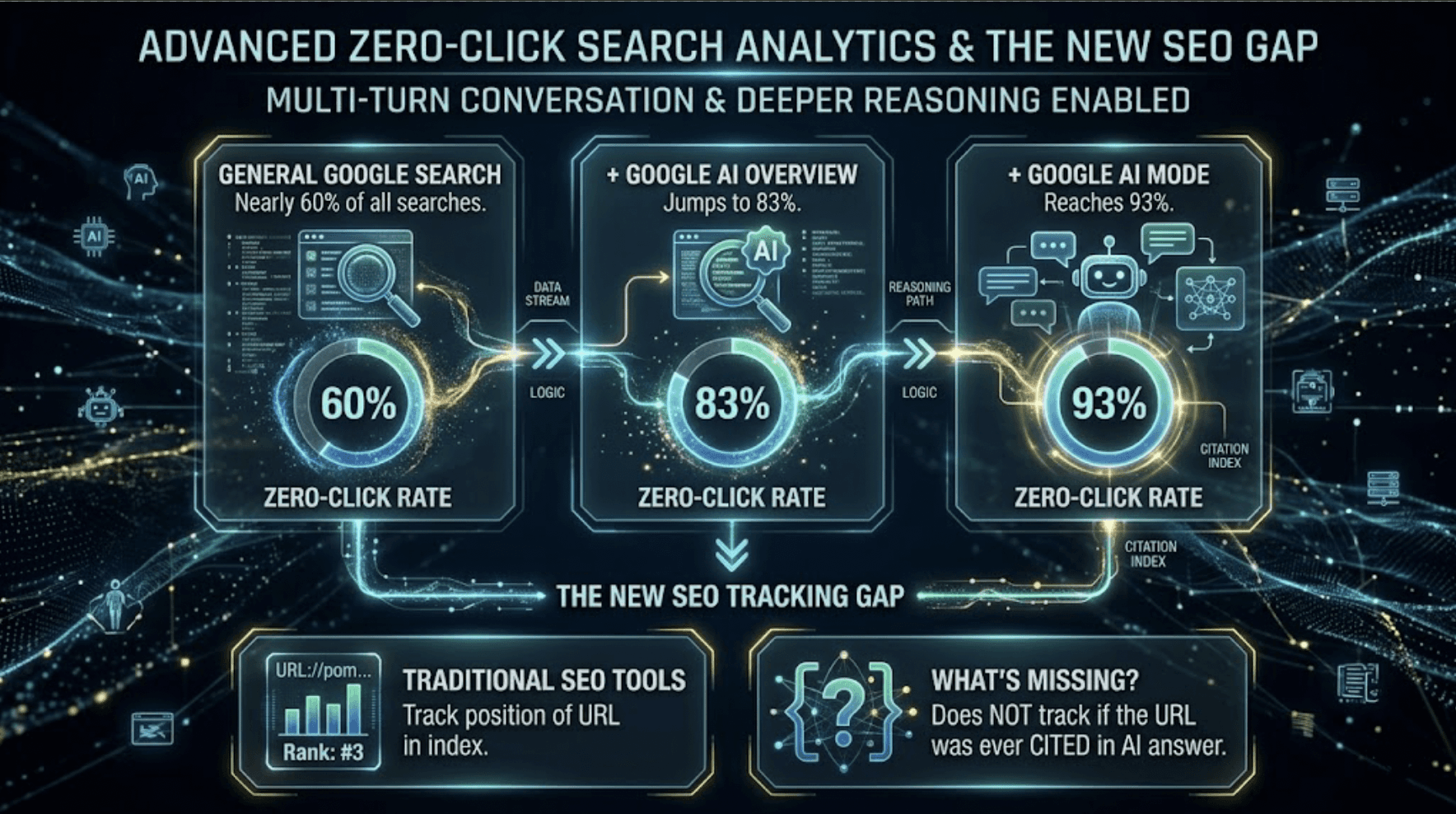
That's the gap most dashboards still can't see.
The distinction matters financially, too. While traditional organic search carries an average conversion rate of around 2.8%, referral traffic from AI platforms like ChatGPT converts at roughly 14.2%. Users arriving from an AI citation have already been pre-qualified by the engine's synthesis. They're not browsing. They're deciding. Losing AI visibility isn't just a reach problem — it's losing the highest-intent traffic in your funnel.
Rank tracking tells you where your link sits. AI citation tracking tells you whether the AI even used you.
What "AI Citation Tracking" Actually Means Across ChatGPT, Perplexity, Claude, and AI Overviews
"Citation" looks different on every platform. A strategy built on one engine's logic will fail on another.
ChatGPT has become a primary research tool for hundreds of millions of users, processing more than 2.5 billion prompts daily. For ChatGPT online rank tracking, what matters is direct source dominance — the platform is 11.1 percentage points more likely to cite a brand's official website than traditional Google Search. Citations appear as inline hyperlinked bubbles or a dedicated "Sources" panel. If your documentation and product pages aren't structured for direct sourcing, a competitor's will be.
Perplexity works differently. It treats citations as a core UX element, surfacing numbered footnotes for nearly every factual claim. Users spend an average of 9 minutes on referred sites from Perplexity clicks — it's a researcher's tool, and it favors structured, fact-dense content. Perplexity online rank tracking tools need to account for this footnote architecture and the platform's strong bias toward real-time news and academic-style sources.
Claude, developed by Anthropic, uses what's been called a "reputation architecture." It's skeptical of brands citing themselves. Instead, Claude looks for corroboration: third-party publications, industry directories, review sites, and academic mentions. For Claude online rank tracking, the signal isn't your own content — it's how often high-authority external sources endorse you. Claude online rank tracking tools that only scan your owned pages will miss the actual lever.
Google AI Overviews and AI Mode operate on entity-based SEO logic, drawing from Google's Knowledge Graph. AIO appears in 18-25% of all searches, and crucially, 40-60% of cited sources rotate every month. AI Overview online rank tracking isn't a set-and-forget exercise — citation drift is real, and continuous monitoring is what separates brands that stay visible from those that disappear quietly.
AI Platform | Monthly Reach | Primary Citation Format | Source Selection Bias |
|---|---|---|---|
ChatGPT | 883M users | Inline bubbles + Sidebar | Official docs, direct brand sites |
Perplexity | 22M+ users | Numbered footnotes | Real-time news, academic sources |
Claude | 18.9M users | Context-span footnotes | Third-party consensus, publications |
Google AIO | 1.5B users | Source cards & Link icons | High DA, entity-clear domains |
No single platform's data tells the full story. A brand might dominate Perplexity through technical whitepapers but remain invisible on Claude for lack of PR coverage. Cross-platform tracking isn't optional at this point — it's the baseline.
5 Tools for AI Citation Tracking and Online Rank Tracking Across AI Platforms
The GEO tooling market has grown fast. Here's a direct comparison across the five most relevant platforms in 2026:
Tool | Engine Coverage | Citation Tracking | Rank Tracking | Starting Price |
|---|---|---|---|---|
Topify | ChatGPT, Perplexity, AIO, Claude, DeepSeek | Source & URL Analysis | Position relative to rivals | $99/mo |
Profound | 10+ engines (Grok, Meta AI, DeepSeek) | Evidence-based snapshots | Enterprise SPI scoring | $99/mo |
Peec AI | ChatGPT, Perplexity, AIO, Gemini | Domain usage frequency | Answer position tracking | ~$95/mo |
Otterly.AI | ChatGPT, Perplexity, AIO, Copilot | Link citation counts | Brand Visibility Index | $29/mo |
Nightwatch | ChatGPT, AIO, Perplexity, Claude | Source-level sentiment | Local/zip-code rank tracking | $32/mo + AI add-on |
#1 Topify: Cross-Platform AI Citation Tracking with Source-Level Intelligence
Topify is built around a specific question most AI visibility tools don't answer: not just "was my brand mentioned," but "which exact domains and URLs did the AI use to construct that answer — and why."
That distinction is what the platform calls Source-Level Intelligence. It's the core of the Source Analysis module.
Source Analysis tracks every domain and individual URL that AI platforms reference when generating responses in your category. If a user asks ChatGPT for the "best HR software for remote teams" and your competitor gets cited, Topify identifies precisely which pages the AI pulled from — a G2 review, a niche HR blog, a Reddit thread. That's your gap list. You now know exactly which third-party properties to target to enter the AI's citation logic.
Position Tracking goes further: it quantifies where you appear in the recommendation order. Being fourth on a list of four is categorically different from being the primary recommendation. Topify measures "Primary Recommendation Rate" alongside raw mention counts, so you're not confusing presence with influence.
A B2B SaaS company in HR tech ran into a scenario that illustrates this well. They were consistently cited in ChatGPT's deep research responses — but entirely absent from Google AI Overviews for the same high-intent queries. Using Topify's Source Analysis, they found that ChatGPT was pulling their detailed implementation documentation, while Google AIO was favoring competitors who had deployed Organization and FAQ schema on their top-level landing pages. Four weeks after fixing the structural gap, they appeared in AIO results. That's the difference between general visibility data and source-level forensics.
Topify plans:
Basic ($99/mo): 100 prompts, 9,000 AI answer analyses, covers ChatGPT / Perplexity / AIO / Claude
Pro ($199/mo): 250 prompts, 22,500 AI answer analyses, 10 seats, suitable for agencies managing multiple clients
#2–#5: Other AI Rank Tracking Tools Worth Knowing
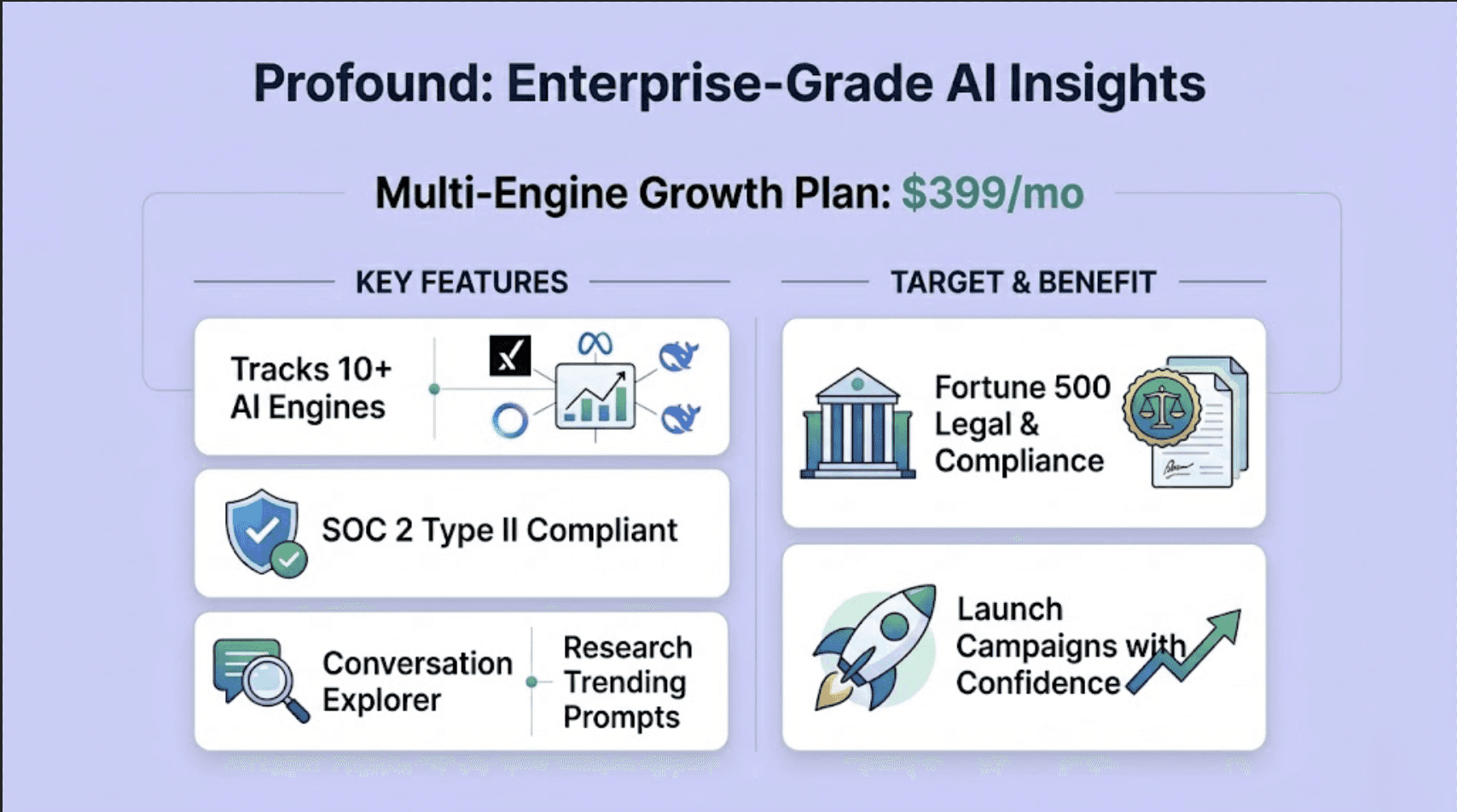
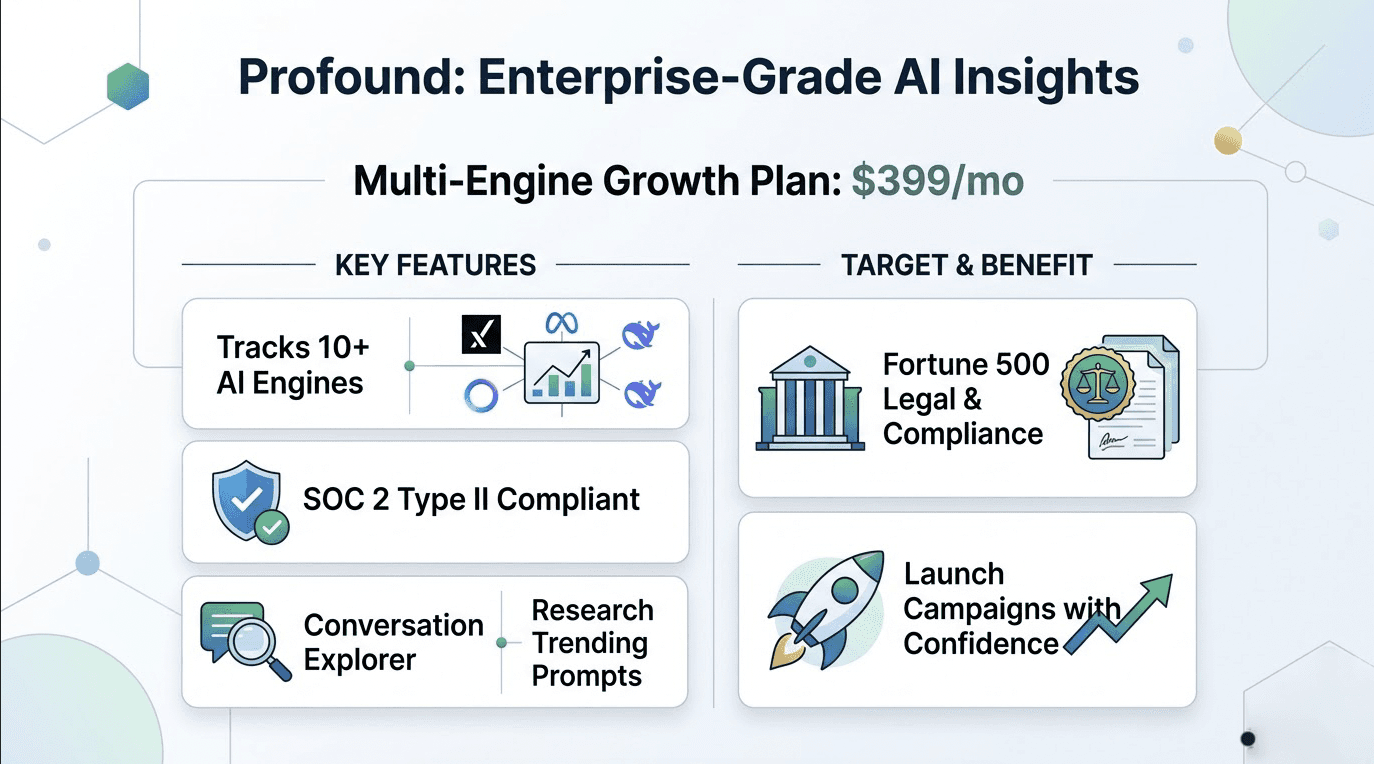
Profound is the enterprise-grade option. It tracks 10+ engines including Grok, Meta AI, and DeepSeek, with SOC 2 Type II compliance and a "Conversation Explorer" feature for researching trending prompts before a campaign launches. Its full multi-engine Growth plan sits at $399/mo. Built for Fortune 500 legal and compliance environments.
Peec AI differentiates through UI-scraping methodology — it captures what real users actually see on screen rather than relying purely on API calls, which can return sanitized responses. Starting around $95/mo with unlimited user seats, it's practical for agency-client collaboration on ChatGPT, Perplexity, and AI Overviews tracking.
Otterly.AI is the entry point for startups and solo marketers. At $29/mo, it delivers a Brand Visibility Index and automated sentiment tracking with clean visual dashboards. It's light on optimization features but covers the basics of Share of Voice monitoring across ChatGPT, Perplexity, AIO, and Copilot.
Nightwatch bridges traditional SEO and AI tracking with local and zip-code-level rank monitoring alongside LLM response tracking. Particularly valuable for local service providers who need to know if an AI is recommending their specific physical location. Starts at $32/mo with an optional AI add-on.
Winning the Citation vs. Winning the Recommendation — and Why You Need to Track Both
Here's what happens when you only track one dimension: you get a misleading picture of your actual competitive position.
An AI might cite your domain as the source for a technical definition while recommending your competitor as the product to buy. You "won" the citation. You lost the conversion. That's a hollow victory.
AI citation tracking and AI rank tracking answer fundamentally different questions:
Metric Type | AI Citation Tracking | AI Rank Tracking |
|---|---|---|
Primary Question | "Was my URL used as a source?" | "Was my brand recommended?" |
Focus Area | Technical accuracy, schema, authority | Brand sentiment, reviews, positioning |
Key Indicator | Citation Share / Source-Level Links | Primary Recommendation Rate |
Strategic Goal | To be the "Source of Truth" | To be the "Selected Solution" |
For ai overviews online rank tracking tools specifically, the focus skews toward static citation patterns — AIO draws from structured schema and high-DA pages that rotate monthly. For ai mode online rank tracking tools, the challenge is different: AI Mode uses multi-turn conversation and "query fan-out" to construct deeper answers, meaning your rank can shift mid-conversation depending on how the user follows up.
AI overview online rank tracking tools need to account for this rotation. AI mode online rank tracking tools need to handle conversational position shifts across follow-up prompts.
The brands winning in 2026 use platforms like Topify to run both analyses in parallel. Citation data reveals which pages the AI trusts. Rank data reveals whether that trust translates into recommendations. Together, they show you exactly where to intervene.
Conclusion
The shift from a "market of links" to a "market of recommendations" is no longer a forecast. It's the operating reality of 2026.
With zero-click rates exceeding 90% in conversational AI modes and AI-referred traffic converting at five times the rate of traditional organic clicks, the brands that invest in AI citation tracking aren't chasing a trend. They're protecting their highest-value acquisition channel.
The recommended path forward is direct: audit your current AI visibility across ChatGPT, Perplexity, Claude, and AI Overviews, identify which sources the AI is citing instead of you, and close the gaps systematically. Topify's Basic plan at $99/mo gives you 100 prompts and 9,000 AI answer analyses monthly — enough to establish a meaningful baseline and start benchmarking against competitors.
Search is a conversation now. The brands that get cited are the ones who prepared for that conversation in advance.
FAQ
What is AI citation tracking and how is it different from SEO rank tracking? AI citation tracking monitors whether AI engines — ChatGPT, Perplexity, Claude, AI Overviews — use your content as a source when generating answers. Traditional SEO rank tracking measures a URL's position in a list of links. Citation tracking measures whether the AI includes your brand in its synthesized conclusion, which is a separate and increasingly more important metric.
Can I track how often my brand appears in ChatGPT vs Perplexity vs Claude vs AI Overviews? Yes. Tools like Topify provide cross-platform tracking in a single dashboard. This matters because each platform has a different citation logic — Perplexity defaults to numbered footnotes for nearly every claim, while Claude weights third-party corroboration more heavily than direct brand sources.
What are the best tools for AI Overviews online rank tracking? For mid-market brands needing source-level intelligence and competitive gap analysis, Topify is among the top options. For enterprise environments with compliance requirements, Profound offers multi-engine tracking with SOC 2 Type II. For basic entry-level monitoring, Nightwatch offers an affordable modular AI add-on.
Does Topify support Claude online rank tracking and AI mode online rank tracking? Yes. Topify covers ChatGPT, Perplexity, Claude, Google AI Mode, and DeepSeek. AI Mode tracking is particularly important because it uses query fan-out across multi-turn conversations, which can surface a different set of cited sources than standard AI Overviews responses.
How many prompts do I need to track AI citations effectively? A meaningful baseline audit typically starts with 20-30 core queries covering your brand and primary products. For active competitive benchmarking across customer segments, tracking 100-250 prompts per month is the industry standard for marketing teams that need statistically stable visibility data.