
Key Takeaways
The "Passage Indexing" Rule: Google AIO does not rank pages; it ranks "Passages." Your content structure must ensure that every 150-word block makes sense in isolation, without needing the surrounding context.
The Visual Bias: AIO is visual. It pulls images, lists, and tables to make the snapshot engaging. If your data is trapped in paragraphs, it is invisible to the "Snapshot Engine."
The Verdict: Stop writing "Walls of Text." Structure your content like a Database, not a Novel. Use Topify to audit your HTML structure against the winning patterns of your competitors.
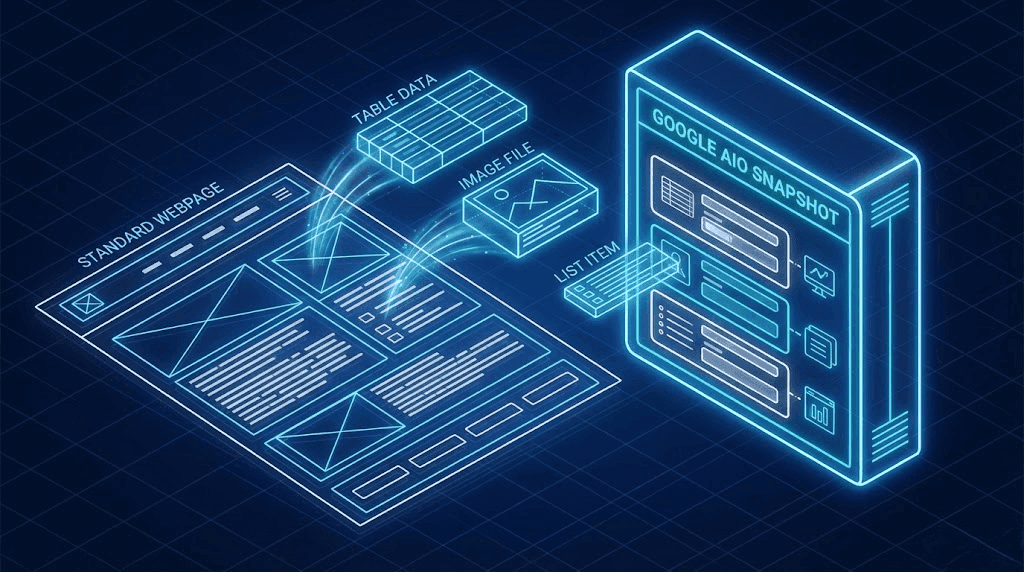
The Anatomy of a Snapshot
For years, SEOs optimized for the "Blue Link." Then, we optimized for "Position Zero" (The Featured Snippet).
Now, we must optimize for the AI Overview (AIO) Snapshot.
This is not just a bigger snippet. It is a dynamic, multi-source collage. Google reads the web, extracts the best sentences, images, and lists from different sites, and stitches them together into a single answer.
The scary part? You might rank #1 organically but be excluded from the AIO Snapshot because your HTML structure is messy.
Topify analysis of 100,000 SERPs shows a critical pattern: Structure eats Authority for breakfast. A lower-DA site with perfect HTML lists often beats a high-DA site with unstructured text.
So, how do you architect your page to fit into this new box?
This guide details the Modular Content Strategy—the specific HTML structures and layout patterns that Google's AI prefers to scrape.
Part 1: The "Modular" Mindset (Writing for Passages)
The fundamental difference in AIO optimization is Modularity.
1.1 The "Context Dependency" Trap
In a traditional blog post, you might write:
"As mentioned above, this feature is critical because..."
To an AI extracting a single passage, "As mentioned above" is confusing. It breaks the logic.
The Fix: Every H2 section must be Self-Contained.
Structure: H2 (Topic) -> Direct Answer (Summary) -> Supporting Evidence (List/Table).
1.2 The "Entity Anchor" Strategy
Google's AI looks for Entity Anchors—clear headings that define what the following text is about.
Bad H2: "Getting Started"
Good H2: "How to Configure [Product Name] for Enterprise Security"
Topify Insight: Pages with descriptive, entity-rich H2s see a 40% higher citation rate in AIOs.
Decision Point: Audit your content. If you copy-paste a random H2 section into a blank document, does it make sense? If not, rewrite it to be standalone.
Part 2: HTML Patterns That Win (The Code of Citations)

Google AIO is an extraction engine. It looks for specific HTML tags that signal "Structured Information."
2.1 The Power of <table>
This is the single most underused tag in SEO.
Why: AI struggles to extract comparisons from sentences ("X is $10 and Y is $20"). It instantly understands a table.
Best Practice: Use distinct
<th>(Table Headers).Topify Data: For "Pricing" and "Comparison" queries, 85% of AIO citations come from pages containing an HTML table.
2.2 The Logic of <ul> and <ol>
Unordered Lists (
<ul>): Use for features, ingredients, or non-sequential items.Ordered Lists (
<ol>): Use for "How-to" steps.The Trick: Keep the list item (
<li>) short. If the list item is a paragraph, the AI might skip it. Keep it punchy.
2.3 The Definition List (<dl>) (Advanced)
While rare, using Definition Lists (<dt> term, <dd> definition) is a strong signal for "Glossary" type queries.
Decision Point: Don't use CSS to fake a list. Use the actual HTML tags. The AI reads the code, not the visual rendering. Use Topify to verify your competitor's HTML structure.
Part 3: Comparison Matrix – Standard SEO vs. AIO Structure
How does your page layout need to change?
Component | Traditional SEO Page | AIO Optimized Page |
Introduction | Long "Hook" (Storytelling) | TL;DR Summary Box (Direct Answer) |
Body Text | Long Paragraphs | Short Blocks broken by Headers |
Data Presentation | Sentences | HTML Tables |
Navigation | Table of Contents (Links) | Jump Links (Named Anchors) |
Tone | Subjective / Opinion | Objective / Fact-Based |
Images | Stock Photos | Charts / Infographics with Alt Text |
Tracking | Rank Tracker |
Key Insight: The AIO page looks like a Technical Datasheet or a Wiki Entry, not a magazine article.
Part 4: The "Visual" Optimization (Images in AIO)
Google AIO almost always includes a carousel of images. Winning the text citation is only half the battle.
4.1 Alt Text as a Signal
The AI reads the Alt Text to understand if the image supports the answer.
Bad Alt: "Chart"
Good Alt: "Bar chart showing Topify vs Semrush pricing comparison 2026"
4.2 Proximity to Evidence
Google prefers images that are physically close (in the DOM) to the cited text.
Strategy: Place your supporting chart immediately after your "Direct Answer" paragraph. Do not float it 5 paragraphs down.
Decision Point: Visual search is part of AIO. Ensure your images are original and tagged with relevant Schema.
Part 5: The "Dual-Serving" Workflow
You still need to serve human readers who might find your page "too dry" if it's just tables. How do you balance it?
Step 1: The "Answer Box" Top (For AI)
Place a summary box at the very top of the article with the core answer, a small table, and key bullet points.
Goal: Feed the AIO Snapshot immediately.
Step 2: The "Deep Dive" Body (For Humans)
Below the fold, expand on the topic with examples, nuances, and storytelling.
Goal: Engage the human reader who clicks through.
Step 3: The Topify Validation
Use Topify to track the URL.
Metric: "Snapshot Inclusion Rate." Are you appearing in the generated overview?
Diagnosis: If not, check your Information Density. Is the "Answer Box" too vague?
Part 6: Case Study: "FinCompare" Wins the Pricing Snippet
FinCompare (pseudonym), a financial affiliate site, lost its #1 ranking to a Google AIO update.
6.1 The Problem
Their pricing page was a long, beautiful narrative explaining the costs of credit cards.
AI Result: Google AIO simply listed the prices from a competitor's table.
6.2 The Structural Fix
They didn't change the data. They changed the Container.
They moved the pricing data into a responsive HTML
<table>.They added a
<h2>immediately before it: "2026 Credit Card Fee Comparison."
6.3 The Result
Timeframe: 7 Days.
Outcome: FinCompare replaced the competitor in the AIO Snapshot table.
Traffic: While organic clicks dropped slightly, Click-Through Rate (CTR) from the AIO citation was 2x higher because users trusted the visible data.
Decision Point: Sometimes you don't need new content; you just need structured content. Use Topify to find these "Formatting Gaps."
Conclusion: Code is Content
In the era of AI Overviews, the line between "Technical SEO" and "Content Marketing" has dissolved.
Your writer needs to think in HTML. Your developer needs to understand Content Strategy.
The content that wins in 2026 is Modular, Structured, and Machine-Readable. It respects the AI's need for clean data extraction.
Topify is the architect's blueprint for this new structure. We help you see your content the way the AI sees it—as a dataset waiting to be queried.
FAQ: AIO Structure
Q: Can I use Accordions (Hidden text) for AIO?
A: Proceed with caution. While Google claims to index hidden content, Topify data suggests that content visible by default (not hidden in tabs) has a higher probability of being cited in the AIO Snapshot.
Q: Does Schema guarantee an AIO placement?
A: No, but it is a prerequisite for understanding. FAQPage and HowTo schema give Google the confidence to extract your steps. Think of Schema as the "invitation" and clean HTML as the "map."
Q: How does Topify track AIO specifically?
A: Topify distinguishes between a standard "Organic Rank" and an "AIO Citation." Our dashboard shows you exactly when your brand appears in the AI Snapshot versus the traditional links below it. See our guide on tracking AI Overviews rankings.
Q: Should I use H3s and H4s?
A: Yes. Deep hierarchy helps the AI understand relationships. An H3 nested under an H2 tells the AI: "This is a sub-feature of the main topic." This context is crucial for accurate retrieval.