
Key Takeaways
The "Inverted Pyramid" Rule: AI models prioritize the first 20% of a document. You must place your core definition, answer, or data point at the very top (The "BLUF" method: Bottom Line Up Front).
Format is a Signal: Unstructured text is hard to cite. Topify benchmarks show that pages containing HTML Tables and Bullet Lists are 50% more likely to be retrieved by Perplexity than plain text paragraphs.
The Verdict: Stop writing "Fluff." Adjectives and anecdotes dilute your entity signal. Focus on High-Entropy Content—unique statistics, expert quotes, and distinct definitions that the AI cannot find elsewhere.

Why Your "Storytelling" is Failing in AI
For a decade, Content Marketing gurus preached one gospel: Tell a story. Hook the reader. Keep them on the page.
This advice works for humans. It fails miserably for Artificial Intelligence.
When ChatGPT scans your 2,000-word "Ultimate Guide," it isn't looking for a hero's journey. It is looking for a specific vector match to a user's query. If you bury the answer to "What is GEO?" in paragraph #15 after a long introduction about the history of the internet, the AI's retrieval window might miss it entirely.
Topify platform analysis of 50,000 blog posts shows a clear correlation: Brevity and Structure correlate with Visibility.
This creates a conflict for content teams: How do we write content that satisfies the robot without boring the human?
This guide outlines the GEO Editorial Standard—the best practices for structuring, writing, and formatting content that wins the "Zero-Click" citation.
Part 1: The "Answer-First" Architecture
The biggest mistake in AI content marketing is burying the lead.
1.1 The BLUF Method (Bottom Line Up Front)
AI models (and busy executives) value speed.
Old Way: "In this article, we will explore the many facets of..." (Intro fluff).
GEO Way: "Generative Engine Optimization (GEO) is the process of..." (Direct Definition).
Why: This increases the probability that your definition becomes the "Snippet" or "Direct Answer."
1.2 The "Definition Block" Strategy
Every core concept in your article should have a standalone "Definition Block" utilizing <h2> headers.
Header: What is [Topic]?
Content: 40-60 words. Clear, objective, noun-heavy.
Topify Insight: Brands that use this structure capture the "What is..." queries 70% more often than those that weave definitions into long paragraphs.
Decision Point: Audit your top 10 traffic pages. Do they answer the user's core question in the first screen view? If not, rewrite the intro. Use Topify to audit your content's visibility before and after the change.
Part 2: Information Density (The "Anti-Fluff" Standard)
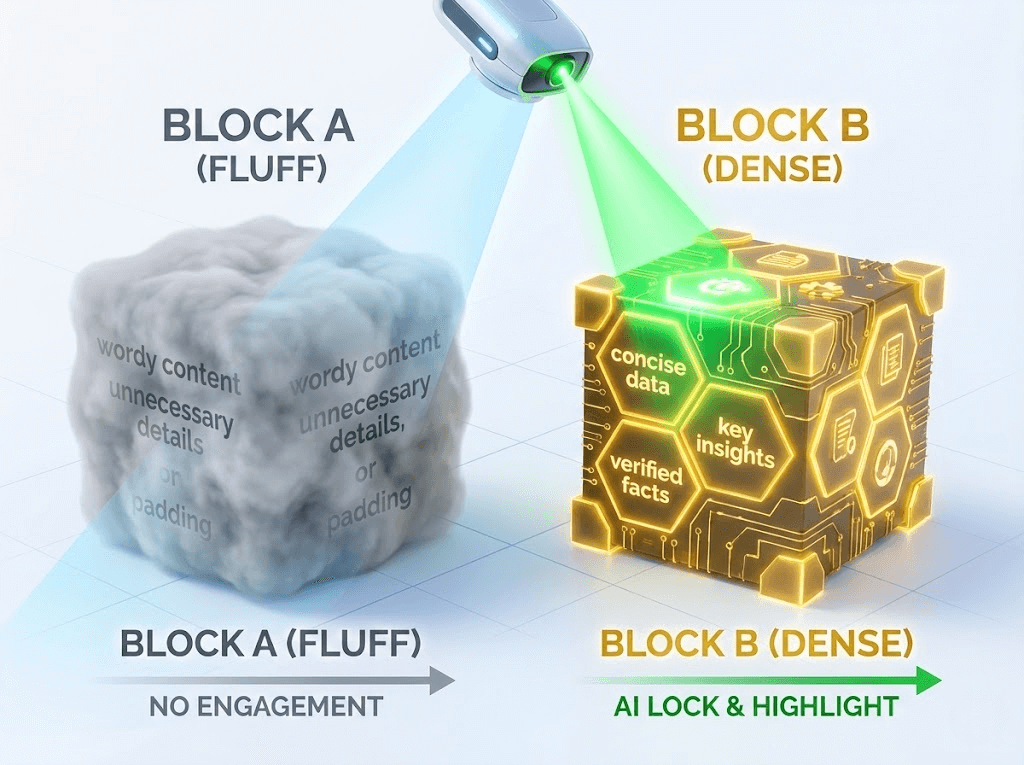
AI models have a limited "Context Window" and a bias towards "Information Gain." They want the most facts per token.
2.1 The Density Ratio
Low Density: "It is really important to note that maximizing your visibility is key to success." (15 words, 0 facts).
High Density: "Topify data shows that maximizing visibility increases lead quality by 30%." (12 words, 1 data source, 1 statistic).
2.2 Semantic Co-Occurrence
You don't need keyword stuffing; you need Contextual Vocabulary.
If you write about "CRM," the AI expects to see: Pipeline, Churn, ARR, Integration, Salesforce.
If these related entities are missing, the AI doubts your authority (E-E-A-T).
Decision Point: Measure your Information Density. If your content is full of "Stop Words" (really, very, essentially), strip them out. AI cites facts, not adjectives.
Part 3: Comparison Matrix – Traditional Blog vs. GEO Asset
How should your content templates change?
Feature | Traditional Content Marketing | GEO / AI-Ready Content |
Headline | Clickbait / Emotional ("Why You Fail") | Descriptive / Entity-Based ("Guide to X") |
Intro | Storytelling / Hook | Summary / Key Takeaways |
Structure | Wall of Text | Tables, Lists, Schema |
Style | Conversational / Subjective | Authoritative / Objective |
Length | 2,000+ Words (for dwell time) | As long as necessary (for density) |
Citations | External Links (to others) | Internal Data (Self-reference) |
Success KPI | Time on Page |
Key Insight: GEO content looks more like a Wiki or a Data Report than a standard blog post.
Part 4: Formatting as a Language
AI models "read" structure better than they read nuance. You can force an AI to understand your data by using the right HTML tags.
4.1 The Power of Tables
AI loves <table>. It is the easiest way for an LLM to extract comparative data.
Best Practice: Always use tables for Pricing, Feature Comparisons, and "Pros vs Cons."
Topify Data: Pages with comparative tables are 2x more likely to be cited in "Best X vs Y" queries on Perplexity.
4.2 List Logic
Use ordered lists (<ol>) for processes and unordered lists (<ul>) for features.
Why: It tells the AI: "This is a discrete set of items."
Tip: Keep list items parallel in structure (e.g., all start with a verb).
4.3 Citation Hooks
If you want to be cited, provide unique data.
Strategy: "According to [Brand] internal data..."
Why: AI models look for "Primary Sources." If you quote someone else, the AI cites them. If you quote yourself (with data), the AI cites you.
Decision Point: Review your content. Are you presenting data in paragraphs? Convert them to Tables immediately. Use Topify to check if these structural changes improve your ranking in AI responses.
Part 5: The Topify Optimization Loop
How do you implement this across a whole blog?
Step 1: Baseline Measurement
Use Topify to scan your current Share of Voice for "Informational Queries" (e.g., "How to..."). Identify pages that rank on Google but are invisible on AI.
Step 2: The "Refactoring" Sprint
Take those underperforming pages and apply the GEO Best Practices:
Add a TL;DR.
Convert prose to tables.
Inject unique statistics.
Step 3: Schema Injection
Ensure the page is wrapped in Article or FAQPage schema. This is the "label" on the package that tells the AI what's inside.
Step 4: Validate
Wait 2 weeks. Use Topify's Elastic Probing to re-test the queries.
Did your Sentiment improve?
Did you gain a Citation Slot?
Decision Point: Content marketing is no longer "Publish and Pray." It is "Publish, Probe, and Perfect." You need the feedback loop that Topify provides.
Part 6: Future-Proofing for "Agentic Retrieval"
In late 2026, AI Agents will browse the web for users. They won't read; they will parse.
6.1 The "Shadow DOM" Strategy
Best-in-class brands are beginning to serve two versions of content:
Visual: For humans (Storytelling, Images).
JSON-LD: For agents (Pure Data, Logic).
Topify helps brands monitor the health of this "Machine Layer." If your machine layer is clean, the agents will prefer you over competitors who force them to scrape messy HTML.
Conclusion: Respect the Machine
The shift to GEO does not mean "writing for robots" in the spammy sense of 2010 SEO.
It means respecting the machine's time.
AI models are the busiest readers in history. They process billions of tokens. They appreciate clarity, structure, and density. By adopting these GEO best practices, you aren't just optimizing for an algorithm; you are making your content better, clearer, and more useful for humans, too.
Topify is your editor-in-chief for this new era. We tell you when your content is clear enough to be the answer.
FAQ: GEO Content Strategy
Q: Do I have to rewrite all my old blog posts?
A: No. Use the Pareto Principle (80/20). Use Topify to identify the top 20% of pages that drive business value but have low AI visibility. Refactor those first.
Q: Will "Dense" content hurt my human readers?
A: Generally, no. Humans also appreciate "TL;DRs" and Summary Tables. The "Wall of Text" era is over for everyone. GEO best practices usually improve the User Experience (UX).
Q: Does word count matter for AI?
A: No. Information Density matters. A 500-word page packed with unique data is worth more to an LLM than a 3,000-word fluff piece. Stop paying writers by the word; pay them by the insight.
Q: How does Topify help with content creation?
A: Topify is not a writer; it is a Judge. It measures if your content is working. You write (or use tools like Goodie AI), and Topify validates the impact on brand visibility.