
For the past decade, the playbook for content marketing was clear: write a 2,000-word blog post, include the target keyword in the H1, and build backlinks. The goal was to rank on Page 1 of Google to drive clicks.
In 2026, the game has changed fundamentally. Users are increasingly turning to AI "Answer Engines" (like ChatGPT, Gemini, and Perplexity) that synthesize information into a single, direct answer. These engines do not care about your click-through rate; they care about your trustworthiness and machine readability.
This shift demands a new set of rules: Generative Engine Optimization (GEO).
Marketing leaders are asking, "What are best practice geo for content marketing?" The answer requires unlearning old habits. It is no longer about keeping users on your page; it is about providing the raw data (facts) that AI models need to construct their answers.
In this comprehensive guide, we explore the essential GEO best practices for content marketing that will define the winners of the AI search era.
Defining GEO Best Practices for Content Marketing
Before diving into tactics, we must define the objective. What are best practice geo for content marketing fundamentally trying to achieve?
Traditional SEO optimizes for Retrieval (finding the link). GEO optimizes for Synthesis (constructing the answer).
Therefore, the core best practice is to treat your content not as a "story" to be read by humans (though that still matters for conversion), but as a structured database of facts to be ingested by machines. Your goal is to make it computationally easy for an LLM to extract your brand's value proposition and cite it as a source of truth.
For a deeper understanding of the difference, read our guide on GEO vs SEO.
Structuring Content for AI Retrieval and RAG
Retrieval-Augmented Generation (RAG) is the mechanism AI engines use to fetch real-time data. To align with what are best practice geo for content marketing, your content structure must cater to RAG systems.
AI models have a limited "attention span" (context window). If your key insights are buried in paragraph 14, the AI might miss them.
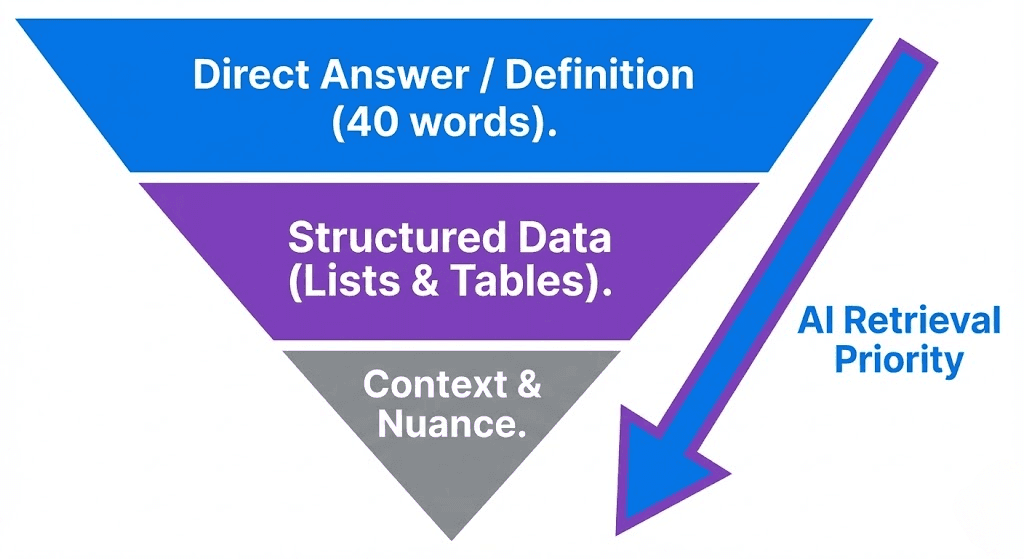
The "Inverted Pyramid" for AI: Start every section with the conclusion.
Direct Answer: If your H2 is "What is GEO?", the very first sentence should be a definition: "GEO is the practice of optimizing content for AI visibility..."
Supporting Data: Follow immediately with statistics or data points.
Nuance: Save the detailed explanation for later paragraphs.
Semantic Formatting: Use HTML tags to signal importance.
Lists: Use bullet points for features or steps. AI models prefer list structures over dense paragraphs.
Tables: Comparison tables are the gold standard for winning "Brand A vs Brand B" citations.
Quotes: Use blockquotes for expert opinions to signal authority.
Increasing Information Gain and Fact Density
Google and OpenAI prioritize content with high "Information Gain"—content that adds new facts to the knowledge graph rather than recycling existing ones.
When considering what are best practice geo for content marketing, Fact Density is the most critical metric.
Low Density (SEO Fluff):"It is important to choose the right software for your business to ensure you can grow effectively and manage your team." (Zero unique facts).
High Density (GEO Optimized):"Topify's 2026 benchmark report indicates that B2B SaaS companies using GEO strategies see a 24% increase in Perplexity citations." (High unique facts).
Best Practice: audit your content. Remove adjectives; add nouns and numbers. Every sentence should fight for its right to exist by providing a distinct entity or data point.
Establishing Entity Authority and Trust
In the probabilistic world of AI, "Authority" is calculated differently than in SEO. It is based on Entity Salience.
The AI must recognize your brand as a valid entity in its specific domain.
Citation Strategies:
Co-occurrence: Ensure your brand name appears alongside industry keywords (e.g., "Topify" + "AI Search") on third-party sites.
Consensus: AI models look for consensus across the web. If 10 reputable sources say your product is the "fastest," the AI will adopt that as a fact.
Digital PR: Focus on getting mentioned in reports and whitepapers, which are heavily weighted in LLM training data.
Learn more about tracking your authority in our review of AI search visibility tracking tools.
Leveraging Topify for Content Gap Analysis
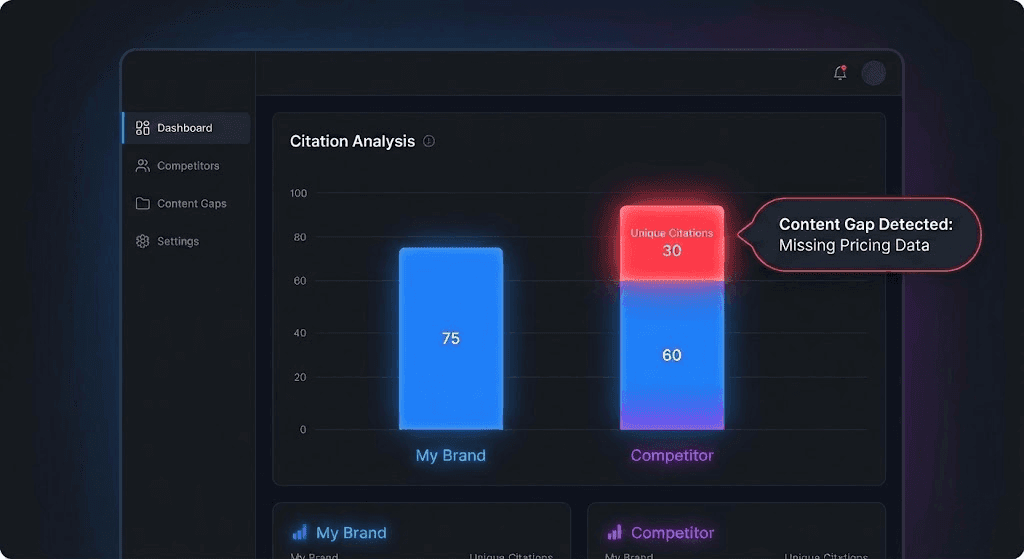
You cannot optimize what you cannot measure. A critical part of what are best practice geo for content marketing is using software to identify where you are losing citations.
Topify allows you to perform a "Gap Analysis" against your competitors in AI answers.
The Workflow:
Monitor Prompts: Track questions like "Best enterprise CRM" in Topify.
Analyze Competitor Citations: See which sources the AI is citing instead of you.
Identify Missing Facts: Is the competitor cited because they have a pricing page and you don't? Do they have a "Security Compliance" page?
Fill the Gap: Create specific content assets that provide the missing data points.
Topify’s Content Generation feature can even draft these assets using the optimal structure for RAG systems.
Comparison: Traditional Content Marketing vs. GEO Content Marketing
To clarify what are best practice geo for content marketing, here is a comparison of the old way versus the new way.
Feature | Traditional Content Marketing (SEO) | GEO Content Marketing (AI) |
Primary Goal | Clicks & Time on Site | Citations & Share of Voice |
Keyword Strategy | High Volume Keywords | Natural Language Prompts |
Writing Style | Storytelling & Length | Concise Facts & Structure |
Success Metric | Page 1 Ranking | |
Audience | Humans first, Crawlers second | Machines first, Humans second |
Tools Required | Ahrefs, SEMrush | Topify, Profound |
Measuring Success Beyond Traffic
The hardest adjustment for content marketers is the loss of direct attribution. In GEO, a "win" might not result in a click.
If a user asks "What is the best tool for X?" and the AI answers "Topify is the best tool because...", the user might go directly to your homepage or just absorb the brand impression.
New KPIs for GEO:
Mention Frequency: How often does your brand appear in answers?
Sentiment Score: Is the context positive or negative?
Citation Rate: How often is a link included (even if not clicked)?
For a step-by-step guide on measurement, read how to monitor brand visibility in AI.
Future-Proofing Your Content Strategy
As AI models evolve from GPT-4 to GPT-5 and beyond, they will become better at discerning truth from marketing spin.
The ultimate answer to what are best practice geo for content marketing is radical transparency and accuracy. Brands that publish original research, maintain consistent entity definitions across the web, and structure their data for machines will dominate the enterprise SEO visibility landscape.
Start by auditing your current content library with Topify today to ensure your brand is ready for the age of the answer engine.
Frequently Asked Questions About GEO Best Practices
Q1: What are best practice geo for content marketing in terms of length?
Length matters less than density. A 500-word article packed with unique data is better than a 2,000-word fluff piece. AI prefers concise, high-entropy content.
Q2: Should I rewrite all my old blog posts?
Prioritize high-traffic posts or those targeting "What is" questions. Add direct answer definitions at the top and convert paragraphs into tables where possible.
Q3: Can Topify help with content creation?
Yes. Topify includes GEO-focused content generation tools that help you draft articles with the correct structural elements (lists, bolding, definitions) that LLMs favor.
Q4: Is GEO only for B2B?
No, but B2B sees higher impact because queries are often research-heavy (e.g., "Compare X vs Y"). However, B2C brands are also affected by product recommendation queries.
Q5: How does schema markup fit into GEO best practices?
Schema is critical. It is the most direct way to speak to the machine. Use Article, FAQPage, and Product schema to ensure the AI understands your entities without ambiguity.