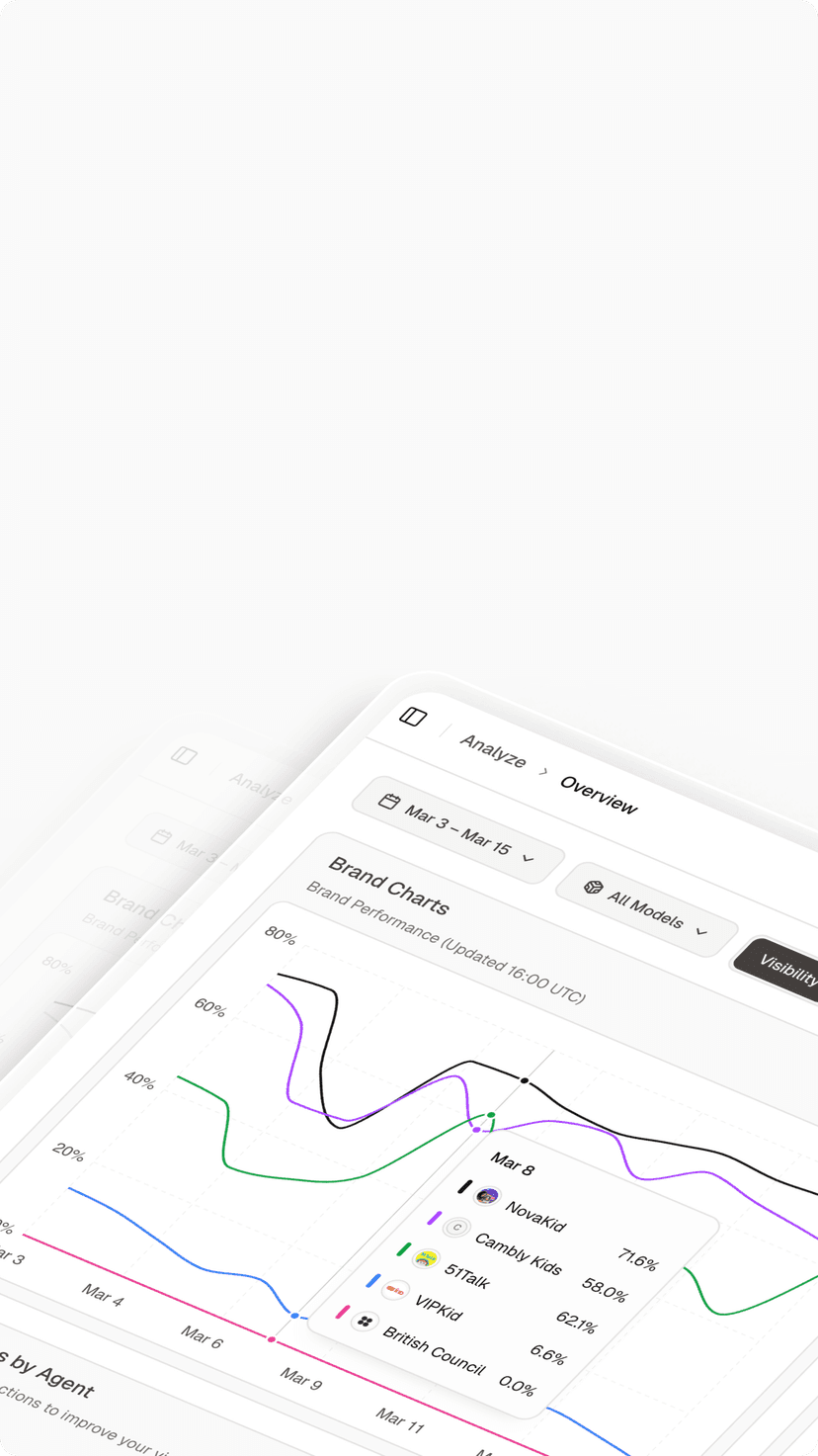
Step-by-Step: How to Audit Brand Visibility on LLMs
Manual auditing is impossible due to the “Stochastic” (random) nature of AI. You need a dedicated AI brand visibility tool. Here is the workflow using Topify.
Phase 1: The “Unbranded” Category Audit
Goal: Determine if you are part of the AI’s “Consideration Set.”
Action: Input 50 generic prompts related to your industry into Topify (e.g., “Top 5 project management tools for agencies”).
Analysis: Topify will run these prompts across ChatGPT-4o, Claude 3.5, and Perplexity.
Metric: Category Presence Rate. (e.g., “We appear in 30% of category recommendations.”)
Phase 2: The “Branded” Reputation Audit
Goal: Detect hallucinations and sentiment issues.
Action: Input specific navigational prompts (e.g., “Is [Brand Name] secure?”, “What are the cons of [Brand Name]?”).
Analysis: Look for “Hallucination Flags” in the Topify dashboard.
Correction: If the AI claims you lack a feature you actually have, this is a content gap you must fill on your website using Schema Markup.
Phase 3: The Competitor Head-to-Head
Goal: Understand why you are losing.
Action: Use Topify’s competitor tracking features to run a side-by-side comparison.
Insight: Does the competitor have more citations from high-authority sources like Wikipedia or G2?
Analyzing the Data: The Audit Scorecard
Once Topify completes the scan, you need to organize the data. Use this scorecard template to report to stakeholders.
Metric
Definition
Good Score
Critical Flag
Entity Confidence
How accurately the AI describes your core offering.
>90% Accuracy
AI calls you by a wrong category.
Share of Voice
Frequency of appearance in “Best of” lists.
>40% Presence
<10% (Invisible).
Sentiment Score
The qualitative tone of the mention (-100 to +100).
>75 (Positive)
<50 (Neutral/Negative).
Hallucination Rate
Percentage of answers containing false info.
<5%
>20% (Reputation Risk).
Choosing the Right AI Brand Visibility Tool
You cannot perform this audit with Google Search Console. You need specialized software.
Topify is the industry standard for this specific task because:
Multi-Model coverage: It audits ChatGPT, Gemini, and Perplexity simultaneously.
Historical Benchmarking: It shows you if your visibility is trending up or down over time.
Citation Forensics: It traces the exact URL the AI used to generate the answer, allowing you to fix the source.
For a comparison of other tools in the market, read our review of best tools for tracking brand visibility.
From Audit to Action: Fixing the Gaps
An audit is useless without a remediation plan. Here is how to fix the issues you find.
Scenario A: Low Entity Salience
Diagnosis: The AI doesn’t know you.
Fix: You need “Knowledge Graph Optimization.” Update your “About Us” page, Wikipedia entry, and Crunchbase profile. Ensure your brand entity is clearly defined in structured data.
Scenario B: Negative Sentiment
Diagnosis: The AI calls your product “glitchy.”
Fix: The AI is likely pulling from an old forum thread. You need to flood the context window with fresh, positive reviews on trusted third-party sites like Capterra or Trustpilot.
Scenario C: Losing Share of Voice
Diagnosis: Competitors appear in the “Top 5” list, but you don’t.
Fix: Your content lacks “Listicle Structure.” Rewrite your comparison pages to be more direct and data-heavy, making it easier for the AI to extract your features.
Resource: Learn more in our content engineering guide.
The Future of Brand Auditing: “Persona-Based” Audits
As we look toward late 2026, audits will become more granular. You won’t just audit “ChatGPT”; you will audit “ChatGPT for a CFO Persona” vs. “ChatGPT for a Developer Persona.”
Topify is already pioneering this advanced AI search optimization strategy, allowing brands to see how their reputation shifts depending on who is asking the question.
Conclusion: Visibility is Liability (Until Audited)
In the generative age, what you don’t know can hurt you. An unchecked AI model recommending your competitor is a silent revenue leak.
By learning how to audit brand visibility on LLMs today, you turn this risk into an asset. You gain control over your narrative in the most influential channel of the decade.
Don’t guess. Audit. Use Topify to shine a light into the black box and secure your brand’s future.
FAQs:
How often should I conduct an AI Brand Audit?
We recommend a “Deep Audit” quarterly and “Pulse Checks” weekly. AI models update their weights and retrieval sources frequently. A weekly check with an AI brand visibility tool ensures you catch hallucinations before they spread.
Can I remove my brand from an AI model?
Generally, no. Once you are in the training data, you are there. However, you can use robots.txt to block future scraping, though this is often counterproductive as it ensures the AI only has old data about you. The better strategy is optimization, not removal.
Why does the AI say my pricing is wrong?
This is a common hallucination caused by the AI reading outdated pricing pages or third-party reviews. Use Topify to identify the source of the misinformation and update it with a “Last Updated: 2026” timestamp to signal freshness.
Does social media affect my AI audit scores?
Yes. Models like Grok (Twitter/X) and Google Gemini (YouTube/Reddit) ingest social data in real-time. A viral negative thread can tank your sentiment score overnight.
What is the difference between an SEO Audit and a GEO Audit?
An SEO audit checks technical site health (speed, links). A GEO (Generative Engine Optimization) audit checks information accuracy and entity relationships. It is more akin to PR than engineering.