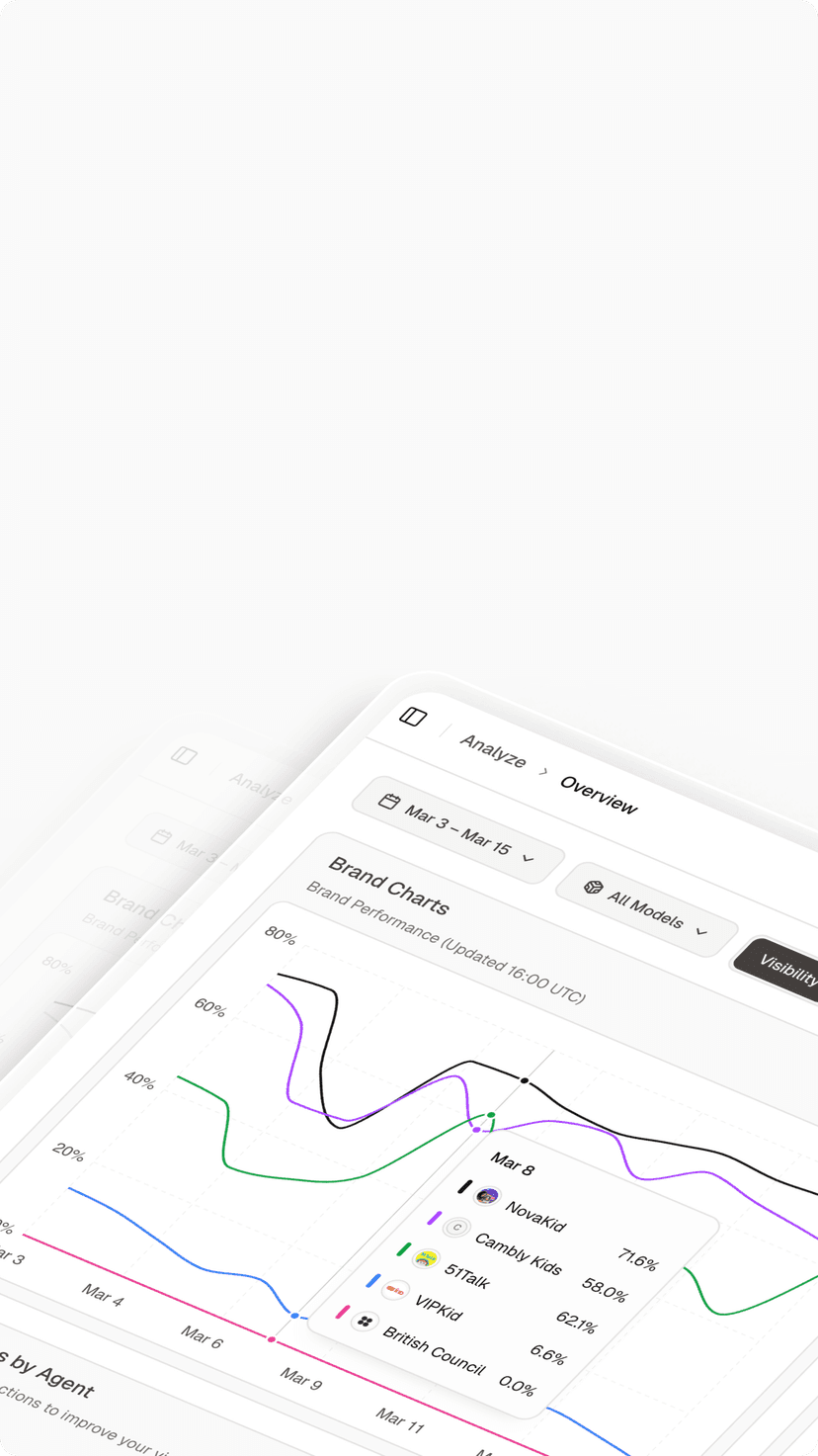
Defining the New KPIs: Citation Growth vs. Rank Position
In the generative web, a single number cannot capture performance. Here are the five metrics that actually matter.
1. Snapshot Trigger Rate (STR)
How often does an AI Overview actually appear for your target keywords?
Calculation: (Queries with AI Overview / Total Queries Checked) * 100.
Why it matters: You cannot rank in an AI Overview if Google isn’t generating one. Knowing the STR helps you prioritize keywords worth optimizing. Informational queries often have an STR above 80%, while transactional queries may vary.
2. Citation Presence (CP)
If an AI Overview triggers, is your brand cited? This is the new “Rank #1.”
Metric: Citation Rate = (Total Citations / Total Snapshots Triggered).
Goal: Aim for a CP >40% for core brand terms. Anything less implies the AI prefers a competitor’s data source.
3. Citation Growth Velocity
This measures the change in citation frequency over time. It is a leading indicator of future traffic.
Goal: If you applied our content engineering strategies last month, positive velocity proves the model is “learning” your content.
4. Sentiment Score & Velocity
Topify uses NLP to grade the sentiment of the text surrounding your citation (-100 to +100).
Sentiment Velocity: Tracking the rate of change in sentiment is crucial. A rapid drop in sentiment velocity often predicts a removal from the AI snapshot before it actually happens, giving you time to react.
5. Share of Model (SoM)
Unlike Share of Voice, SoM measures how much of the AI’s context window is dominated by your brand entities. Are you mentioned once, or are you the primary subject of the generated answer?
Step-by-Step: How to Track AI Overviews Rankings with Topify
Manually checking Google is impossible due to personalization. You need an automated system.
Step 1: Isolate “Generative Keywords”
Use Topify to filter your keyword list for “AI-Triggering Queries.” Focus on complex, informational queries (e.g., “how to integrate CRM”) rather than simple navigational terms, as these trigger the most citation opportunities.
Cluster Strategy: Group keywords by intent. Transactional AI queries often feature carousels, while informational ones favor text citations.
Step 2: Configure “Snapshot” Monitoring
Set Topify to analyze priority keywords daily. Unlike static SERPs, AI answers change frequently based on new data ingestion (RAG). You need a historical record to detect if your brand is dropped.
Location Variance: AI Overviews are highly localized. Ensure your tracking is set to the specific regions (e.g., US-NY vs. UK-London) relevant to your market, as the AI’s source selection can differ wildly by geography.
Step 3: Segment by Citation Type
Topify distinguishes visibility value:
Text Citation (Gold Standard): Brand mentioned in the paragraph. Highest authority.
Carousel Link (Traffic Driver): Content in the horizontal scroll. Highest CTR.
Expansion Link (Deep Dive): Visible only after clicking “Show More.” Lower visibility.
Advanced Analytics: Measuring Citation Growth Over Time
Citation Growth is a lagging indicator of Authority. Here is how to analyze it.
The “Authority Lag” Phenomenon
Topify data shows an average “Authority Lag” of 14-21 days between publishing content and seeing it cited in an AI Overview. Don’t panic; track the trend, not the day.
Correlating Optimization with Growth
Use Topify’s annotation feature to mark when you optimized a page (e.g., added Schema Markup). Look for a correlation between that date and an upward trend in Citation Presence weeks later. This proves your complete GEO strategy framework is working.
Content Decay Tracking
AI models “forget” content that isn’t refreshed. Use Topify to monitor Content Decay. If a high-performing citation suddenly drops, it often means the AI considers your data “stale.” Refreshing the publication date and stats can often restore the ranking within 48 hours.
Competitor Share of Voice (SoV)
Are you growing, or is the market shrinking? Overlay your Citation Growth against competitors in Topify. If they are growing faster, audit their “Information Gain” tactics.
The Economics of AI Visibility: ROI Calculation
If clicks go down but citations go up, are you winning? Yes, if you measure “Qualified Visitor Value.”
Visitors clicking an AI Citation are “Pre-Qualified.” They have consumed the summary and want deep details. Formula: (AI Citation Traffic * Conversion Rate) * Lifetime Value (LTV). Most brands find AI Citation Traffic converts 2x-3x higher than standard search traffic.
Diagnosing Drops: When AI Rankings Disappear
One day you are cited; the next day you aren’t. Common causes:
Information Redundancy: If another site publishes your data but formats it better (e.g., in a table), Google may swap them in. Fix: Update with fresh, unique data.
Sentiment Shift: Negative reviews can cause the AI to remove you to protect its credibility. Fix: Monitor sentiment in Topify.
Structural Confusion: Broken H2/H3 hierarchies confuse the LLM. Fix: Re-validate with our technical SEO checklist.
Algorithm Volatility: Google frequently updates its RAG thresholds. If you see a global drop, check Topify’s “Market Volatility” index to see if it’s a system-wide update or specific to your brand.
Conclusion
Your CFO cares about growth. By shifting reporting from “Organic Traffic” to “Citation Growth,” you align KPIs with reality.
You cannot manage what you cannot measure. Use Topify to gather the granularity needed to prove your GEO efforts are driving value.
FAQs:
1. Can Google Search Console track AI Overviews?
GSC data is aggregated and lacks detail. It tells you that you appeared, but not how (text vs. carousel) or the sentiment. You need a dedicated tool like Topify.
2. What is a good “Citation Rate”?
For informational queries, 20-30% is excellent. For navigational queries (e.g., your brand name), it should be near 100%.
3. Why does Citation Growth fluctuate?
AI models are probabilistic. They re-generate answers to test quality. Focus on the 30-day moving average rather than daily spikes.
4. Does Citation Growth correlate with sales?
Yes. Users clicking AI citations convert at a higher rate because the AI has pre-qualified the answer for them.
5. How much does Topify cost?
Topify offers scalable pricing. Startups can begin with the essential pack detailed in our startup tool stack guide.
6. Can I track competitor rankings?
Absolutely. Topify allows you to input competitor domains to see their visibility for your keywords, helping you identify “Gap Analysis” opportunities.