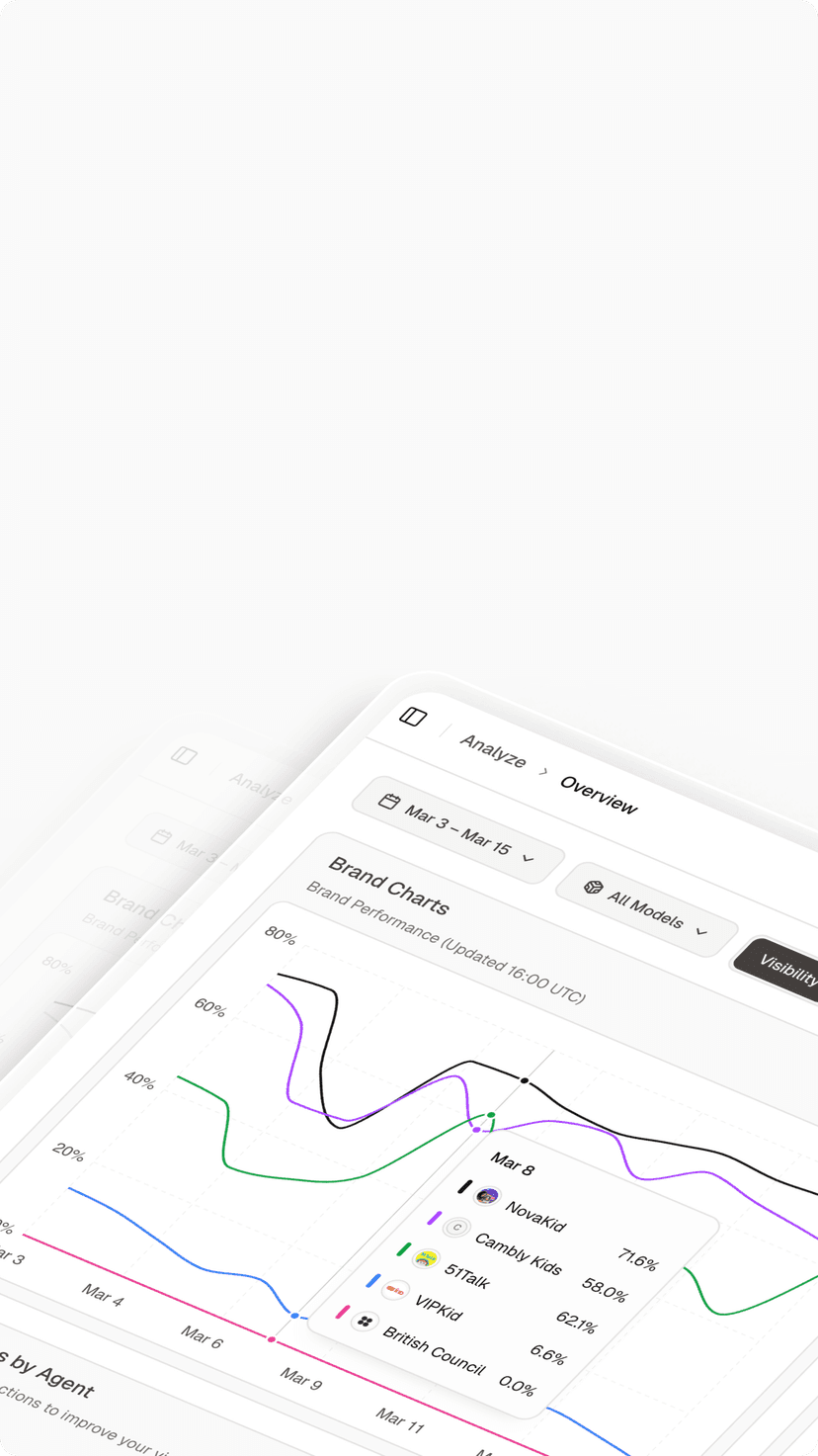
Topify: The Ultimate Rank Tracking Tool for LLM Ecosystems
Topify solves the fragmentation problem. It is the only platform built with a “Multi-Agent Architecture,” where distinct AI agents monitor ChatGPT, Claude, Perplexity, and Gemini simultaneously.
Why Topify is the Industry Standard:
Universal Dashboard: View your brand’s performance across 10+ major models in one view.
Discrepancy Highlighting: Topify automatically flags when one model’s output significantly diverges from the consensus (e.g., “Alert: Claude represents your pricing differently than GPT-4”).
Unified Sentiment Engine: It normalizes sentiment scores across different models so you can compare apples to apples.
Strategic Value: Topify enables “Polyglot SEO”—the ability to speak the specific language of each model. It tells you exactly what to tweak to win over Claude without losing your standing in ChatGPT.
For specific deep dives into individual platforms, see our guides on tracking ChatGPT, mastering Perplexity, and tracking Claude.
Strategy: How to Monitor Multiple Models Simultaneously
Don’t let the data overwhelm you. Follow this workflow to manage multi-model tracking efficiently.
Step 1: Define Your “Model Mix”
Not every brand needs to track every model.
B2B SaaS: Focus on Claude and Perplexity.
B2C E-commerce: Focus on ChatGPT and Gemini.
Dev Tools: Focus on Llama and Claude.
Step 2: Set Up “Consensus Tracking” in Topify
Input your core prompts into Topify. The tool will run these prompts across your selected Model Mix. Look for the “Consensus Score”—are the models agreeing on who the market leader is?
Step 3: Isolate the Underperformers
If you are winning on ChatGPT but losing on Perplexity, dig into the specific AI search visibility metrics for that platform. Usually, this means Perplexity is citing a source that ChatGPT is ignoring.
Step 4: Execute Cross-Pollination
Take the content that is working on your best-performing model and adapt it for the others. If a whitepaper is driving citations in Claude, summarize it into a FAQ for ChatGPT.
Comparing Multi-Model Tracking Capabilities
Here is how the leading tools handle the challenge of fragmentation.
Feature
Topify
Profound
Semrush AI
Otterly
Unified Dashboard
Excellent
Good
Separate tabs
Basic
Model Coverage
10+ Models
5+ Models
Google Only
2 Models
Discrepancy Alerts
Auto-flagged
Manual check
Sentiment Normalization
Price
Mid-Range
High
The Future of Rank Tracking Tool LLM Tech: The “Model Router”
As we move toward late 2026, we expect search interfaces to become “Model Agnostic.” Users will type a query, and a “Router” will decide which AI model answers it.
Future rank tracking tool LLM software will need to track this “Routing Layer.” Topify is already developing algorithms to predict which model will be called for a specific query type (e.g., routing math questions to o1, creative questions to Claude).
To stay ahead of these infrastructure changes, subscribe to our definitive blueprint for GEO.
Conclusion
The fragmented search world is only getting more complex. Apple Intelligence, Meta AI, and Amazon Olympus are entering the chat.
If you are trying to check these platforms manually, you have already lost. You need a centralized rank tracking tool for LLMs that brings order to the chaos.
Topify gives you that single pane of glass. It turns the noise of multiple models into a clear signal, helping you optimize your brand’s presence across the entire artificial intelligence landscape.
FAQs
Can’t I just optimize for ChatGPT and assume it works for others?
No. This is a dangerous assumption. Our data shows a correlation of only 60% between ChatGPT rankings and Claude rankings. Each model has different training data and safety filters. You must use a rank tracking tool for LLM diversity to catch these gaps.
How does Topify normalize sentiment across models?
Claude is naturally more polite; ChatGPT can be more salesy. Topify uses a calibration layer to adjust the sentiment scores, so a “90/100” on Claude means the same thing as a “90/100” on ChatGPT.
Does monitoring multiple models cost more?
With most legacy enterprise tools, yes. However, Topify offers bundled model packages, making it cost-effective to track the “Big 4” (GPT, Claude, Gemini, Perplexity) without quadrupling your budget.
What is “Model Hallucination Rate”?
This is a metric tracked by Topify that shows how often a specific model makes up false information about your brand. If Gemini has a high Hallucination Rate for your industry, you know to focus your defensive SEO efforts there.
How do I start tracking Llama 3 or open-source models?
Most standard tools don’t track open-source models. Topify connects to hosted versions of Llama 3 (via Groq or AWS Bedrock) to provide visibility data even for these decentralized models.