
Your domain authority is solid. Your keyword rankings are holding. But none of that tells you whether Perplexity is recommending your competitor instead of you, or whether ChatGPT describes your product in a way that matches your actual positioning.
Search "AI search monitoring tracking tools" and you'll find a growing list of platforms claiming to solve this. Half of them only cover one AI platform. The other half surface dashboards full of metrics with no guidance on what changed or why. Meanwhile, AI-driven clicks are growing at 700% year-over-year, and last month's data is already stale.
The real question isn't whether you need to track AI search visibility. It's whether you're measuring the right things, on the right platforms, with the right frequency.
Your Brand Might Already Be Invisible to ChatGPT. Here's Why That's a Problem Now.
ChatGPT now handles 2.5 billion prompts per day and has surpassed 800 million weekly active users. Google's global traffic share has dropped from 89% in 2023 to roughly 71% by Q4 2025, while ChatGPT alone accounts for approximately 20% of global search share.
That's not a trend. That's a structural shift in how decisions get made.
Consumers are increasingly turning to ChatGPT, Perplexity, and Google's AI Mode to get synthesized, conversational answers to product and vendor questions. When they do, they're not browsing a list of links. They're getting a direct recommendation. Either your brand is in that recommendation, or it isn't.
The gap between awareness and action is stark. While 91% of decision-makers have asked about their brand's AI visibility in the past year, only 16% of Fortune 500 consumer brands are systematically tracking their AI search performance, according to McKinsey. The remaining 84% are flying blind.
That's the gap most brands still haven't closed.
What AI Search Monitoring and Tracking Actually Covers
AI search monitoring tracking is the systematic practice of measuring how a brand appears in AI-generated answers across platforms like ChatGPT, Gemini, Perplexity, and DeepSeek. It covers frequency of mention, position relative to competitors, the sentiment of how the brand is described, and what sources AI engines are pulling from.
It's not a single metric. It's a multi-dimensional framework.
The most comprehensive monitoring systems track seven core dimensions: visibility (how often you appear), sentiment (how you're described), position (where you rank among mentioned brands), volume (the scale of AI queries relevant to your category), mentions (raw brand reference count), intent alignment (which funnel stage the prompts belong to), and conversion visibility rate (the estimated likelihood that an AI answer drives a user toward your brand).
Together, these build a picture of your brand's "AI presence score," which is something traditional SEO tools aren't built to generate.
ChatGPT Search Tracking Is Not the Same as Google Rank Tracking
This is the most important distinction to understand before choosing any tool or building any process.
Google rank tracking is deterministic. A page either ranks at position 3 for a keyword or it doesn't. The result is consistent across queries, users, and time windows. Tracking it is straightforward: input keyword, get rank.
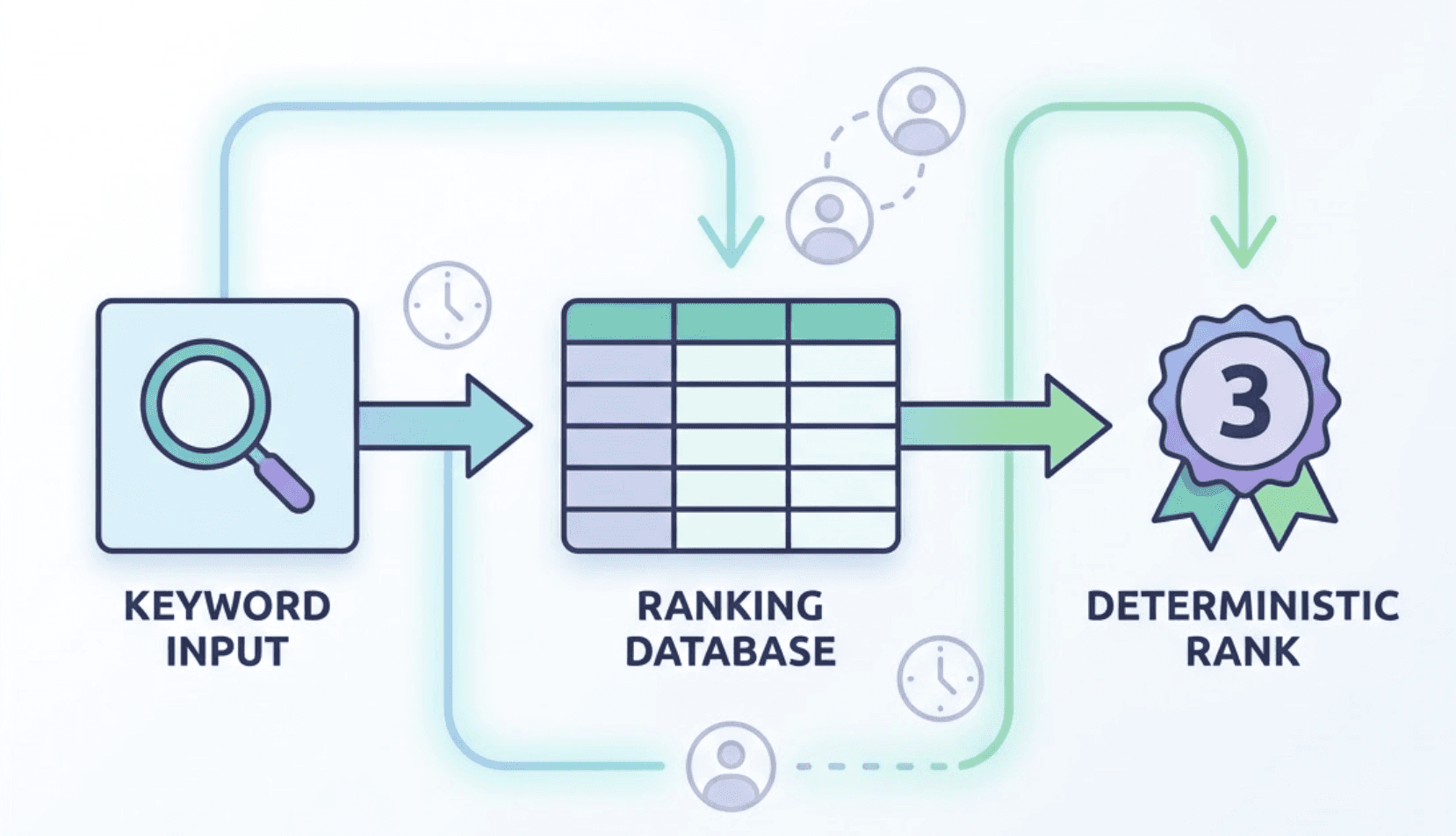
ChatGPT search tracking is probabilistic. The same prompt can generate meaningfully different responses depending on timing, user session context, and model updates. There's no fixed "position 1." There's only a probability that your brand gets mentioned, and the relative prominence of that mention within the generated text.
That's why prompt-based tracking exists. Instead of querying a fixed index, AI monitoring tools run a defined set of prompts repeatedly to build a statistical picture of brand visibility. The AI prompt average length is 23 words, versus 3.4 words for traditional search queries. This means tracking inputs look less like "best CRM software" and more like "what's the best CRM for a mid-sized B2B company that needs Salesforce integration and strong reporting?"
The methodology shift is significant. Monitoring has to move from "what rank did we get" to "what percentage of relevant AI responses included our brand, and how prominently?"
Harvard research found that 44% of AI search users now use these platforms as their primary source for insights, outpacing traditional search at 31% and brand websites at 9%. Brands that don't adapt their tracking methods will simply not see this audience.
The 5 Metrics That Make AI Search Monitoring Actually Useful
Not all monitoring dashboards are equally actionable. These five metrics tend to drive the most useful decisions.
Visibility Rate is the headline number. It measures the percentage of relevant AI responses in which your brand appears. A rate below 5% typically signals that your content lacks the authority or structural clarity that AI retrieval systems favor. Rates above 30% in a competitive category suggest strong positioning.
Positioning Index tracks where your brand appears within multi-brand responses. Research indicates that brands mentioned in the first two sentences of an AI answer receive 5x the consideration of brands listed further down. Being the third name on a list matters far less than being the first recommendation.
Sentiment Score captures whether AI describes your brand positively, neutrally, or negatively. This isn't just a reputation metric. If AI consistently describes your enterprise product as "great for small teams," that misalignment actively undercuts your positioning with the buyers you're targeting. Identifying and correcting these narratives requires tracking, not guesswork.
Source Citations reveal which domains AI is pulling from when it mentions your brand. Only about 5% to 10% of AI citations point directly to brand-owned websites. The rest come from third-party publications, review sites, forums, and industry media. Knowing which external channels feed AI answers tells you where to focus your PR and content distribution.
Competitive Gap Analysis is the most immediately actionable metric. It identifies the specific prompts where competitors appear and you don't. By analyzing what content those competitors are being cited for in your absence, you can identify precise content gaps worth closing.
ChatGPT Search Rank Tracking Tools: What to Look for Before You Commit
The market for chatgpt search rank tracking tools is growing quickly, and the differences between platforms matter more than they might initially appear.
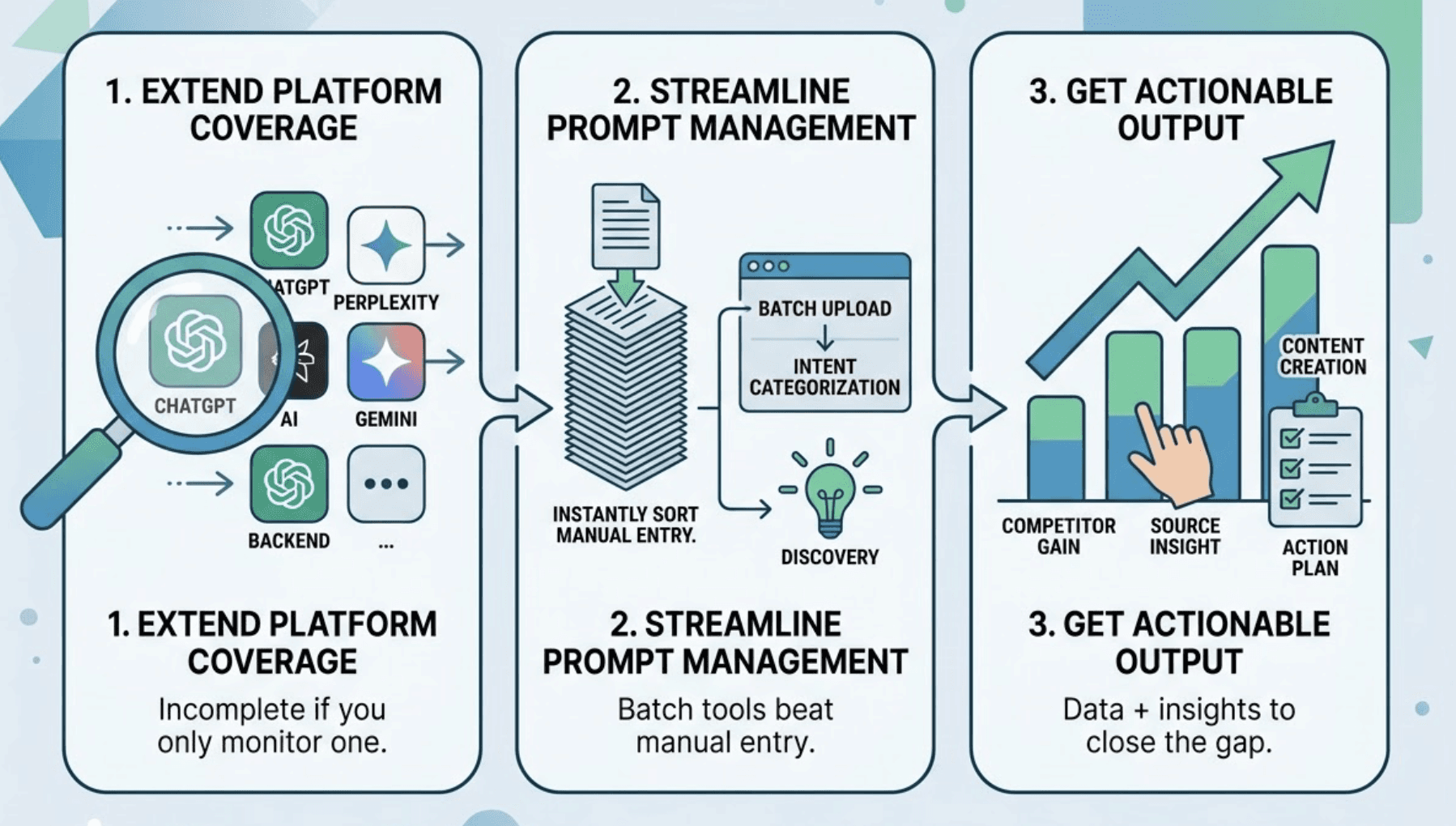
The first thing to evaluate is platform coverage. A tool that only monitors ChatGPT gives you an incomplete picture. Your audience is also on Perplexity, Gemini, and increasingly on AI-native tools built on multiple LLM backends. Limiting tracking to one platform means missing visibility gaps on others.
The second is prompt capacity and management flexibility. Your monitoring system is only as good as the prompts you're running. Tools that support batch upload, intent-based categorization, and prompt discovery from actual search data give you a significant methodological advantage over tools that require manual prompt entry one at a time.
The third is whether the tool provides actionable output or just data. Dashboards that show you a drop in visibility are useful. Dashboards that also tell you which competitor gained, which source drove the change, and what content you'd need to publish to close the gap, are valuable.
Here's how the main categories of tools compare on these dimensions:
Traditional SEO Tools (e.g., Ahrefs) | Manual Tracking | ||
|---|---|---|---|
Tracking logic | Intent-based prompt probing | Keyword-based SERP simulation | Ad hoc manual checks |
AI platform coverage | 7+ platforms (ChatGPT, Gemini, Perplexity, DeepSeek, and more) | Limited to Google AI Overviews | Very low |
Sentiment analysis | Entity-level sentiment modeling | Basic keyword matching | Subjective |
Starting price | $99/month | $500 to $800+/month | $0 (but high labor cost) |
Optimization guidance | Automated content gap analysis | Traditional SEO recommendations | None |
For teams evaluating chatgpt search tracking specifically, the platform coverage and prompt flexibility differences are usually what determines whether a tool is actually useful versus just visually impressive.
How to Set Up AI Search Monitoring Tracking in 3 Steps
The most common mistake teams make is starting with their brand name as the only prompt. That tells you almost nothing useful about competitive positioning or category visibility.
Step 1: Build a prompt library by intent, not by keyword.
Organize prompts into three buckets. Category-level prompts cover the space your brand operates in ("what's the best platform for tracking brand visibility in AI search?"). Competitive comparison prompts directly surface how AI positions your brand against alternatives ("how does [Brand A] compare to [Brand B] for enterprise teams?"). Use-case prompts capture specific problem scenarios your buyers describe ("how do I know if my brand is appearing in ChatGPT answers?"). Starting with 20 to 50 prompts across these three categories gives you a meaningful baseline. For larger brands with multiple product lines, 100 to 500 prompts are needed to get statistically reliable data across funnel stages.
Step 2: Define which platforms to prioritize.
ChatGPT still accounts for the majority of AI search volume, making it the logical starting point. Perplexity tends to have higher click-through rates on cited sources, making it valuable for understanding source attribution. Gemini draws on Google's Knowledge Graph, which gives it different citation patterns and makes it particularly relevant for brands with strong SEO authority. Running all three simultaneously from the start gives you a more complete picture than sequencing them.
Step 3: Establish a baseline before optimizing anything.
Publish no new content, run no new campaigns. Instead, run your full prompt set across target platforms and record your current visibility rate, positioning index, sentiment score, and top cited sources. That's your benchmark. Without it, you can't measure whether subsequent content or PR efforts actually moved the needle.
Topify's prompt discovery feature helps accelerate Step 1 by surfacing high-potential long-tail prompts from Google Search Console data, giving teams a practical starting point rather than building a prompt library from scratch.
Software to Measure ChatGPT Search Visibility: Topify in Practice
For teams specifically looking for software to measure ChatGPT search visibility, the decision usually comes down to depth of coverage and what happens after you see the data.
Here's what a realistic Topify workflow looks like for a SaaS brand entering this space.
The team inputs a set of target prompts into Topify and routes them to ChatGPT 4o and Perplexity models. The initial report shows a visibility rate of 12% on their core category prompt, while a competitor holds 45% on the same prompt. That's a meaningful gap, but the useful part isn't the number. It's what comes next.
Topify's AI agent analyzes the responses where the competitor appears and the brand doesn't. It finds that the competitor is being cited for an original research report on AI search metrics that AI engines reference frequently. The brand has no comparable authoritative asset in that topic area.
That's a clear content signal. The team publishes a structured white paper using JSON-LD entity markup and a clean Q&A format built for AI retrieval. Four weeks later, Topify's tracking shows visibility on that prompt has climbed from 12% to 28%, with sentiment also improving as the new content shifts how AI describes the brand's expertise.
The loop is: measure, diagnose, act, remeasure. Most tools cover the first step. The value of purpose-built platforms is compressing the gap between measurement and action.
Topify's pricing starts at $99/month on the Basic plan, which covers ChatGPT, Perplexity, and AI Overviews tracking across 100 prompts and 9,000 AI answer analyses. For teams managing multiple brands or larger prompt sets, the Pro plan at $199/month expands to 250 prompts and 22,500 analyses.
Visitors from AI-cited sources tend to convert at roughly twice the rate of traditional search visitors, which means even modest improvements in visibility can produce measurable revenue impact when attribution is set up correctly.
Conclusion
AI search monitoring tracking isn't a future-state initiative. For brands in competitive categories, it's already the gap between being recommended and being invisible at the moment a potential buyer is forming their decision.
The fundamental shift is from rankings to recommendations. Traditional SEO tracked where your page appeared on a list. AI search tracking measures whether your brand gets cited as an answer. Those are different games, and they require different tools, different metrics, and a different measurement cadence.
Start with a defined prompt library. Establish a baseline across the platforms your buyers use. Track the five metrics that drive actual decisions: visibility rate, positioning, sentiment, source citations, and competitive gaps. Then use that data to target the specific content areas where competitors are earning citations you're not.
Get started with Topify and run your first AI visibility audit in under 10 minutes.
FAQ
Q: What is AI search monitoring and tracking?
A: It's the systematic process of measuring how a brand appears in AI-generated answers across platforms like ChatGPT, Gemini, and Perplexity. This includes tracking how frequently a brand is mentioned, where it appears relative to competitors, how AI describes the brand (sentiment), and which sources AI engines cite when referencing it. Unlike traditional SEO rank tracking, AI search monitoring uses prompt-based probing rather than keyword-position lookups, because AI answers are probabilistic and dynamic rather than fixed.
Q: How is ChatGPT search tracking different from Google SEO tracking?
A: Google SEO tracking is deterministic. A page ranks at a specific position for a specific keyword, and that result is consistent and repeatable. ChatGPT search tracking is probabilistic. The same prompt can generate different responses at different times, so tracking requires running prompts repeatedly at scale to build a statistical view of brand visibility. Also, the inputs are different: AI prompts average 23 words versus 3.4 words for traditional search queries, which means the monitoring methodology has to shift from keyword matching to intent-based prompt engineering.
Q: What software can measure ChatGPT search visibility?
A: The main categories are AI-native monitoring platforms, traditional SEO tools with AI add-ons, and lightweight trackers. AI-native platforms like Topify offer multi-platform coverage (ChatGPT, Gemini, Perplexity, DeepSeek, and others), built-in sentiment and competitive analysis, and automated content gap recommendations. Traditional SEO platforms have added AI visibility features, but most are limited to Google's AI Overviews and don't cover third-party AI search platforms. Lightweight trackers can work for small-scale monitoring but tend to lack the depth needed for competitive analysis.
Q: How many prompts do I need to track to get meaningful AI visibility data?
A: For most focused use cases, like a single SaaS product in a defined category, 20 to 50 prompts covering category queries, competitive comparisons, and use-case scenarios is a practical starting point. For enterprise brands with multiple product lines or broader category footprints, 100 to 500 prompts are typically needed to get statistically reliable data across different funnel stages and buyer intents. The quality of prompt selection matters more than raw quantity. Prompts that reflect actual buyer language and decision-stage questions will produce more actionable data than generic keyword-based prompts.