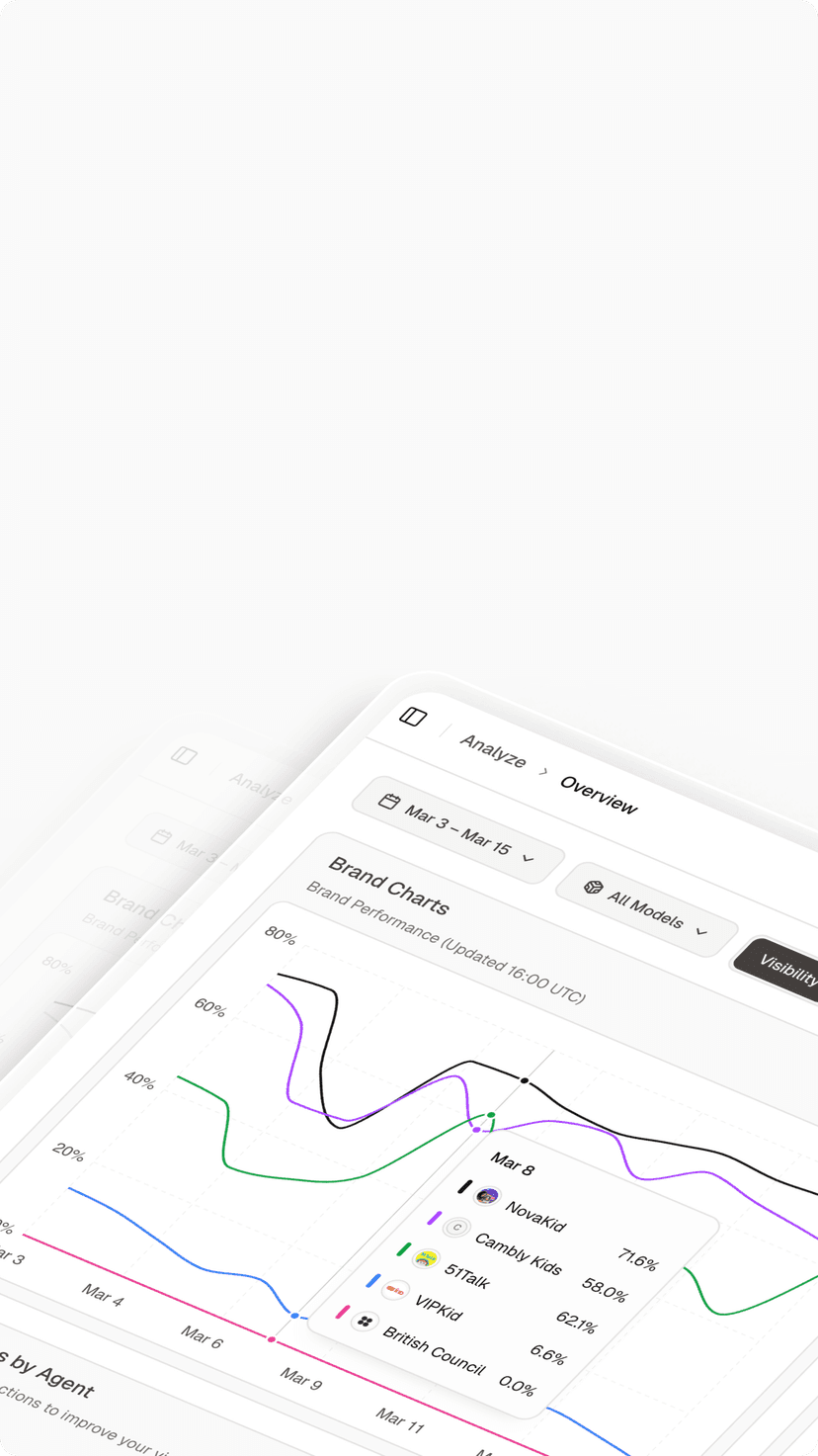
The era of a single, dominant search engine is coming to an end. While Google still maintains a significant share of traditional search traffic, the high-intent "discovery" phase of the buyer journey is rapidly fragmenting. Users are now bifurcating their queries: they go to Perplexity for real-time research, ChatGPT for creative synthesis, Gemini for ecosystem-integrated tasks, and Claude for technical or long-form reasoning.
For global brands, this fragmentation creates a profound visibility crisis. A brand might be a "Primary Answer" in ChatGPT but remain completely "Invisible" in Perplexity. To navigate this, enterprises must adopt a Multi-Model Tracking Strategy. This guide explores the technical methodologies for measuring brand visibility across diverse LLMs and provides a roadmap for using Topify to maintain a consistent and dominant AI Share of Voice (SOV).

Key Takeaways
The Fragmentation Reality: Brand visibility is no longer a monolith; performance varies significantly between search-centric models (Perplexity) and knowledge-centric models (ChatGPT).
AI Share of Voice (SOV): Success is measured by the percentage of high-intent prompts where your brand is cited or recommended across the entire model ecosystem.
Retrieval Dynamics: Tracking must account for Retrieval-Augmented Generation (RAG) layers, identifying which specific content fragments are being pulled by each model.
Sentiment Stability: Cross-platform monitoring ensures that your brand narrative remains consistent and positive, preventing "Sentiment Drift" between different AI assistants.
Predictive Optimization: Using platforms like Topify allows brands to preemptively fix "Invisibility Gaps" before they lead to market share erosion.
The Multi-Model Crisis: Why Single-Platform Tracking Fails
In traditional SEO, if you ranked well on Google, you generally ranked well on Bing or DuckDuckGo. The underlying "Link-Based" logic was similar across the board. In the generative era, the logic is fundamentally different for every model.
1.1 Differing Retrieval Weights
Every LLM has a different "Retrieval Weight" in its architecture. Perplexity, for instance, is highly sensitive to real-time structured data and factual density. ChatGPT, conversely, places a higher weight on historical brand authority and its own pre-trained weights. If you only track visibility in one model, you are ignoring half of your potential conversational market share.
1.2 The Knowledge Cutoff vs. Live Search
Some models rely more on "internal memory" (knowledge cutoffs) while others rely almost entirely on live web retrieval (RAG). Tracking software must be able to distinguish between these two states to tell you if you have a "Reputation Problem" in the model's training data or a "Visibility Problem" in its real-time search engine. This is a critical distinction in from SEO to GEO Search Strategy.
Core Methodologies for Cross-Platform Tracking
Since AI models are "Black Boxes," tracking visibility requires a paradigm shift from simple scraping to Probabilistic Probing. Topify utilizes three primary mechanisms to quantify visibility across ChatGPT, Gemini, and Perplexity.
2.1 Large-Scale Synthetic Probing
Synthetic probing involves sending thousands of simulated prompts to multiple models simultaneously. These prompts represent various user "Personas" (e.g., a skeptical buyer, a technical engineer, or a budget seeker).
The Goal: To build a statistical map of how frequently each model cites your brand.
The Outcome: A Confidence Score that tells you the likelihood of your brand being recommended to a real-world user.
2.2 RAG-Layer Interception
For search-enabled models like SearchGPT and Perplexity, tracking tools monitor the "Citation Trail." By observing which URLs the model fetches during its research phase, Topify can identify exactly which of your pages are "machine-readable" and which are being ignored due to technical clutter or low information density. This is a vital part of What is AEO.
2.3 Semantic Distance Mapping
Using open-source embedding models, visibility platforms can calculate the "Numerical Distance" between your brand's data and the user's intent. If your content is "too far" from the user's query in a vector space, the AI will never retrieve it. Tracking this distance allows teams to "Fact-Inject" their content to close the gap.
Essential KPIs for Multi-Platform Visibility
To manage cross-platform performance, marketing teams must move away from "Keyword Rank" and adopt a more sophisticated set of Key Performance Indicators (KPIs).
3.1 AI Share of Voice (SOV)
This is the percentage of relevant industry prompts where your brand is mentioned. If there are 1,000 prompts about "best enterprise firewall" and your brand is in 300 of them, your SOV is 30%. Topify tracks this metric across all models to show you where you are winning and where you are losing.
3.2 Citation Rate and Link Integrity
A mention is good; a citation is better. We track how often an AI provides a direct link to your official domain. This is essential for Mastering Entity SEO for AI Visibility, as it proves the AI trusts you as a primary source of truth.
3.3 Sentiment Variance
Tracking how the "tone" of your brand changes between models. Does ChatGPT describe you as "expensive" while Perplexity calls you "high-performance"? Identifying this variance allows for targeted PR and content updates to normalize your brand narrative.
Comparison Matrix: Tracking Across the "Big Four"

Platform Feature | ChatGPT (OpenAI) | Gemini (Google) | Perplexity | Claude (Anthropic) |
Retrieval Type | Pre-trained + RAG | Hybrid Index/LLM | Real-time RAG | Context-Heavy |
Tracking Focus | Brand Reputation | Technical E-E-A-T | Factual Density | Narrative Logic |
Update Cycle | High Volatility | Medium | Very High | Low |
Source Priority | Authority/Wikipedia | Google Search Data | Structured Fact Units | Technical Docs |
Topify Metric | Implicit Trust | Ecosystem SOV | Citation Share | Sentiment Alignment |
For a deeper dive into tool selection, refer to our guide on The Future of AI Search Optimization Tools.
Step-by-Step Implementation Roadmap
Implementing a multi-platform tracking system with Topify involves a four-stage process designed to move you from "Data" to "Dominance."
Step 1: Establish the Multi-Model Baseline
Run a comprehensive audit of your top 100 commercial prompts across ChatGPT, Perplexity, Gemini, and Claude.
The Goal: Identify your "Blind Spots." In which models are you currently invisible?
Step 2: Identify and Fix "Invisibility Gaps"
An Invisibility Gap occurs when you rank on Google but are absent in the AI's summary.
The Action: Use Topify's RAG Interception report to see which competitors are stealing your citations and what "Fact Units" they are using. This is the core of How to Rank in AI Overviews.
Step 3: Synchronize Entity Signals
AI models hallucinate when they see conflicting data. Ensure your brand’s founding date, products, and leadership are identical across LinkedIn, Wikipedia, and your official site.
The Action: Use the Topify Entity Sync tool to monitor your brand's "Digital Truth" across the Knowledge Graph.
Step 4: Recursive Monitoring & Sentiment Correction
LLMs are fine-tuned and updated daily.
The Action: Set up "Visibility Alerts" in Topify. If a competitor displaces you as the primary source in ChatGPT, you need to know within 24 hours to initiate a content refactoring cycle.
Case Study: Reclaiming Authority in a Fractured Landscape
To illustrate the ROI of multi-platform tracking, let’s look at a B2B SaaS company (pseudonym: DataSecure) that faced a traffic crisis in late 2024.
6.1 The Situation
DataSecure had a dominant 45% SOV in ChatGPT for queries regarding "cloud data protection." However, in the emerging SearchGPT and Perplexity results, their SOV was nearly 0%. They were losing the "Zero-Click" conversion point to smaller, more nimble startups.
6.2 The Topify Diagnosis
Using Topify, the team discovered that while ChatGPT "remembered" DataSecure from its training data, Perplexity's real-time retriever was failing to ingest DataSecure's content. Why? The site was cluttered with legacy JavaScript that the RAG bot found difficult to parse.
6.3 The Result
By refactoring their high-intent pages into fact-dense HTML modules based on Topify's roadmap, DataSecure achieved:
Perplexity SOV: Increase from 2% to 28% in 3 months.
Citation Rate: Grew by 1,200% across SearchGPT.
Direct Lead Gen: High-intent leads originating from AI citations converted at a 30% higher rate than traditional organic traffic.
Strategic Outlook: Agentic Discovery and M2M Signals
By 2026, the focus will shift from "Answers" to Agents. AI agents will autonomously browse multiple generative platforms to "compare and buy" for users.
7.1 Optimizing for Machine-to-Machine (M2M) Handshakes
Visibility tracking will soon include monitoring how well an AI agent can verify your brand's facts in milliseconds. Topify is already building "Agentic Visibility Scores" to help brands ensure their APIs and technical logs are optimized for autonomous discovery.
7.2 Social Proof as a Grounding Layer
We are seeing a trend where LLMs use high-authority social discussions (Reddit, X, LinkedIn) as a "Grounding Layer" for their answers. Tracking your Social Brand Signals is the next frontier of GEO, ensuring that community sentiment reinforces the facts on your official website.
Frequently Asked Questions (FAQ)
8.1 Is it possible to track visibility in "closed" models like Claude?
Yes. While we don't have access to Claude's internal parameters, we can use "Synthetic Probing"—sending millions of questions and analyzing the outputs—to statistically determine your visibility. Topify provides a high-confidence map of your brand presence even in the most restricted models.
8.2 Why does my AI Share of Voice change so often?
AI visibility is probabilistic and highly volatile. A model update, a new competitor blog post, or a change in a model's "retrieval temperature" can displace your citation. This is why continuous monitoring is required; you cannot "set and forget" a GEO strategy.
8.3 Can I track my competitors' visibility with Topify?
Absolutely. One of the core values of Topify is competitive benchmarking. You can track any brand's SOV across any set of prompts. This allows you to identify which content strategies your competitors are using to win citations in specific models.
8.4 Does high visibility in ChatGPT lead to more traffic?
Not always directly in terms of "clicks," but it leads to higher Brand Influence. Even if a user doesn't click a link, the fact that the AI recommended your brand as the "top choice" creates a massive trust signal that often results in a "Branded Search" later in the user journey.
Conclusion: Taking Control of the Multi-Model Future
The fragmentation of search is a risk for the unprepared, but a massive opportunity for brands that embrace the new metrics of the AI era. You can no longer afford to be a "Black Box" to the world's most powerful AI models.
By leveraging the multi-platform tracking intelligence provided by Topify, brands can move from being an "Invisible Entity" to becoming the definitive, cited answer across every conversational prompt. The future of influence is not in the links you buy, but in the Trust Signals you generate.