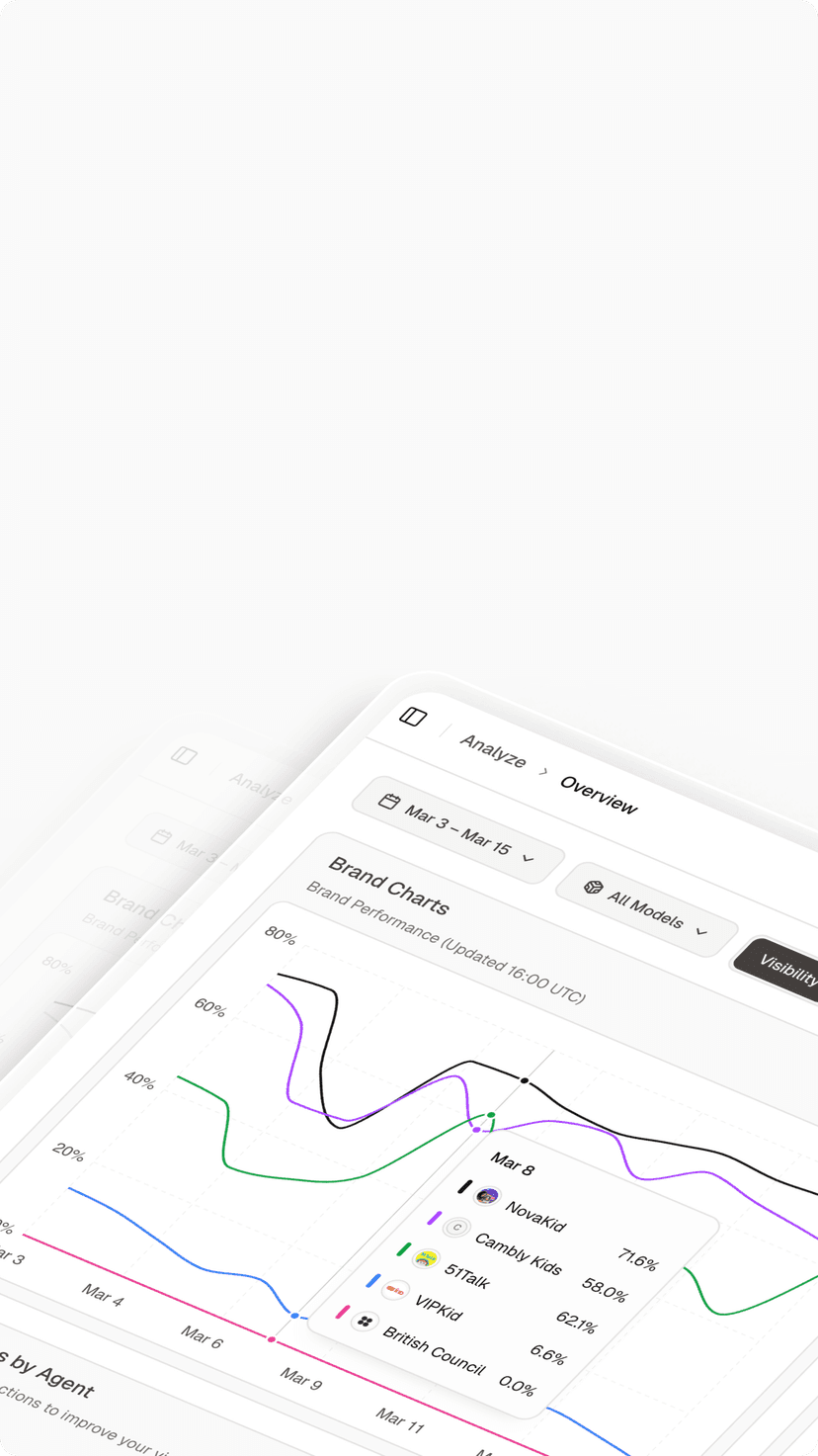
AI Share of Voice (SOV): Measuring Quantitative Dominance
The first and most foundational metric measured by Topify is AI Share of Voice (SOV). In traditional advertising, SOV measures your percentage of the total market conversation. In the GEO era, it measures your “Market Presence” within the AI’s generated knowledge base.
The Statistical Probability of Mention
Because LLMs are probabilistic (stochastic), they may mention your brand in some sessions but not others. Visibility tracking doesn’t look at a single response; it aggregates thousands of “Synthetic Probes” to calculate a Probability Score.
The Metric: If Topify runs 1,000 prompts for “best enterprise cloud security” and your brand appears in 450 of them, your SOV is 45%.
Strategic Value: This allows CMOs to understand their baseline dominance across different model versions (e.g., GPT-4o vs. GPT-5) and identify “Invisibility Gaps” where competitors are winning the recommendation share.
Competitive Overlap
Topify also measures Competitive Co-occurrence. If an AI assistant mentions you, who else is in the room? Measuring which competitors are consistently grouped with your brand helps identify which “Entity Neighborhood” the AI has placed you in. This is a vital part of from SEO to GEO Search Strategy.
Sentiment Polarity and Narrative Bias: Measuring Quality
A brand mention is a liability if the sentiment is negative. Unlike traditional keyword trackers, Topify measures the Qualitative Perception of your brand.
The Adjective Audit
LLMs are trained on massive datasets that include social sentiment and reviews. Tracking software uses Natural Language Processing (NLP) to extract the adjectives and descriptors associated with your brand.
Positive Bias: “Innovative,” “Market-leading,” “Scalable.”
Negative Bias: “Legacy,” “Expensive,” “Complex setup.” By measuring these descriptors, Topify helps brands identify when they have a “Sentiment Drift” problem that needs correction through Mastering Entity SEO for AI Visibility.
Recommendation Strength
Visibility tracking measures whether the AI is giving a “Passive Mention” (simply listing the brand) or an “Active Recommendation” (strongly suggesting the brand as the best choice). Topify quantifies this as the Recommendation Index, which is a leading indicator for bottom-of-funnel conversions.
Citation Integrity and Attribution: Measuring Credibility
In a world of AI hallucinations, “Citations” are the modern equivalent of the backlink. For search-centric models like Perplexity and SearchGPT, the citation is the primary driver of traffic.
Link Persistence and Accuracy
Tracking tools measure how often the AI provides a direct, clickable link to your domain.
Deep Linking: Does the AI link to your homepage, or does it deep-link to a specific technical specification page?
Attribution Errors: Topify flags instances where an AI attributes your competitor’s feature to your brand, or vice versa. This “Truth Monitoring” is the core of What is AEO.
Information Density and RAG Selection
By analyzing which specific snippets of your content were retrieved during the Retrieval-Augmented Generation (RAG) process, Topify measures the Information Density of your content. If the AI consistently selects your “FAQ” section but ignores your “Features” page, it’s a signal that your feature page lacks the structured clarity required for machine ingestion.
Semantic Proximity: Measuring Vector Alignment
This is the most technical dimension of visibility measurement. Behind the scenes, LLMs convert your brand content into Vector Embeddings—numerical values in a multi-dimensional space.
Cosine Similarity Scoring
Tracking platforms use proxy embedding models to calculate the Semantic Distance between your brand and the user’s intent.
The Measurement: If your brand’s vector is mathematically “close” to a high-conversion prompt (e.g., “SOC2 compliant payroll for startups”), your visibility probability increases.
The Optimization: Topify provides a roadmap to “Fact-Inject” your content to move your brand’s vector closer to the center of high-value user intents. This is the technical foundation of the future of search engine optimization.
Factual Accuracy and Hallucination Risk: Measuring Integrity
AI visibility tracking is also a tool for Brand Protection. One of the most critical metrics is the Factual Integrity Score.
Misinformation Detection
If an LLM misrepresents your pricing, security standards, or leadership, it creates a trust gap. Topify measures the “Delta” between your official facts and the AI’s generated output.
Inconsistency Identification: We track where the AI is getting its “bad data”—often from an outdated LinkedIn profile or an old press release.
The Fix: By synchronizing your brand signals across the Knowledge Graph, you can “force” the AI back to the truth.
Comparison Matrix: What Traditional SEO vs. AI Tracking Measures
Measurement Metric
Traditional SEO (e.g., GSC)
AI Visibility Tracking (Topify)
Visibility Unit
URL Rank (Position 1-100)
AI Share of Voice (SOV %)
Trust Factor
Backlinks & Domain Rating
Factual Density & Entity Sync
Content Logic
Keyword Frequency
Semantic Proximity & Vectors
User Value
Click-Through Rate (CTR)
Citation Rate & Recommendation
Health Metric
Technical Errors (404s, etc.)
Sentiment Bias & Hallucination Rate
To see how these metrics apply to your specific brand, you can learn how to rank in AI Overviews using our latest research.
Strategic Case Study: Quantifying the “Unseen” for a SaaS Brand
To illustrate the power of these metrics, let’s look at a B2B SaaS firm (pseudonym: SecureFlow) that utilized Topify to audit its AI presence.
The Audit: Discovering the Sentiment Gap
SecureFlow ranked #1 on Google for “workflow automation.” However, the Topify audit revealed a paradox:
AI SOV: 42% (High quantity).
Sentiment Score: -0.4 (Negative quality).
The Problem: While the AI was mentioning the brand frequently, it was consistently describing it as “legacy” and “expensive” because it was retrieving data from outdated review threads on Reddit.
The Transformation
Following Topify’s roadmap, SecureFlow refactored its documentation for Information Density and launched a “Truth Sync” campaign to update its brand signals.
Result: After 4 months, their Sentiment Score flipped to +0.7 (“Innovative and Cost-Effective”), and their Citation Rate in Perplexity increased by 300%.
Strategic Outlook: Measuring Agentic Discovery (2025-2026)
By 2026, the primary “users” of your website will be AI Agents. Tracking visibility will shift from “What do humans see?” to “What do agents verify?”
Machine-to-Machine (M2M) Visibility
Topify is already developing metrics for Agentic Readiness. This measures how easily an autonomous AI agent can ingest your pricing tables, API technicals, and compliance logs to make a purchasing decision on behalf of a user. In this era, Factual Integrity will be the only metric that truly matters.
Frequently Asked Questions (FAQ)
How can Topify measure visibility if LLM responses are private or session-based?
We utilize “Synthetic Probing”—simulating thousands of unique user sessions across different geographic nodes and personas. By statistically aggregating these “Black Box” responses, we can build a high-confidence map of your brand’s overall visibility and sentiment without needing direct access to the model’s weights.
Is AI Share of Voice (SOV) the same as market share?
No, but it is a Leading Indicator. High SOV in AI assistants means your brand is the “Primary Recommendation” at the moment of discovery. Over time, high AI visibility consistently correlates with an increase in branded search volume and direct conversions.
Why does the AI cite my competitor even though I have more backlinks?
LLMs prioritize Information Density and Semantic Alignment over raw backlink volume. If your competitor has a page that is structured as a clear “Fact Unit” that answers the user’s prompt directly, the AI’s RAG engine will select it as the most “trustworthy” grounding source, regardless of Domain Authority.
What is a “Hallucination Risk” score?
This is a metric provided by Topify that measures how often the AI provides incorrect data about your brand. A high risk score indicates that your brand signals across the web (Knowledge Graph) are conflicting, causing the AI to “guess” or merge your facts with another entity’s.
Conclusion: Turning the Invisible into the Actionable
AI visibility tracking is the diagnostic engine for the generative search era. In a landscape where the answer is synthesized in real-time, brands can no longer rely on vanity metrics like “Rankings” to understand their influence.
By measuring AI Share of Voice, Sentiment Polarity, and Citation Integrity through Topify, you gain the visibility required to take control of your narrative. In the age of AI, you are either a verified source of truth or a victim of algorithmic probability.