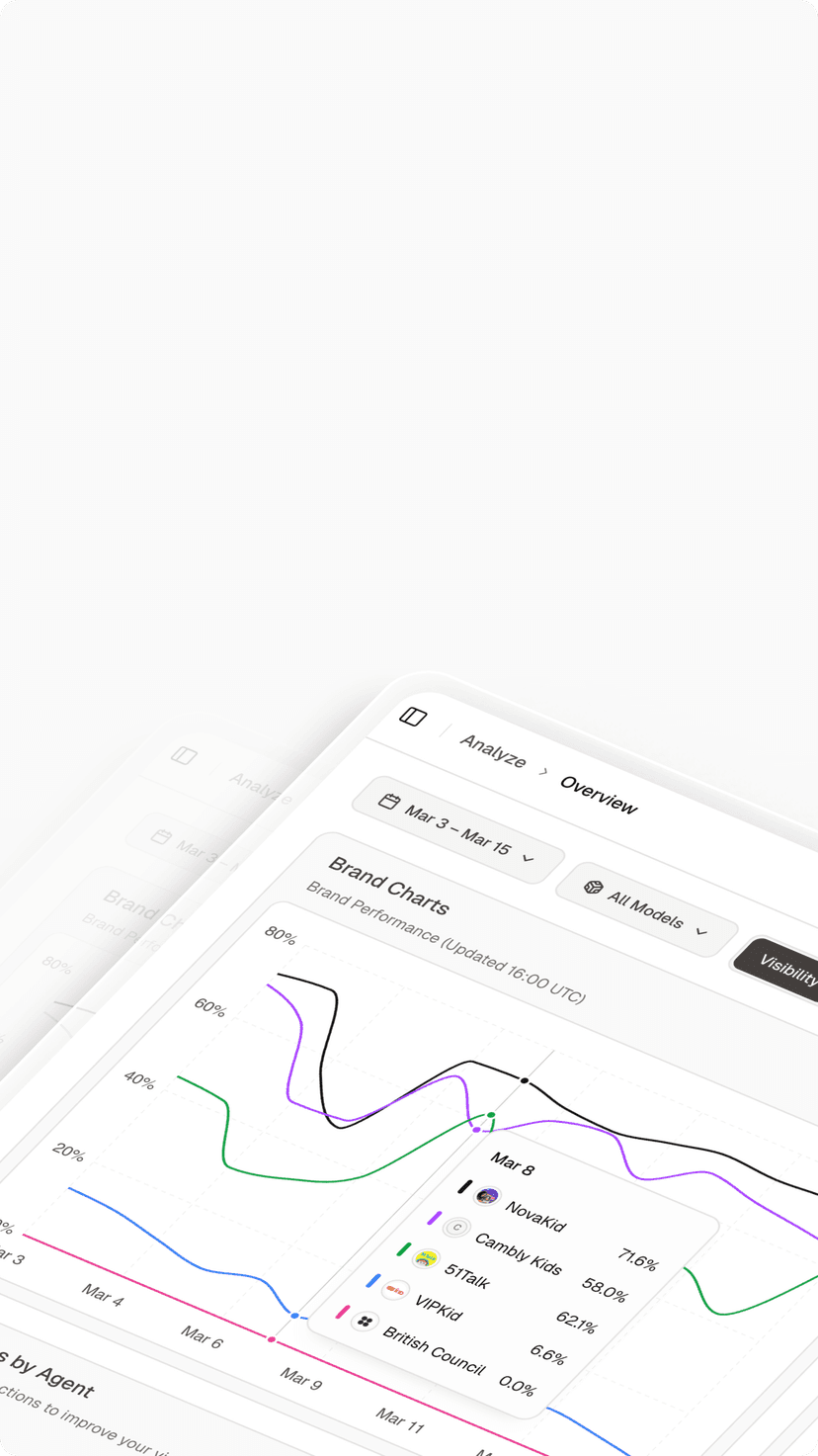
The digital marketing landscape is currently defined by a "dual-track" search reality. On one track, we have the traditional Google Search Engine Results Page (SERP), where success is measured by blue link positions and click-through rates (CTR). On the other track, we have the rapidly expanding Generative Search ecosystem—led by ChatGPT, Perplexity, and Gemini—where success is measured by the synthesis of an answer.
For global enterprises, the traditional SEO dashboard is becoming incomplete. If a brand ranks #1 on Google but is omitted or misrepresented in an AI-generated summary, the marketing team is losing the most critical "Zero-Click" conversion point. To navigate this, leading organizations are now integrating AI Visibility as a primary Key Performance Indicator (KPI) alongside their existing SEO metrics. This guide outlines the strategic framework for measuring AI visibility and how Topify provides the cross-platform intelligence needed to quantify brand authority in the conversational web.
Key Takeaways
The KPI Evolution: Traditional SEO KPIs measure "findability," while AI Visibility KPIs measure "citability" and "trust."
AI Share of Voice (SOV): This is the definitive metric for 2026, tracking how often your brand is the primary recommendation in a conversational output.
Citation Rate vs. CTR: In AI search, being cited as a source of truth is the functional equivalent of a Rank 1 position.
Factual Density & Sentiment: Enterprises must track the accuracy and tone of AI responses to protect brand equity from "hallucination-driven" narrative drift.
Hybrid Attribution: Integrating AI visibility data from Topify with traditional GSC data provides a 360-degree view of the brand's digital health.
The Conflict: Why SEO Metrics Alone are Failing Enterprises
In 2026, a company can have perfect "technical SEO" health and still be invisible in the age of generative search. The reason lies in the shift from Syntactic Matching (keywords) to Semantic Synthesis (answers).
1.1 The Death of the "Click" as the Sole Metric
Traditional SEO is built on the premise that a user must click a link to derive value. However, LLMs satisfy user intent directly in the interface. If the AI tells the user that your product is the best for their specific needs, the "Impression" happens before the click. Measuring only traffic excludes the massive "Brand Impression" value generated within the answer box.
1.2 The Stochasticity Problem
SEO rankings are relatively stable. AI visibility is probabilistic—one user might see your brand mentioned, while another might see a different synthesis. Companies need a metric that accounts for this volatility. This is why from SEO to GEO is a necessary transition for any modern data-driven marketing team.
Defining the Core AI Visibility KPIs

To measure AI visibility as a KPI, enterprises must define standardized metrics that can be tracked over time. Topify identifies four core metrics that every CMO should include in their monthly reporting.
2.1 AI Share of Voice (SOV)
This is the most critical KPI. It measures the percentage of high-intent prompt results that recommend or cite your brand compared to your competitors.
Tracking Strategy: Run 1,000 synthetic probes for a category (e.g., "best enterprise cloud storage") across ChatGPT, Gemini, and Perplexity. If your brand appears in 400 of those responses, your SOV is 40%.
2.2 Citation Frequency and Link Rate
Not all mentions are equal. A citation with a clickable link to your domain is the ultimate trust signal.
Tracking Strategy: Monitor the "Citation Rate"—the frequency with which the AI provides a source card or footnote leading to your official documentation. This is a foundational step in mastering entity SEO for AI visibility.
2.3 Narrative Sentiment and Bias Score
AI models often attach an adjective or a "tone" to a brand.
Tracking Strategy: Use NLP (Natural Language Processing) to score the AI's response as Positive, Neutral, or Negative. If an AI consistently calls your brand "expensive," it acts as a negative weight on your visibility KPI.
2.4 Factual Density Score
This measures how much "Grounding Data" the AI is retrieving from your site.
Tracking Strategy: Use Topify to calculate the information density of your cited pages. High density leads to more stable and accurate citations.
Comparison Matrix: SEO KPIs vs. AI Visibility KPIs
Metric Category | Traditional SEO KPI (The Past) | AI Visibility KPI (The Future) |
Primary Goal | Search Engine Result Page (SERP) Rank | AI Share of Voice (SOV %) |
User Action | Click-Through Rate (CTR) | Citation Frequency / Referral |
Trust Factor | Backlinks & Domain Authority | Entity Recognition & Fact Density |
Outcome | Sessions & Pageviews | Brand Citations & Recommendations |
Stability | Deterministic (Rank 1-100) | Probabilistic (Statistical Confidence) |
Platform | Google & Bing Index | ChatGPT, Claude, Perplexity, Gemini |
How to Integrate AI Visibility into Your Marketing Dashboard
Measuring AI visibility requires a "Truth-Based" platform that can bridge the gap between traditional search data and conversational output. Topify serves as this integration layer.
4.1 Connecting Topify to Your Business Intelligence (BI) Stack
For an enterprise, AI visibility shouldn't exist in a silo.
The Workflow: Feed your AI SOV data from Topify into your Snowflake, Tableau, or Salesforce dashboard. This allows the growth team to see how an increase in "Citation Share" in Perplexity correlates with a lift in "Direct Traffic" or "Branded Search" on Google.
4.2 Cross-Referencing "Invisibility Gaps"
One of the most valuable KPI exercises is finding where your Google Rank is high but your AI SOV is low.
The Action: Use Topify to identify these gaps. If you rank #1 on Google for a term but the AI is citing a com
petitor, it is a signal that your content lacks the AEO strategies required for machine ingestion.
Strategic Case Study: Hybrid KPI Management at a Fortune 500 Bank
Let’s examine how a global financial institution (pseudonym: FirstHeritage Bank) transformed its reporting by adding AI visibility to its quarterly KPIs.
5.1 The Challenge: A Silent Traffic Erosion
FirstHeritage had stable SEO rankings for "personal wealth management." However, their digital team noticed a 15% drop in organic traffic from mobile users. Using Topify, they discovered that users were asking Gemini and ChatGPT for financial advice, and the AI was recommending fintech startups instead of the bank.
5.2 The Intervention: Shifting the KPI Focus
Metric Adoption: The bank added "AI Share of Voice" to its executive dashboard.
Audit: Topify identified that the bank's content was too narrative and used "marketing fluff." The AI retrievers preferred the "Fact-Dense" tables of the fintech startups.
Sync: They synchronized their founding dates and technical compliance data across the Knowledge Graph.
5.3 The Result
By refactoring their content for Information Density, the bank's AI Share of Voice increased from 5% to 35% in six months. While traditional organic traffic remained flat, their "AI-Assisted Conversion Rate" (tracked via citation clicks) grew by 300%. This shift proved that how to rank in AI Overviews is the most critical survival strategy for 2026.
The Strategic Outlook: Agentic Discovery and "Agent-First" KPIs

As we look toward 2026, the focus will shift from "Answer Engines" to AI Agents. These agents will autonomously perform searches and make purchases on behalf of the user.
6.1 Optimizing for the "Machine-to-Machine" (M2M) Handshake
In the agentic era, visibility will be measured by "Agent Acceptability." How easily can an AI agent verify your brand’s technical specs and pricing without human intervention?
Future KPI: Machine Readability Score. This measures how well your APIs, technical documentation, and pricing tables are optimized for autonomous discovery. This is the next phase of the future of AI search engine optimization.
Frequently Asked Questions (FAQ)
7.1 Should AI visibility replace SEO rankings in our monthly reports?
No. AI visibility and SEO rankings should be viewed as two sides of the same coin. Traditional SEO is for users who want to explore and compare; AI visibility is for users who want a direct answer or a recommendation. A successful company measures both to ensure they capture the user at every stage of the journey.
7.2 How can Topify measure visibility if LLM results are personalized?
While individual answers can vary, Topify uses synthetic probing to run thousands of simulations across different locations and personas. This large-scale sampling provides a "Statistical Confidence Score" that reflects the overall market perception of your brand, moving beyond the noise of individual personalization.
7.3 Is a "Citation" worth as much as a "Click"?
In many cases, a citation is worth more. A citation from a trusted AI assistant acts as a third-party endorsement. Even if the user doesn't click immediately, the "Branded Impression" built within the AI's answer creates a level of trust that a traditional link simply cannot replicate.
7.4 How do we explain these new KPIs to non-technical stakeholders?
Explain it in terms of "Share of Recommendation." Just as you would measure how many store clerks recommend your product over a competitor's, AI Visibility KPIs measure how many "AI Clerks" recommend your brand to the user. It is the digital equivalent of word-of-mouth marketing at scale.
Conclusion: Balancing the Dashboard for the Answer Era
The digital marketing landscape has reached a point of no return. Companies that continue to rely solely on traditional SEO metrics are like captains navigating a modern sea with an 18th-century map.
By establishing AI Visibility as a primary KPI, enterprises gain the transparency required to protect their brand authority and capture high-intent users within the conversational interfaces of ChatGPT, Perplexity, and Gemini. Topify provides the intelligence, the metrics, and the actionable roadmap to ensure your brand isn't just a result on a page, but the definitive answer to the user's inquiry.