
Your domain authority is solid. Your keyword rankings haven't dropped. But when someone asks Perplexity, "What's the best tool in your category?" your brand isn't in the answer.
That's the gap traditional SEO metrics can't close. Perplexity doesn't rank pages. It cites sources. And the signals that decide which sources get cited have almost nothing to do with backlink profiles.
The good news: a new category of AI search visibility checking tools exists specifically to solve this problem.
Most Search Visibility Checking Tools Still Don't Measure Perplexity. That's a Problem.
Perplexity isn't a niche platform anymore. By May 2025, it had reached 153 million monthly visits, a 191.9% year-over-year increase. Monthly search queries hit 780 million, with projections pointing toward 1 billion weekly queries by 2026.
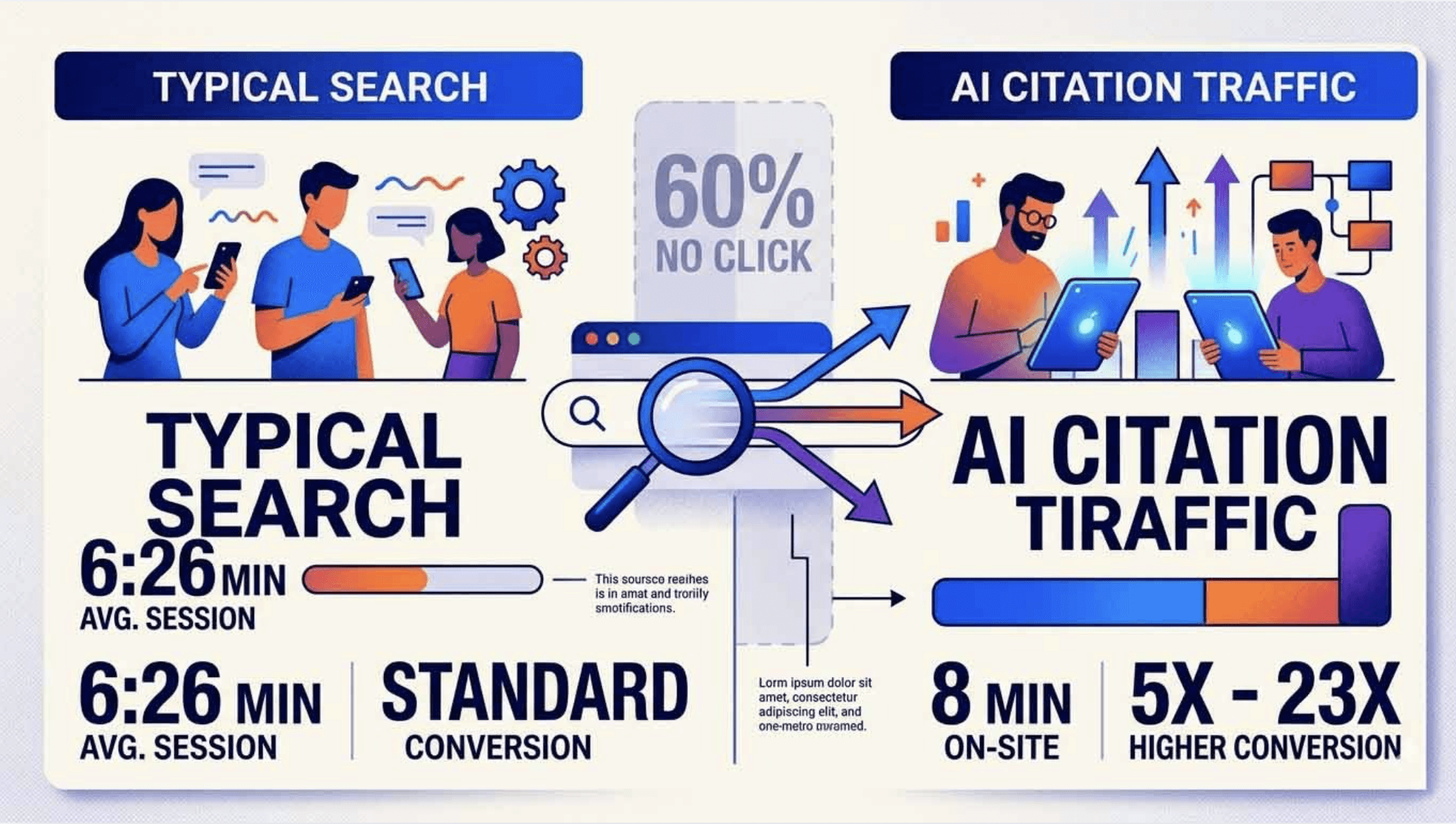
The users driving that growth aren't casual browsers. Over 53% of Perplexity visitors are between 18 and 34, and the average session length is approximately 23 minutes, compared to 6 minutes 26 seconds for typical search engine users. These are research-oriented information workers asking detailed, multi-step questions that average 23 words in length.
That's the audience you want in front of your brand.
The catch: 60% of Perplexity searches end without a click because the AI delivers the answer directly. But when a user does click through to a cited source, that traffic converts at rates up to 5x to 23x higher than traditional organic search. Users arriving from AI citations spend an average of 8 minutes on-site versus 2.5 minutes for organic search visitors.
The stakes are high. Most legacy SEO tools are still measuring the wrong thing entirely.
What Perplexity SEO Actually Measures (It's Not Keyword Rankings)
Google functions as a link ecosystem. It prioritizes domain authority, backlink profiles, and E-E-A-T signals. Perplexity operates on a fundamentally different logic.
Its proprietary crawler, PerplexityBot, scans the web not to index pages for keyword matches but to extract facts that can be synthesized into a coherent answer. The content that wins is content that answers the query in the first 100 words. Research shows that 90% of top-cited sources in Perplexity answer the core query immediately, a principle known as "BLUF" (Bottom Line Up Front).
There's also a citation diversity dynamic that works in smaller brands' favor. Perplexity repeats websites in only 25.11% of its answers, compared to 58.49% for Google. And 80% of LLM citations don't rank in the top 100 organic results on Google for the same query.
That means smaller, specialized publishers can displace legacy domain giants by optimizing for structural clarity over raw domain weight.
The metrics that matter in Perplexity SEO:
Metric | What It Measures |
|---|---|
Citation Rate | % of relevant queries where your domain is cited as a source |
Mention Position | Where in the numbered citation list your brand appears |
Sentiment Score | How the AI describes your brand (0-100 scale) |
Semantic Overlap | How accurately the AI echoes your actual messaging |
Intent Mapping | Whether your brand appears in awareness vs. transactional prompts |
None of these metrics exist in a traditional SEO dashboard. That's exactly why a dedicated ai search visibility checking tool is necessary.
6 AI Search Visibility Checking Tools for Perplexity SEO
Not all tools in this category are built the same. The six below cover a range from entry-level accessibility to enterprise-grade compliance. Here's a quick comparison before the detailed breakdown.
Tool | Perplexity Coverage | Core Strength | Starting Price | Best For |
|---|---|---|---|---|
Topify | High | 7 metrics + one-click execution | $99/mo | Strategy-heavy marketing teams |
ZipTie.dev | High | Behavior simulation & action guidance | $69/mo | Action-oriented SEOs |
Profound AI | Maximum (10+ engines) | Compliance & brand safety | $99-$399/mo | Fortune 500 / Agencies |
Peec AI | High | Geographic SOV & benchmarking | ~$104/mo | Research/content teams |
Otterly AI | Moderate (6 platforms) | Affordable baseline monitoring | $29/mo | SMBs & freelancers |
BrightEdge | High | Unified SEO/AEO content strategy | Custom | Enterprise content ops |
#1 Topify: Cross-Platform AI Brand Visibility Checking With Full Perplexity Coverage
Topify goes further than tracking whether your brand gets mentioned. It analyzes the mechanics of why citations are earned or lost.
The platform monitors seven core metrics across every major AI platform including ChatGPT, Perplexity, Gemini, DeepSeek, and others: visibility, sentiment, position, volume, mentions, intent, and CVR (Conversion Visibility Rate). This comprehensive data set lets you connect Perplexity citation performance directly to revenue-driving activities, not just vanity metrics.
Where Topify differentiates is at the Source Analysis layer. It identifies exactly which domains Perplexity is citing for your category's high-priority prompts, then surfaces the content gaps between those cited domains and your own. You find out not just that a competitor is being cited, but why: what structure they used, which data points the AI extracted, and what's missing from your own pages.
The Competitor Benchmarking feature tracks position drift in real time. If a new competitor starts appearing at citation position #1 for a prompt you previously dominated, you'll catch it before it erodes pipeline.
Perhaps the most operationally useful feature is One-Click Execution. Instead of handing a data report to a separate content team and waiting weeks, Topify lets you translate an insight (a missing FAQ, an outdated statistic, a content gap) directly into a deployed GEO strategy. No manual workflows.
Pricing: Basic at $99/mo (100 prompts, 9,000 AI answer analyses, 4 projects), Pro at $199/mo (250 prompts, 22,500 analyses). A 30-day trial is available. See full pricing here.
Best for: Marketing teams and in-house SEO leads who need Perplexity visibility data connected to an optimization workflow, not just a reporting dashboard.
#2 ZipTie.dev: Action-Oriented Behavior Simulation
ZipTie.dev differentiates itself by refusing to use API-only data. Instead, it simulates real user behavior to capture exactly what a human would see in a live Perplexity session. This closes a measurement gap: API responses sometimes differ from what the actual product surface shows users.
It combines query discovery, competitive citation analysis, and specific content recommendations. The "visibility decay" tracking is particularly useful for teams running active content optimization campaigns. Starting at $69/mo.
Best for: SEO practitioners who need immediate action items alongside their visibility data.
#3 Profound AI: Enterprise Brand Safety at Scale
Profound AI is built for Fortune 500 companies and regulated industries. It covers 10+ AI engines including Perplexity, ChatGPT, Claude, Gemini, Grok, and DeepSeek, and offers SOC 2 Type II compliance alongside misinformation alerts.
Its "persona-based" journey mapping lets enterprise teams see how different audience segments discover their brand through AI, a useful feature for brands with complex buyer personas. The Starter plan at $99/mo is limited to ChatGPT only. Perplexity coverage starts at $399/mo on the Growth plan.
Best for: Large enterprises where brand safety, compliance documentation, and maximum engine coverage are non-negotiable.
#4 Peec AI: Statistical Rigor for Research Teams
Peec AI targets content agencies and research-focused teams with strong geographic targeting and statistical benchmarking. Its "citation drift" tracking monitors how your citation sources shift over time, which is valuable for tracking the impact of content updates.
Data refreshes daily across selected models. Starts at approximately $104/mo (€89/mo) for 25 prompts, with additional AI model coverage available as add-ons.
Best for: Content agencies managing multi-market campaigns where geographic visibility differences matter.
#5 Otterly AI: Accessible Baseline Monitoring
Otterly AI is the lowest-friction entry point for teams that need to establish a visibility baseline before committing to a full GEO budget. It tracks six major platforms including Perplexity, and provides positive/neutral/negative sentiment categorization with minimal setup.
The Lite plan at $29/mo includes 1,000 GEO URL audits and 15 search prompts, which is sufficient for SMBs or solo founders doing initial discovery.
Best for: SMBs and freelancers who need basic AI visibility data without enterprise complexity.
#6 BrightEdge AI Catalyst: Unified SEO and AEO Intelligence
BrightEdge embeds AI search tracking inside its broader enterprise SEO platform. Its proprietary Generative Parser provides unified visibility for Perplexity, ChatGPT, and Google AIO in one dashboard, which is valuable for teams that don't want to run separate tools for traditional and AI search.
The built-in AI Copilot uses historical query data to suggest optimization priorities and prompt coverage gaps. Custom enterprise pricing only.
Best for: Large content operations that are already using BrightEdge for traditional SEO and want AI visibility tracking without adding a separate platform.
How to Run Your First Perplexity Search Visibility Check
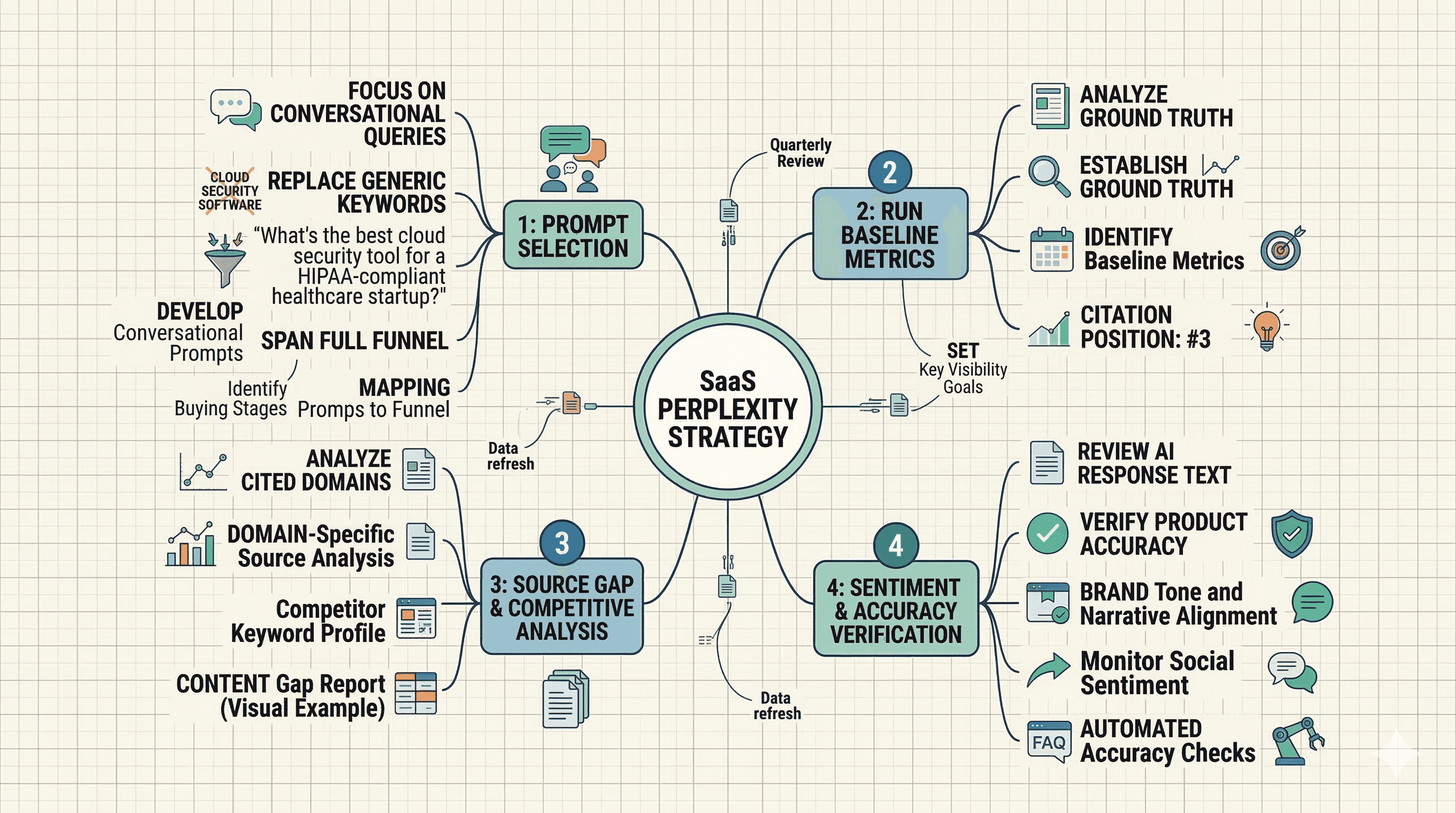
Getting from zero data to a working baseline takes four steps.
Step 1: Prompt selection. Don't start with keywords. Start with the conversational queries your buyers actually use in Perplexity. Instead of "cloud security software," track "What's the best cloud security tool for a HIPAA-compliant healthcare startup?" These should span the full funnel, from awareness-stage definitions to decision-stage comparison prompts.
Step 2: Run baseline metrics. Use a best ai search visibility checking tool like Topify to establish your initial ground truth: Is your brand included? What's your citation position in the numbered source list? Capture this as a dated snapshot. AI responses shift over time, and you need the baseline to measure progress.
Step 3: Source gap and competitive analysis. Pull the Source Analysis report. Which domains is Perplexity consistently citing for your category terms? If a competitor's whitepaper or a specific Reddit thread keeps appearing at position #1, analyze why. Are they answering the query in the first paragraph? Are they using a comparison table instead of prose? That's your content gap.
Step 4: Sentiment and accuracy verification. Read the actual Perplexity response text. Does the AI describe your product accurately? If it's attributing wrong pricing, discontinued features, or inaccurate positioning, that's a brand narrative problem. Clearer entity signals and structured FAQ content on your own domain are typically the fix.
This full process takes under an hour for the first run. Get started with Topify here.
Why Perplexity SEO Needs a Strategy That Looks Nothing Like Google
The optimization playbook that built your Google rankings will not work here.
Google rewards backlink authority and content length. Perplexity rewards clarity, recency, and structural extractability. In a groundbreaking study conducted by researchers from Princeton, Georgia Tech, and the Allen Institute for AI across 10,000 queries, three tactics showed the largest measurable impact on AI citation rates: adding concrete statistics boosted visibility by up to 40%, incorporating expert quotations improved citation likelihood, and citing other authoritative sources within your own content made AI models more likely to treat your page as a credible anchor. 65% of Perplexity citations point to content published within the past 12 months, which means recency is an active signal, not a nice-to-have.
The structural differences are just as significant. LLMs can parse HTML tables 30-40% more efficiently than prose, which is why comparison sections formatted as tables consistently outperform paragraph-based equivalents in Perplexity citations. "BLUF paragraphs" (50-70 word definitions placed at the very top of a page) satisfy the context window constraint that forces the model to filter aggressively.
Google rewards authority. Perplexity rewards clarity.
This also extends to third-party signals. Semrush data shows LinkedIn is the second most cited domain across AI search models, appearing in 11% of responses. Reddit and Quora are frequently cited for opinion-type queries. Building presence on those platforms isn't just community marketing anymore. It's a direct GEO input.
The best ai brand visibility checking tools make this actionable by showing you which content structures and third-party sources Perplexity is pulling from in your category, so you're not optimizing blind.
Turning Perplexity Visibility Data Into a Repeatable Optimization Loop
Data without action is just a dashboard. The value of running regular Perplexity SEO checks comes from building a closed feedback loop.
A typical optimization workflow runs like this: visibility data identifies which prompts are returning competitor citations instead of yours. Source analysis reveals which domains are winning those citations. Content gap analysis tells you whether the issue is structure (no comparison table), recency (last updated 18 months ago), or entity clarity (the AI is unsure what your product actually does). From there, page updates, FAQ additions, or schema cleanup are the tactical responses.
Topify's One-Click Execution collapses that loop. Instead of transferring a data report across teams, you can generate and deploy an optimized content block directly from the insight. The separation between "finding the gap" and "filling the gap" shrinks from weeks to hours.
For brands with high commercial stakes in AI search, this cadence should run weekly. Citation sources drift as AI models are updated. A prompt your brand dominated last quarter may tell a different story today. The brands that stay visible are the ones running regular checks and updating their content accordingly, not the ones that optimized once and moved on.
Conclusion
Perplexity now processes 780 million monthly queries from a user base that converts at rates far above traditional search. The cost of being invisible in those answers isn't a future problem. It's a current pipeline gap.
The good news: Perplexity SEO is measurable, and the optimization levers are clear. Add statistics, answer the query immediately, structure content for extraction, and build third-party presence where AI models listen. The harder part is tracking which of those moves are working, and for which prompts, across which platforms.
That's exactly what the best ai brand visibility checking tools are built to do. Start with a baseline check on Topify. From there, the gaps tend to make themselves obvious.
FAQ
Q1: What is Perplexity SEO? Perplexity SEO, also known as Generative Engine Optimization (GEO) or Answer Engine Optimization (AEO), is the practice of optimizing content to be cited as a source in AI-generated responses. It focuses on structural clarity, information density, and extractability rather than backlink volume or keyword density.
Q2: How is Perplexity SEO different from traditional Google SEO? Google rewards domain authority and link profiles. Perplexity rewards content that answers the query immediately, uses structured formats like tables and lists, includes verifiable statistics, and has been updated recently. 80% of LLM citations don't even rank in Google's top 100 organic results for the same query.
Q3: What's the best AI search visibility checking tool for tracking Perplexity? For marketing teams that need visibility data connected to an optimization workflow, Topify is a strong choice with full Perplexity coverage, seven tracking metrics, and one-click execution. ZipTie.dev suits SEOs who want behavior simulation and immediate action items. Otterly AI is the most accessible entry point for smaller teams at $29/mo.
Q4: How often should I run a Perplexity search visibility check? For high-priority commercial prompts, weekly or bi-weekly checks are recommended. AI citation sources drift as models are updated, and what worked last month may not reflect your current standing. Enterprise brands with active brand narrative concerns typically run daily monitoring.