
Search "best AI search visibility tool" and you'll find a dozen platforms that all claim to do the same thing. The pitch is nearly identical: track your brand across ChatGPT, get a visibility score, watch your competitors. What the marketing pages don't tell you is that only 11% of cited domains overlap across ChatGPT, Gemini, and Perplexity for the same query. That means a tool covering just one engine is, by definition, missing 89% of the picture.
Choosing the wrong platform doesn't just waste your budget. It gives your team false confidence while a competitor quietly dominates the AI answers your buyers are actually reading.
Most AI Search Visibility Tools Are Built for One Engine. Your Buyers Use Several.
The core problem isn't that these tools are bad. It's that they were often built when "AI search" meant "ChatGPT."
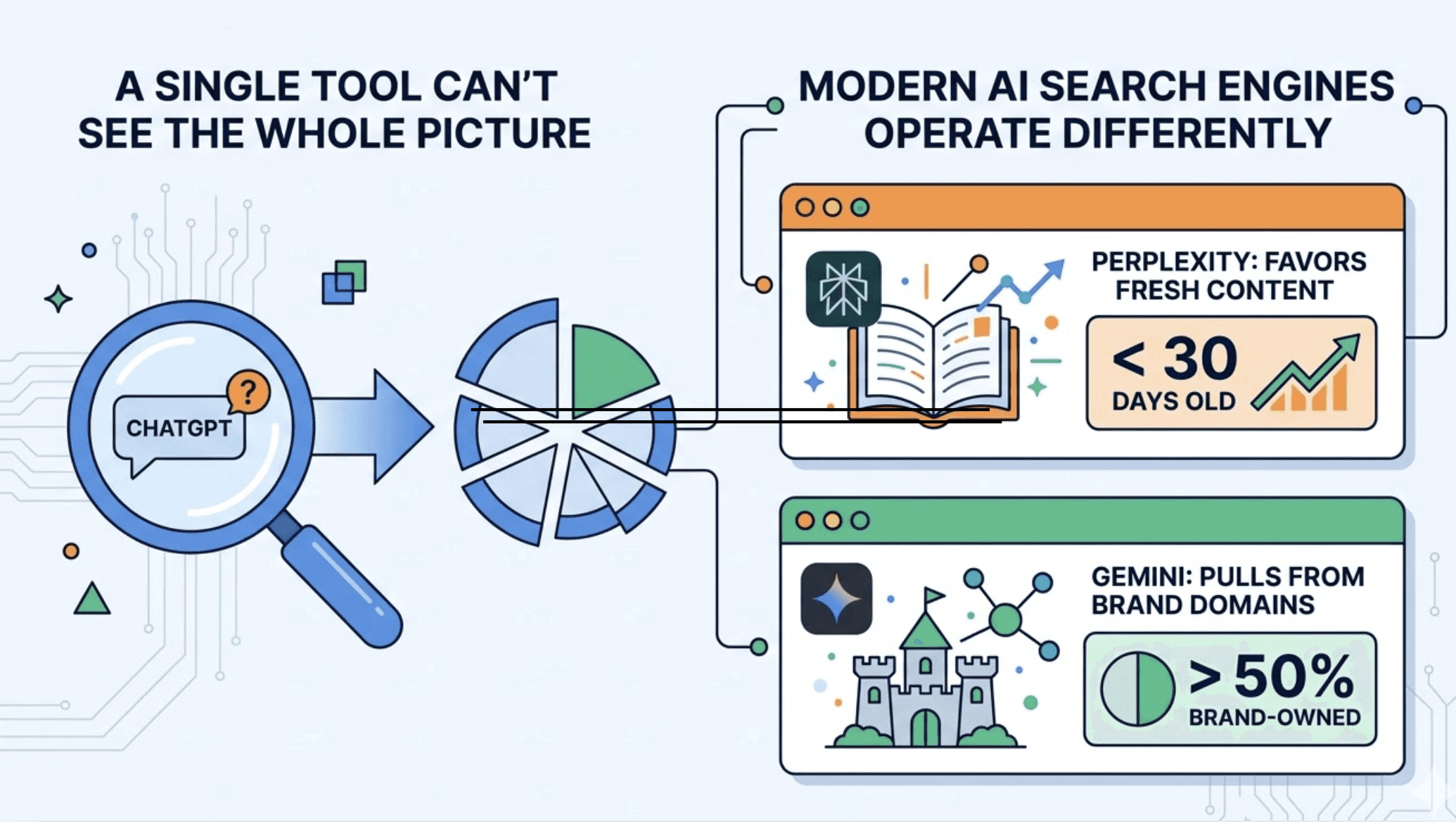
That's not the landscape anymore. Google AI Overviews now reaches 1.5 billion monthly users, while ChatGPT processes queries from over 900 million weekly active users. Perplexity has built a proprietary index of 200 billion URLs with citation patterns that differ fundamentally from both. Each engine has its own retrieval logic, trust signals, and content preferences.
A tool that tracks only ChatGPT will tell you almost nothing about how Gemini, which pulls 52.15% of its citations from brand-owned domains, is treating your brand. Or how Perplexity, which favors content updated within the last 30 days (with an 82% citation rate vs. 37% for older content), ranks your assets.
That's the gap most brands still can't see.
The 5 Metrics That Define Real AI Search Visibility
Before comparing tools, it helps to agree on what "AI search visibility" actually means. Not all platforms track the same things.
Visibility Rate (Share of Model): How often does your brand appear when a user asks a relevant question? This is the foundational metric, but it's only useful if measured across multiple AI platforms simultaneously.
Position Tracking: When your brand does appear, where does it rank in the response? Being mentioned fourth in a list of five is meaningfully different from being the first recommendation.
Sentiment Scoring: AI models don't just mention brands; they frame them. Are you described as a "leader," a "budget option," or is your product associated with qualifiers like "good for beginners"? Qualitative positioning drives downstream conversion.
Source and Citation Analysis: Which external domains is the AI citing when it mentions you? Which domains is it citing when it recommends a competitor? This is where you find your content gaps.
Competitor Share: Your visibility score is relative. A brand with 40% visibility in a category where the top competitor has 70% is in a worse position than a brand with 25% visibility in a fragmented category.
These five metrics should be non-negotiable requirements when evaluating any AI search visibility tool.
Top AI Search Visibility Tools at a Glance
Tool | Platforms Tracked | Starting Price | Key Strength | Best For |
|---|---|---|---|---|
Topify | 10+ (ChatGPT, Gemini, Perplexity, DeepSeek, Qwen, and more) | $99/mo | 7-dimension GEO analytics + One-Click execution | Marketing teams, agencies, SaaS brands |
Quattr | ChatGPT, Gemini, AIO, Perplexity | Custom | Unified SEO + GEO workflow | Enterprise execution |
Profound | 10+ models (Grok, Claude, etc.) | $99/mo | Conversation Explorer demand data | Enterprise monitoring |
Otterly AI | 6 platforms | $29/mo | 25-factor GEO audit | SMBs and early-stage startups |
Peec AI | 5 platforms | €89/mo | Multi-language, real-time UI scraping | European mid-market |
Scrunch AI | 7+ models | $250/mo | Hallucination alerts and AXP | Brand safety teams |
Superlines | 10+ models (Mistral, DeepSeek) | €89/mo | MCP server for agentic workflows | Technical SEOs |
#1 Topify: GEO Analytics Across 7 Dimensions and 10+ AI Platforms
Topify is built around a core thesis: monitoring is not enough. Most tools show you a number. Topify shows you why that number is what it is, and what to do about it.
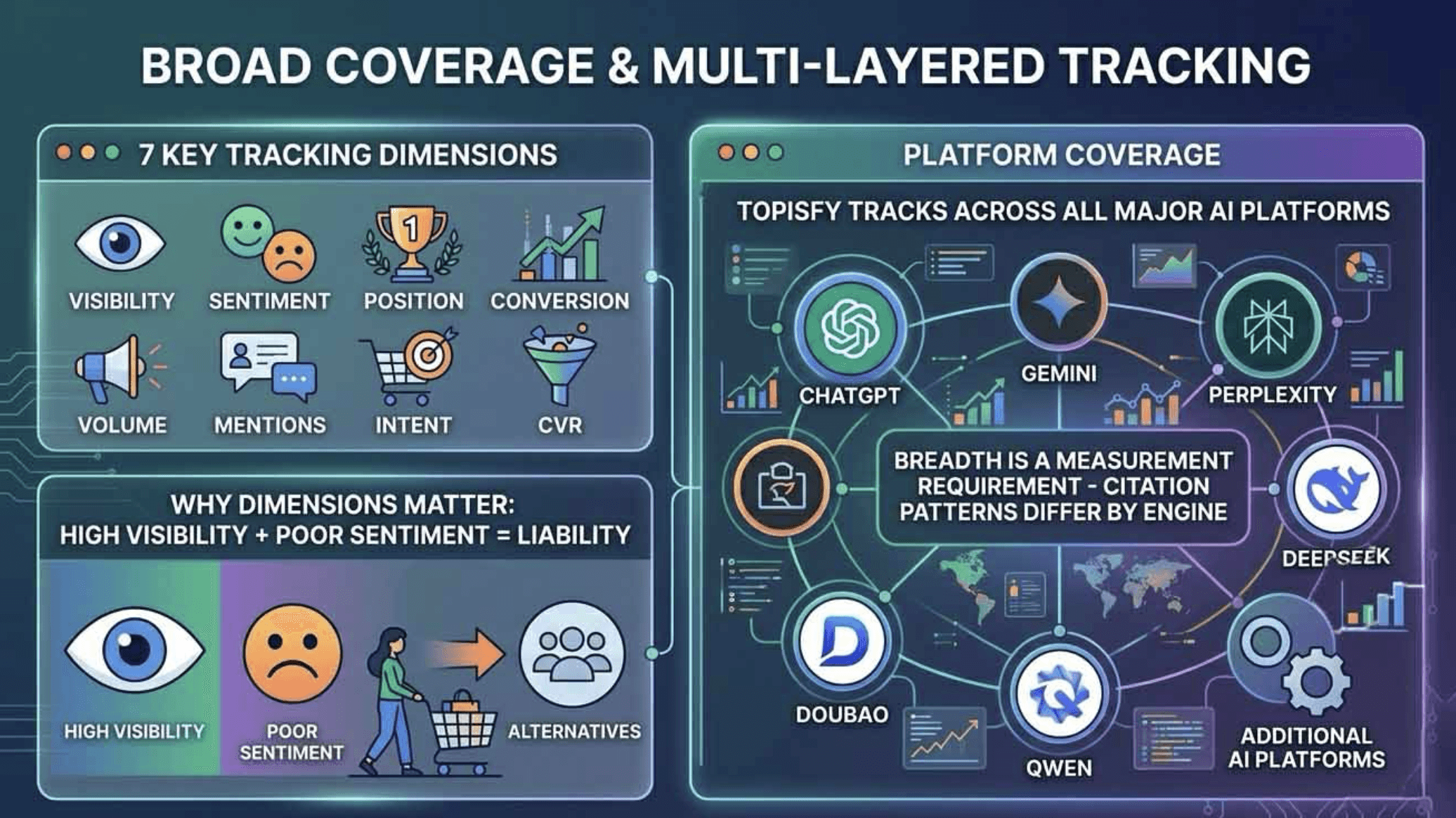
The platform tracks seven key dimensions simultaneously: visibility, sentiment, position, volume, mentions, intent, and CVR (Conversion Visibility Rate). This multi-layered approach matters because a high visibility score with poor sentiment is actually a liability. You're being mentioned, but the framing is pushing buyers toward alternatives.
Platform coverage is Topify's most distinct technical advantage. While most tools in this category focus on ChatGPT and Gemini, Topify tracks across ChatGPT, Gemini, Perplexity, DeepSeek, Doubao, Qwen, and additional major AI platforms. Given that citation patterns and trust signals differ by engine, this breadth is not a marketing feature. It's a measurement requirement.
The Source Analysis function reverses the logic of traditional SEO research. Instead of asking "where should we build links?" it asks "which external domains is the AI actually citing when it answers questions in my category?" For teams trying to understand how AI search visibility tools connect to content strategy, this closes a major analytical gap.
Where Topify separates from monitoring-only platforms is One-Click Agent Execution. You define your objective in plain language. The system proposes a GEO strategy and deploys it. No manual workflow handoff between an analytics team and a content team. Built by founding researchers from OpenAI and Google SEO practitioners, the underlying algorithm is designed for depth, not just breadth.
Pricing: Basic at $99/mo (100 prompts, 9,000 AI answer analyses, 4 platforms), Pro at $199/mo (250 prompts, 10 seats), Enterprise from $499/mo. A 30-day trial is available on Basic.
Best for: In-house marketing teams, growth-focused SaaS brands, and agencies that need to report AI visibility across multiple clients from a single platform.
#2–#6: Other AI Visibility Tools Worth Knowing
Quattr is the strongest option for enterprise teams that want to close the loop between diagnosis and execution. Its "GIGA agent" drafts AI-ready content and automates internal linking. The trade-off is complexity and custom pricing, which makes it less accessible for smaller teams that need basic ai visibility tools without a lengthy onboarding process.
Profound processes over 5 million citations daily and its Conversation Explorer surfaces AI search demand data that often precedes traditional keyword volume trends. It's the monitoring standard for regulated industries (SOC 2 Type II, HIPAA). The significant limitation: it's monitoring-only. Acting on its insights requires a separate execution stack.
Otterly AI starts at $29/month and includes a 25-factor GEO audit covering schema, structured data, and headers. For startups evaluating ai search visibility tools for the first time, it's a reasonable starting point. Weekly data refresh rates can be a constraint when AI citation patterns shift quickly.
Scrunch AI is the right choice if hallucination monitoring is a priority. When an AI generates factually incorrect information about your brand, Scrunch AI sends an alert. At $250/month, it's positioned toward brand safety teams rather than growth-focused marketers.
Superlines covers 10+ AI models including Mistral and DeepSeek and offers a Model Context Protocol (MCP) server that lets users pipe visibility data into their own AI assistants. It's built for technical SEOs who want to build automated workflows around their tracking data. For generalist marketing teams, the learning curve is steep.
Which AI Search Visibility Tool Fits Your Team's Situation
Not every team needs the same thing. Here's how to match the tool to the use case.
If you're an in-house marketing team tracking brand performance across multiple AI platforms while managing competitor benchmarks, Topify's seven-dimension analytics and multi-platform coverage provide the most complete view. The One-Click execution removes the gap between insight and action that slows most teams down.
If you're a marketing agency managing GEO visibility across multiple client accounts, Topify's multi-project architecture (up to 10 seats on Pro, custom on Enterprise) is built for this workflow. For top ai search visibility tools companies are evaluating for agency-scale deployment, the ability to benchmark clients against their specific competitors, not just generic category leaders, is the key differentiator.
If you're a SaaS brand where product discovery increasingly happens through AI assistants and agent-driven workflows, the CVR (Conversion Visibility Rate) metric in Topify directly ties your AI presence to pipeline potential. This matters because ai search visibility tools for SaaS need to do more than count mentions; they need to trace the path from AI mention to buyer action.
If you're early-stage and budget-constrained, Otterly AI's $29/month entry point makes sense for initial visibility auditing. When you're ready to move from auditing to systematic optimization, Topify's Basic plan at $99/month adds execution capability.
If brand safety is the primary concern, Scrunch AI's hallucination alert system has no real equivalent at the same depth in this category.
Conclusion
The shift from keyword ranking to AI visibility is not coming. It's here. Search engine volume is projected to decline by 25% by 2026, and 60% of searches now complete without the user visiting any external website. Being visible in that synthesized answer is the new baseline for brand discovery.
The tools in this category are not interchangeable. Start with platform coverage: if your target audience uses Gemini and Perplexity as much as ChatGPT, a single-engine tracker gives you a dangerous false positive. Then evaluate whether the platform closes the loop between data and action, or leaves your team to figure out the strategy manually. For most marketing teams, agencies, and SaaS brands running GEO analytics AI search visibility tools through a full optimization cycle, Topify's combination of multi-platform depth and one-click execution is the most complete option currently available.
FAQ
Q: What is AI search visibility and why does it matter in 2026?
A: AI search visibility refers to how frequently and how favorably a brand appears in responses generated by AI platforms like ChatGPT, Gemini, and Perplexity. It matters because these platforms now drive a significant share of consumer research. Users who discover a brand through AI search convert at 4.4 to 5 times the rate of users from traditional organic search, making AI visibility a high-leverage channel for revenue-linked marketing investment.
Q: How is AI search visibility different from traditional SEO rankings?
A: Traditional SEO measures your position in a list of ten links. AI search visibility measures whether you're included in a synthesized answer at all, and how you're framed within it. The two metrics are also driven by different signals: brand mentions across the web correlate with AI visibility at 0.664, roughly three times stronger than the 0.218 correlation of traditional backlinks. Optimizing for one does not automatically optimize for the other.
Q: What should I look for when comparing AI search visibility tools?
A: Four criteria matter most. First, platform coverage: does the tool track all the AI engines your buyers use, not just ChatGPT? Second, metric depth: does it measure sentiment and position, or just mention count? Third, execution capability: can the platform help you act on the data, or does it only report it? Fourth, competitor benchmarking: your visibility score is only meaningful in context of what your competitors are getting.
Q: Can AI search visibility tools work for SaaS companies specifically?
A: Yes, and SaaS brands tend to see particularly strong returns from this category. AI assistants are increasingly part of the B2B research and procurement process, especially for software evaluation. Best AI search visibility tools companiesin the SaaS space use to track how their product appears in category queries (e.g., "best CRM for mid-market teams") are directly measuring pipeline exposure. Topify's CVR metric is specifically designed to connect AI visibility data to conversion probability, which maps directly onto how SaaS marketing teams measure channel performance.