
Your brand ranks #1 on Google. But when someone asks ChatGPT "what's the best tool for [your category]," your name doesn't show up.
That gap is the problem AI answer tracking is designed to solve. And right now, most brands have no idea how wide that gap is.
60% of Google searches now end without a click. When a Google AI Overview is present, organic CTR for informational queries can drop by as much as 61%. The traffic isn't disappearing—it's being absorbed by AI platforms. And if you're not tracking what those platforms say about you, you're flying blind.
Your Brand Ranks on Google. AI Has Never Heard of You.
Here's what makes this shift different from previous SEO disruptions: AI platforms don't index pages and rank them. They retrieve, synthesize, and generate answers. If your brand isn't part of the retrieval set when a user asks a relevant question, you simply don't exist in that answer.
ChatGPT now processes 2 billion queries per day. Perplexity has carved out a specific niche among senior professionals, with 30% of its users in leadership roles and 65% in high-income brackets. These aren't casual browsers. They're decision-makers using AI to shortlist vendors, compare options, and validate choices before they ever click a link.
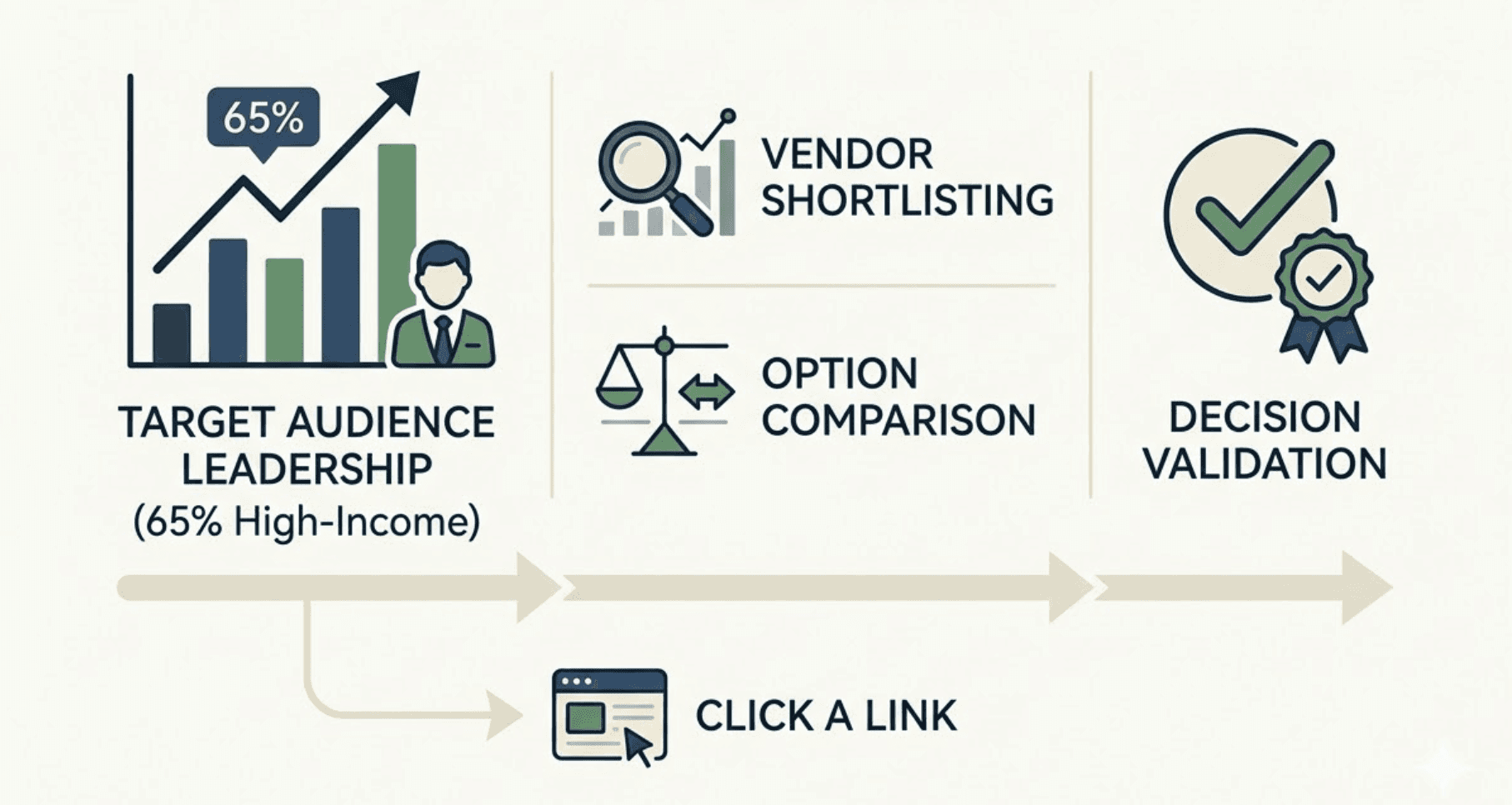
The traffic AI sends is small in volume. The quality is not. Analysis of 12 million website visits shows AI-driven traffic converts at 4 to 5 times higher rates than traditional search traffic—an average of 14.2% versus 2.8%. By the time an AI-referred visitor lands on your site, they've already done the research. They're pre-qualified.
That's the audience you're missing if you're not tracking AI answers.
What AI Answer Tracking Actually Means
AI answer tracking is the practice of systematically monitoring how large language models (LLMs) represent your brand in generated responses. It covers what AI platforms say about you, how often they say it, what sentiment they attach to your brand, and where you rank relative to competitors.
It's not the same as traditional rank tracking. Keyword ranking tells you where your page appears in a list of blue links. AI answer tracking tells you whether your brand is cited, recommended, or mentioned in a synthesized response—and in what context.
The platforms you need to monitor include ChatGPT, Google AI Overviews, Gemini, Perplexity, and DeepSeek. Each has a different user base, different retrieval behavior, and different citation patterns. What works for ChatGPT doesn't automatically translate to AI Overviews.
Here's the thing: AI models are non-deterministic. They can give different answers to the same prompt depending on when it's asked. One-off checks are not tracking. Real tracking requires continuous, high-frequency monitoring across multiple platforms to establish a statistically sound baseline.
The 5 Metrics That Actually Tell You How You're Performing in AI Answers
Most brands start with "does AI mention us?" That's a starting point, not a strategy. Here are the metrics that actually tell you something useful.
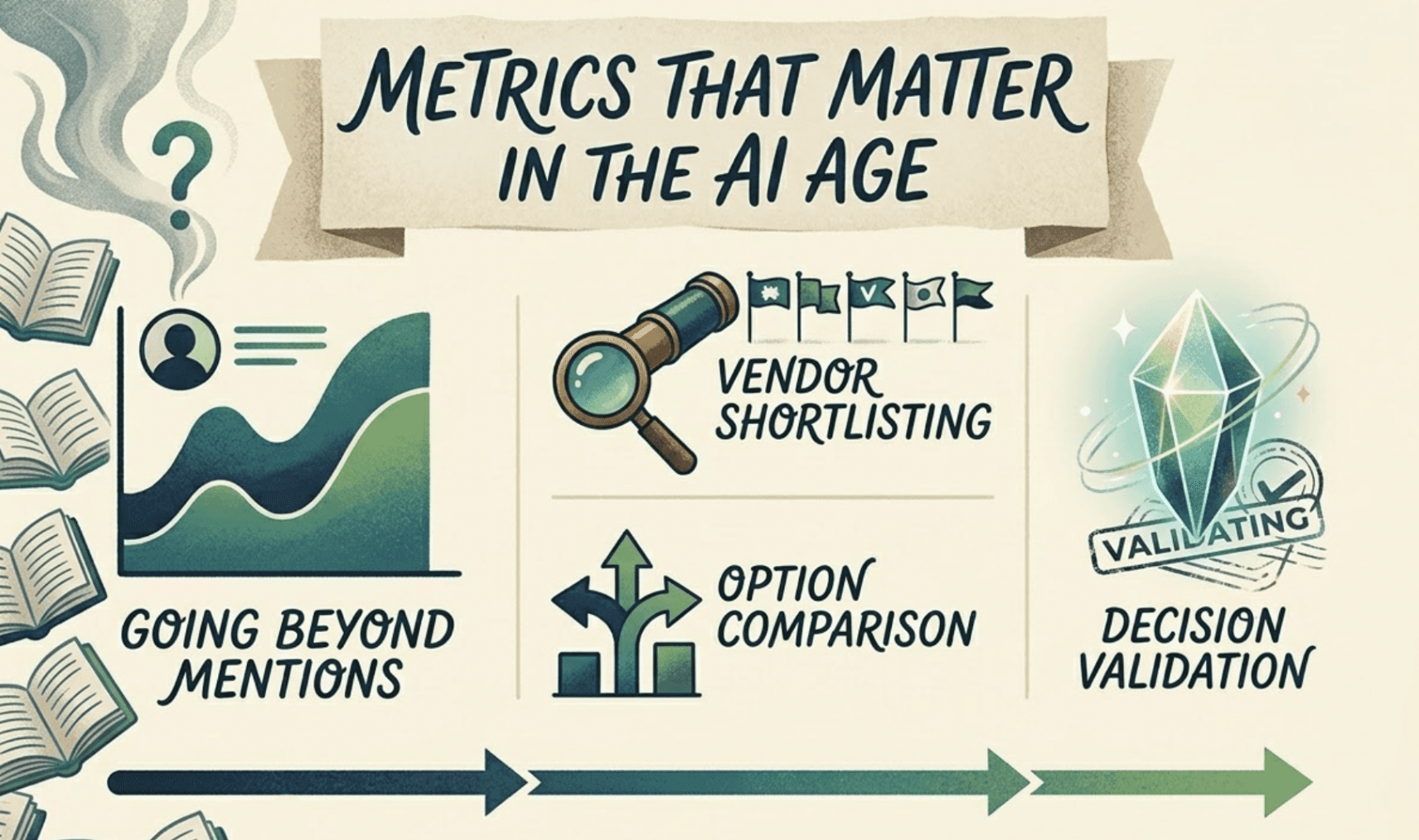
1. Visibility (Citation Frequency) How often your brand appears in AI responses to relevant prompts. This is the modern equivalent of organic click volume—it tells you your share of the conversation. Research shows that web mentions have a 0.664 correlation with AI visibility, making this the strongest signal you can track.
2. Sentiment Score Whether the AI describes your brand positively, neutrally, or negatively. A brand that gets mentioned often but with negative or tepid framing is losing conversions before the click happens. Sentiment shapes first impressions at scale.
3. Position Where you appear within an answer. Being mentioned fifth in a list of five is not the same as being the first recommendation. Position correlates directly with the probability of click-through and conversion.
4. Share of Voice (SOV) What percentage of relevant answers include your brand versus competitors. SOV is your competitive benchmark. A brand can have high visibility in absolute terms and still be losing market share if competitors appear more often.
5. Source Coverage Which URLs and domains AI platforms actually cite when they recommend your brand—or your competitors. 76% of ChatGPT citations come from pages updated in the last 30 days, which means content freshness directly impacts citation eligibility. Source coverage tells you where to invest your content resources.
Track all five. Drop any one and you're missing part of the picture.
How to Build an AI Answer Tracking Strategy From Scratch
The biggest mistake brands make is starting with the wrong prompts. Most begin by tracking branded queries: "What is [Brand Name]?" or "Tell me about [Product]." They get good results. They feel confident. But they're testing the queries they're already winning.
The real risk is unbranded. A ratio of 75% unbranded to 25% branded prompts is the standard used by experienced practitioners. Unbranded queries reveal where competitors are being recommended in your place.
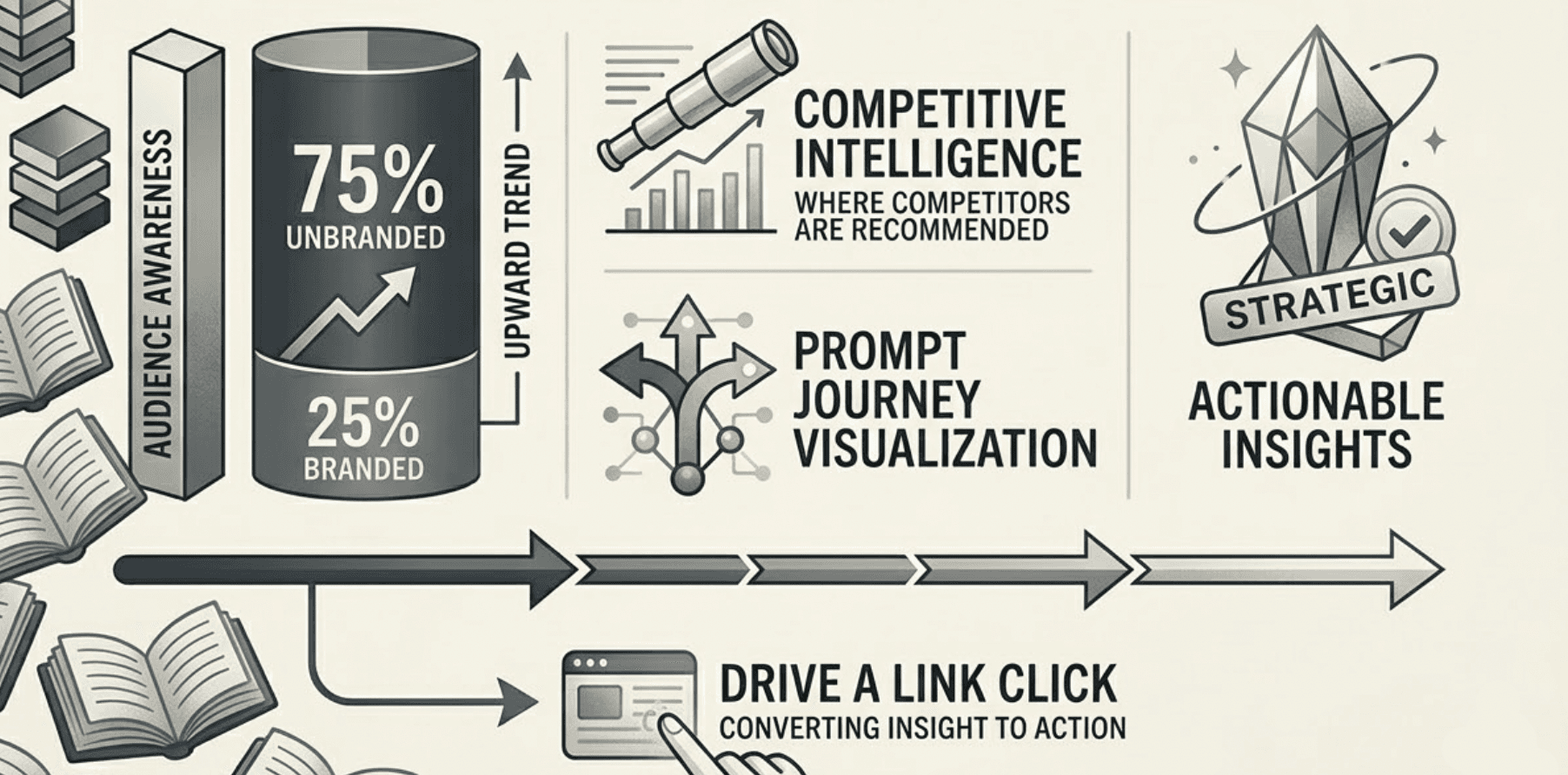
Step 1: Build your prompt library Start with 15 to 25 high-stakes prompts across three categories. Branded prompts verify accuracy. Category prompts capture discovery-stage users. Competitive prompts reveal the AI's stance on head-to-head comparisons. Add persona context where relevant—"marketing leader evaluating software" performs differently than an uncontextualized query.
Step 2: Select your platforms Don't just track one AI engine. ChatGPT dominates with 80.49% AI chatbot market share, but your target audience may be concentrated on Perplexity or using Google AI Overviews. Multi-platform coverage is non-negotiable.
Step 3: Establish a baseline Run your initial tracking across all prompts and platforms. Document your current visibility, sentiment, and position scores before making any changes. Without a baseline, you can't measure improvement.
Step 4: Set tracking frequency Weekly monitoring is the industry standard for enterprise teams—frequent enough to surface trends, manageable enough to act on. Daily is appropriate for high-stakes product launches or competitive moments.
Step 5: Add competitor benchmarking Add your top 3 to 5 competitors to every prompt where it's relevant. AI tracking without competitive context is a dashboard with no reference point. You need to know not just how you're doing, but how you're doing relative to the brands competing for the same recommendations.
5 Best AI Overviews Tools for AI Answer Tracking (Ranked by What Happens After the First Report)
The difference between a useful tool and a frustrating one isn't the first report—it's what you can do with the data afterward. Here's how the main options stack up.
Tool | Starting Price | Platform Coverage | Key Strength | Best For |
|---|---|---|---|---|
Topify | $99/mo | ChatGPT, Gemini, Perplexity, AI Overviews, DeepSeek, and more | 7 metrics, one-click execution, GEO strategy | SaaS & growth brands |
SE Ranking | $52/mo | ChatGPT, AIO, Perplexity | Multi-platform dashboard, competitor research | SMBs & mid-market |
GrackerAI | $99/mo | 6 engines, daily monitoring | Citation monitoring, B2B SaaS focus | B2B SaaS agencies |
Mangools AI | $12/mo | Entry-level visibility | 50 prompts, accessible price point | Solo operators |
BrightEdge | Custom ($10k+/yr) | Google AIO, ChatGPT, Perplexity | Enterprise suite, Citation Intelligence | Large enterprises |
Topify stands out for teams that need to go beyond reporting into execution. The platform tracks brand performance across ChatGPT, Gemini, Perplexity, DeepSeek, and Google AI Overviews simultaneously, measuring seven key metrics: visibility, sentiment, position, volume, mentions, intent, and CVR. What separates it from most tracking tools is the execution layer. You define your goals in plain English, and the platform deploys a GEO strategy with one click—no manual workflow required. The Basic plan starts at $99/month and includes 100 prompts and 9,000 AI answer analyses. For teams scaling up, the Pro plan at $199/month covers 250 prompts and 22,500 analyses.
SE Ranking offers solid value for smaller teams that don't need the full execution layer. GrackerAI is a strong option for B2B SaaS agencies running daily monitoring across multiple clients. Mangools fits solo operators or early-stage brands just getting started with AI visibility. BrightEdge is the enterprise option for organizations already running large-scale SEO programs that want AI tracking integrated into an existing suite.
For most growth teams, the decision comes down to whether you need a data dashboard or a data-plus-execution platform. If your team has the bandwidth to translate insights into action manually, lower-cost options work. If you need the platform to do more of the work, Topify's approach is worth the difference in price.
The Checklist: 7 Signs Your AI Answer Tracking Is Actually Working
Use this to evaluate whether your current setup is producing reliable, actionable data.
Signal | What It Looks Like |
|---|---|
Multi-platform coverage | You're tracking at least 3 AI platforms, not just ChatGPT |
Prompt diversity | 75%+ of your prompts are unbranded category or competitive queries |
Competitor benchmarking | Every prompt includes your top 3 competitors for SOV comparison |
Baseline established | You have a documented starting point to measure change against |
Consistent frequency | Tracking runs weekly or more often—not as one-off audits |
Source-level visibility | You can see which specific URLs AI platforms are citing |
Sentiment monitoring | You track tone, not just mention frequency |
If you're missing more than two of these, your data is likely producing a false sense of confidence—or a false sense of crisis.
3 Mistakes That Make AI Tracking Data Useless
Tracking only one platform. ChatGPT and Google AI Overviews behave differently. Citation patterns, user demographics, and retrieval preferences vary significantly across engines. Brands that only monitor one platform build a partial—and often misleading—picture of their actual AI presence.
Ignoring third-party sources. AI models don't just cite your website. They pull from G2, Capterra, Reddit, industry blogs, and review aggregators. Brands that focus exclusively on their own domain miss 90-95% of the sources that shape how AI describes them. Source Analysis is not optional—it's where most of the optimization opportunity lives.
Treating old rankings as proof of AI visibility. A page-one Google ranking doesn't transfer automatically to AI answer inclusion. Organic rank and citation frequency are increasingly decoupled. A study found that 23% of AI responses contain inaccurate information—meaning even brands with strong traditional SEO may be described incorrectly in AI outputs. Tracking both systems separately is the only way to catch these gaps.
Conclusion
AI answer tracking isn't a new feature to add to an existing SEO workflow. It's a different system for measuring brand influence in a discovery environment that operates on different rules.
Traditional SEO measures where your page ranks. AI answer tracking measures whether your brand is retrieved, cited, and recommended when it matters. Those are different questions, and they require different tools and different data.
The brands that build this capability now—tracking visibility, sentiment, position, source coverage, and competitive share across multiple AI platforms—will have a structural advantage as AI-mediated discovery continues to grow. McKinsey projects that by 2028, AI-mediated search could influence up to $750 billion in retail revenue. The window to build a lead is open. It won't stay open.
If you're ready to start tracking, Topify offers a 30-day trial on the Basic plan—enough time to establish a baseline, run your first competitive analysis, and see exactly where you stand in the AI answers your customers are reading.
FAQ
What is AI answer tracking? AI answer tracking is the practice of monitoring how large language models represent your brand in generated responses—covering mention frequency, sentiment, position, competitive share, and the sources AI platforms cite when discussing your category.
How is AI answer tracking different from traditional SEO tracking? Traditional SEO tracking measures where your pages rank in a list of links. AI answer tracking measures whether your brand appears in synthesized AI responses, and in what context. The two systems are increasingly decoupled—a strong organic ranking doesn't guarantee AI visibility.
How often should I run AI tracking reports? Weekly monitoring is the standard for most teams. For time-sensitive periods like product launches or competitive campaigns, daily tracking is worth the added cost.
Which AI platforms should I track? At minimum: ChatGPT, Google AI Overviews, and Perplexity. Add Gemini and DeepSeek if your audience skews toward power users or international markets. The key is multi-platform coverage—no single engine represents the full picture.
What's the right mix of prompts to track? Aim for 75% unbranded category and competitive prompts, 25% branded. Most brands already perform well on branded queries. The real visibility gaps—and real opportunities—are in unbranded discovery.
How do I improve my AI answer tracking results? Start by establishing a baseline across all five core metrics. Then use source analysis to identify which third-party domains AI platforms cite most often in your category, and build a presence on those platforms. Content freshness matters too—76% of ChatGPT citations come from pages updated in the last 30 days.