
Your domain authority is solid. Your keyword rankings haven't moved. But organic traffic from those rankings keeps dropping, and you can't find a technical reason why. The answer might not be in Google Search Console. It's in what ChatGPT, Perplexity, and Gemini are saying about your category without you.
Traditional SEO metrics weren't built to measure this. And the gap between where your brand ranks and where AI recommends is getting wider every week.
AI Search Visibility Is Not a Ranking, It's a Presence Problem
Traditional search engines operate on a list model. Google shows ten blue links, ranks them by relevance and authority, and lets users decide. Visibility in that world is about position: rank #1 and you get the click; rank #11 and you don't.
AI search doesn't work that way. ChatGPT, Perplexity, and Google's AI Overviews synthesize an answer directly. There's no list. There's a response. And if your brand isn't in that response, you don't exist to that user.
ChatGPT now reaches 800 million weekly active users as of early 2026, doubled from 400 million in 2025. Google's AI Overviews reach 2 billion users monthly across more than 200 countries. Meanwhile, zero-click searches in AI mode have reached 93%, meaning the vast majority of AI search sessions end without a single outbound click.
That's the gap most brands still can't see.
What "AI Search Visibility" Actually Measures
AI search visibility isn't a single number. It's a set of seven interconnected dimensions, each of which tells you something different about where your brand stands in the AI knowledge ecosystem.
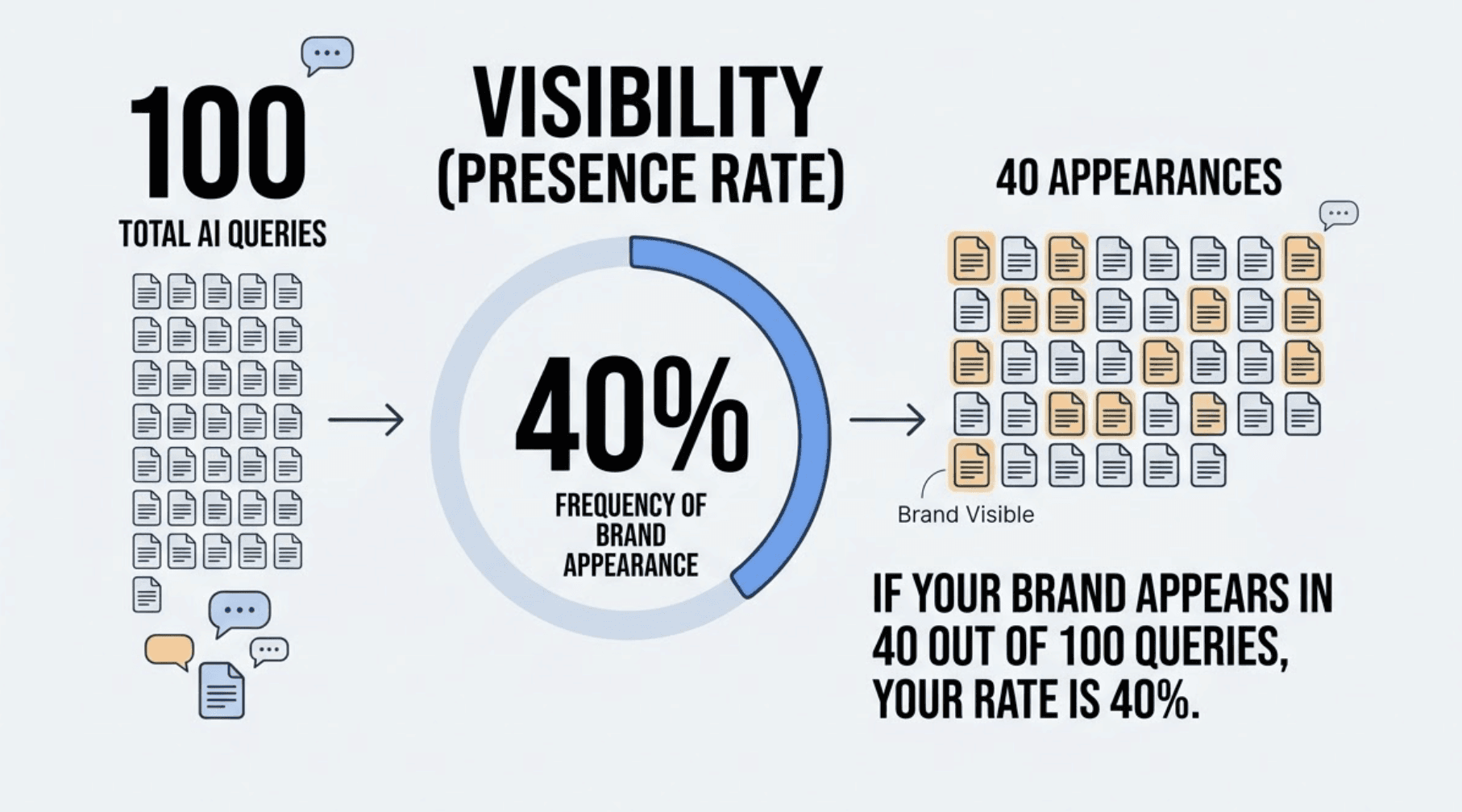
Visibility (Presence Rate): How often your brand appears in AI responses across a defined set of prompts. If you show up in 40 out of 100 queries in your category, your visibility rate is 40%.
Sentiment: Whether AI describes your brand positively, negatively, or neutrally. Unlike a star rating, AI sentiment affects recommendation context directly. The same brand can appear and still be framed as the "budget option" when you've spent years positioning as enterprise-grade.
Position: Where in the response your brand is mentioned. First mention carries significantly more psychological weight than a footnote. In AI search analytics, this is tracked as relative position against competitors.
Share of Voice (Volume): Your brand mentions relative to competitors across the full prompt set. This reflects how dominant your brand is in the AI knowledge graph for your category.
Mentions vs. Citations: A mention is your brand name appearing in a response. A citation is your URL being pulled as a source. Citations drive traffic. Mentions build awareness but don't always lead to clicks.
Intent Coverage: Which query types surface your brand. Are you visible for informational queries ("what is...") but absent from commercial comparison queries ("best... for...")? That's an intent gap worth diagnosing.
CVR (Conversion Visibility Rate): The business impact of AI-driven discovery. Research shows AI-referred visitors convert at 4.4x the rate of traditional organic search visitors, making AI search visibility a revenue metric, not just a marketing metric.
That last number is worth sitting with.
How AI Search Visibility Works Behind the Scenes
AI doesn't "search" the way a user does. It generates answers through two primary knowledge pathways, and understanding both is essential for AI search optimization.
The first is parametric knowledge: what the model absorbed during pre-training. If your brand has limited presence in Wikipedia, major news archives, Common Crawl, or high-domain-authority publications, the model may simply not have enough signal to recall you when a user asks a relevant question without real-time search enabled. Approximately 60% of ChatGPT queries still rely on the model's internal parametric knowledge rather than live retrieval.
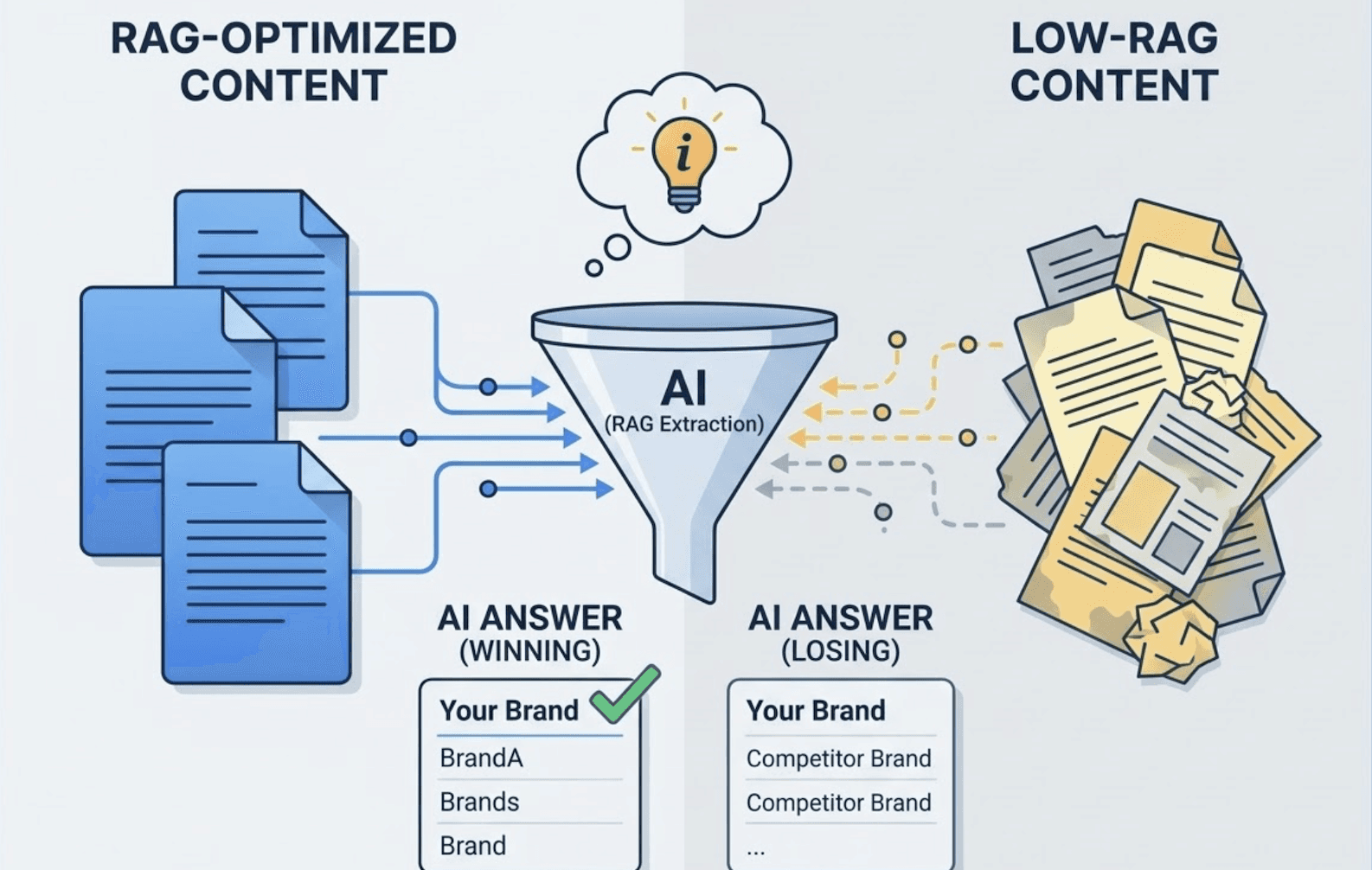
The second is RAG (Retrieval-Augmented Generation): when the model pulls real-time content from the web to generate its answer. This pathway is increasingly dominant for commercial and comparison queries, where freshness and specificity matter.
What gets retrieved through RAG isn't random. Content containing statistics and specific data points shows up to 40% higher AI citation rates than content without them. Content structured with clear H2/H3 headings, FAQ schema, and declarative answer-first summaries is far easier for RAG systems to extract.
Different AI platforms also have distinctly different citation preferences. ChatGPT heavily favors Wikipedia (47.9%) and top news sources, while Perplexity skews toward Reddit (46.7%), YouTube, and niche professional sites. Google AIO mixes Reddit, YouTube, and Wikipedia signals.
That means your AI search intelligence strategy can't be one-size-fits-all across platforms.
5 Signals Your Brand Has an AI Visibility Problem
Most brands don't realize they're invisible to AI search until they actually check. Here's what to look for.
Competitor substitution. Ask ChatGPT or Perplexity about the best tools in your category. If competitors that rank lower than you on Google are showing up in the AI response while you're not, your content isn't winning the RAG extraction battle.
AI hallucinations about your brand. If AI gives incorrect details about your pricing, product features, or company background, it's a sign your entity signal on the web is weak or contradictory. When AI can't verify, it fills in gaps probabilistically — and usually gets it wrong.
Organic traffic decline with stable rankings. If your keyword rankings haven't changed but traffic from those keywords is falling, AI Overviews are likely intercepting high-intent clicks before users reach your listing. Not being cited in the AI Overview means absorbing those losses.
Low brand search volume relative to category volume. Brand search volume correlates with AI visibility at a coefficient of 0.334, the strongest correlation among all measured factors. If your brand isn't well-known enough in web signals, AI won't recall it for broad category queries.
Inconsistent brand narrative across platforms. If your G2 description contradicts your LinkedIn summary, which contradicts your homepage, AI treats the inconsistency as a credibility signal and may downweight your content entirely. Semantic coherence across sources matters more in AI search than in traditional SEO.
How to Measure AI Search Visibility Without Guessing
The only way to move from guessing to knowing is a structured measurement framework. Here's what that looks like in practice.
Where to measure: At minimum, track ChatGPT, Gemini, Perplexity, and DeepSeek. Each platform has a different underlying model, different RAG behavior, and a different user demographic. Single-platform testing produces misleading data.
What to measure: Focus on the seven metrics above, but prioritize source citation mapping — identifying exactly which URLs AI platforms pull from when responding to your category prompts. That tells you where competitors have earned their visibility, and where you have gaps.
How often: Weekly tracking is recommended. AI model updates, changes in third-party source authority, and shifts in competitor content can alter visibility patterns within days.
Manual tracking at this cadence isn't feasible. Checking 100 prompts across five platforms, extracting source citations, and monitoring sentiment changes over time would take a team weeks per cycle. Research estimates manual AI visibility tracking for a 12-person team costs approximately $540,000 annually, compared to roughly $120,000 for an automated platform — a 70-80% cost reduction.
That's where Topify fits in. The platform automates query simulation across ChatGPT, Gemini, Perplexity, DeepSeek, Doubao, Qwen, and other major AI platforms, computing visibility rate, sentiment scores, position, and source citations in a single dashboard. Topify's AI Volume Analytics also estimates the search demand behind specific prompts, helping teams prioritize which queries are worth optimizing for first.
The Basic plan starts at $99/month, covering 100 prompt slots and 9,000 AI answer analyses. For teams running regular AI search analytics across multiple product lines or clients, it's a significantly lower overhead than manual processes — and the data is continuous rather than spot-checked.
How to Improve AI Search Visibility: 4 Levers That Actually Work
Optimizing for AI search visibility — a practice known as Generative Engine Optimization (GEO) — is different from traditional SEO. Rankings don't transfer directly. Here are the four levers with the most consistent impact.
Lever 1: Build Source Authority on AI-Referenced Sites
AI doesn't just index your website. It weights the sources it frequently cites. In your category, certain third-party sites — specific forums, review platforms, industry publications, and community spaces — are being pulled into AI responses at high rates. Getting your brand cited or mentioned on those sites improves your RAG footprint directly.
Topify's Source Analysis feature shows which domains and URLs are being cited when AI responds to your category prompts. That output maps exactly where content investment and PR outreach should focus.
Lever 2: Increase Training Data Density
If your brand has minimal presence in news archives, Wikipedia, widely-syndicated press, or academic mentions, you're invisible to parametric knowledge retrieval. This matters most for broad "what is the best..." queries where AI relies on training data rather than live search.
The strategy is brand narrative consistency at scale. Across every platform where your brand appears, the description of what you do, who you serve, and your core differentiation should be tightly aligned. Semantic coherence strengthens entity association in AI models.
Lever 3: Structure Content for Machine Extraction
AI search optimization means writing content that AI can parse, extract, and quote. That means leading key pieces of content with a 50-70 word direct answer, adding FAQ schema to your highest-traffic pages, and using declarative statements rather than marketing language.
"Topify tracks brand visibility across six AI platforms in real time" is extractable. "We help brands unlock their AI potential" is not. The distinction seems small. In AI citation behavior, it's the difference between being sourced and being skipped.
Lever 4: Benchmark Against Competitors Systematically
If AI recommends your competitor instead of you, the gap is usually in content fact density, source coverage, or recency. Content with higher statistical density and fresher publication dates gets cited disproportionately in AI responses.
Topify's Competitor Monitoring tracks how your brand's visibility, sentiment, and citation distribution compare to competitors across platforms and prompt types. The output maps the specific gaps in source coverage and content authority that explain the difference — not just a scoreboard, but a prioritized action list.
Conclusion
AI search visibility is measurable, traceable, and directly tied to revenue outcomes. It's not a bonus metric to track after you've maxed out traditional SEO. For a growing share of high-intent users, it's where discovery decisions are already being made.
The starting point is knowing where you stand. Run a baseline audit across your core 20-30 category prompts on the platforms your audience uses. The gaps you find will tell you exactly where to focus first.
Get started with Topify and run your first AI visibility audit today.
FAQ
Q: What is AI search visibility?
A: AI search visibility measures how often and how favorably a brand appears in responses generated by AI platforms like ChatGPT, Gemini, and Perplexity. Unlike traditional SEO rankings, it focuses on presence in synthesized answers rather than position in a link list. A brand can rank #1 on Google and still be completely absent from AI-generated recommendations in the same category.
Q: How does AI search visibility work?
A: AI generates responses through two pathways: parametric knowledge (what the model learned during pre-training) and RAG, which pulls real-time web content to build answers. Brands with consistent, fact-dense, well-structured content on high-authority sites tend to appear more frequently in both pathways. The specific sites AI favors for citations vary by platform, which is why cross-platform AI search intelligence matters.
Q: How do I measure AI search visibility?
A: The most practical approach is an AI visibility platform like Topify, which simulates queries across multiple AI engines, tracks brand mention frequency, citation sources, sentiment, and position over time. Manual tracking at meaningful scale isn't feasible for most teams, and single-engine spot-checks don't give you the cross-platform picture you need for reliable AI search analytics.
Q: What are the most common mistakes in AI search visibility?
A: The four most common ones are: assuming Google rankings automatically translate to AI visibility (they don't), publishing content that's marketing-heavy but data-light (AI prefers facts), ignoring third-party platforms like Reddit and G2 where AI pulls heavily, and having inconsistent brand descriptions across channels (which creates semantic ambiguity AI tends to penalize).