
Your brand has solid domain authority. Your sentiment scores look clean. Your social listening dashboard shows thousands of positive mentions across Twitter, Reddit, and review sites. Then a potential customer opens Perplexity and types, "What's the best tool for [your category]?" Your brand doesn't appear. Not once.
That's not a content problem. It's a measurement problem. Traditional brand monitoring wasn't built to track what AI says about you — and that gap is getting expensive.
What Is AI Brand Monitoring Analytics
AI brand monitoring analytics is the practice of tracking how AI systems represent, describe, and recommend your brand in response to user queries. It's not an upgrade to social listening. It's a fundamentally different discipline.
Social listening captures what people say about your brand. AI brand monitoring analytics captures what AI tells people about your brand. That distinction matters because the decision layer has shifted. According to McKinsey, approximately $750 billion in U.S. consumer spending will be directly influenced by AI search by 2028. What AI says about your brand isn't a side channel — it's increasingly the channel.
Three core functions define how AI brand monitoring analytics works: visibility monitoring (how often your brand appears in AI-generated answers), narrative analysis (how AI describes your brand's positioning and use cases), and citation auditing (which sources AI pulls from when it references your brand). Traditional tools measure what happened after a user engaged with your content. AI brand monitoring analytics measures what AI decided before the user ever clicked anything.
The 7 Signals AI Brand Monitoring Analytics Actually Tracks
Most teams start by asking "does AI mention us?" That's the right instinct but the wrong stopping point. Effective ai brand monitoring analytics tracks seven distinct signals, each measuring a different dimension of how AI perceives and surfaces your brand.
Visibility Score measures the percentage of relevant queries where your brand appears in AI-generated responses. This is your baseline. Without it, everything else is speculation.
Share of Voice tracks your brand's weight in AI recommendation lists relative to competitors. Being mentioned fifth on a list of five isn't the same as being mentioned first — and in AI search, position compounds over time.
Sentiment Weight captures how AI frames your brand: innovative, affordable, enterprise-grade, or "best for small teams." Research shows sentiment accounts for up to 85% of AI search ranking logic. A positive mention in the wrong framing can actively hurt positioning with the wrong audience.
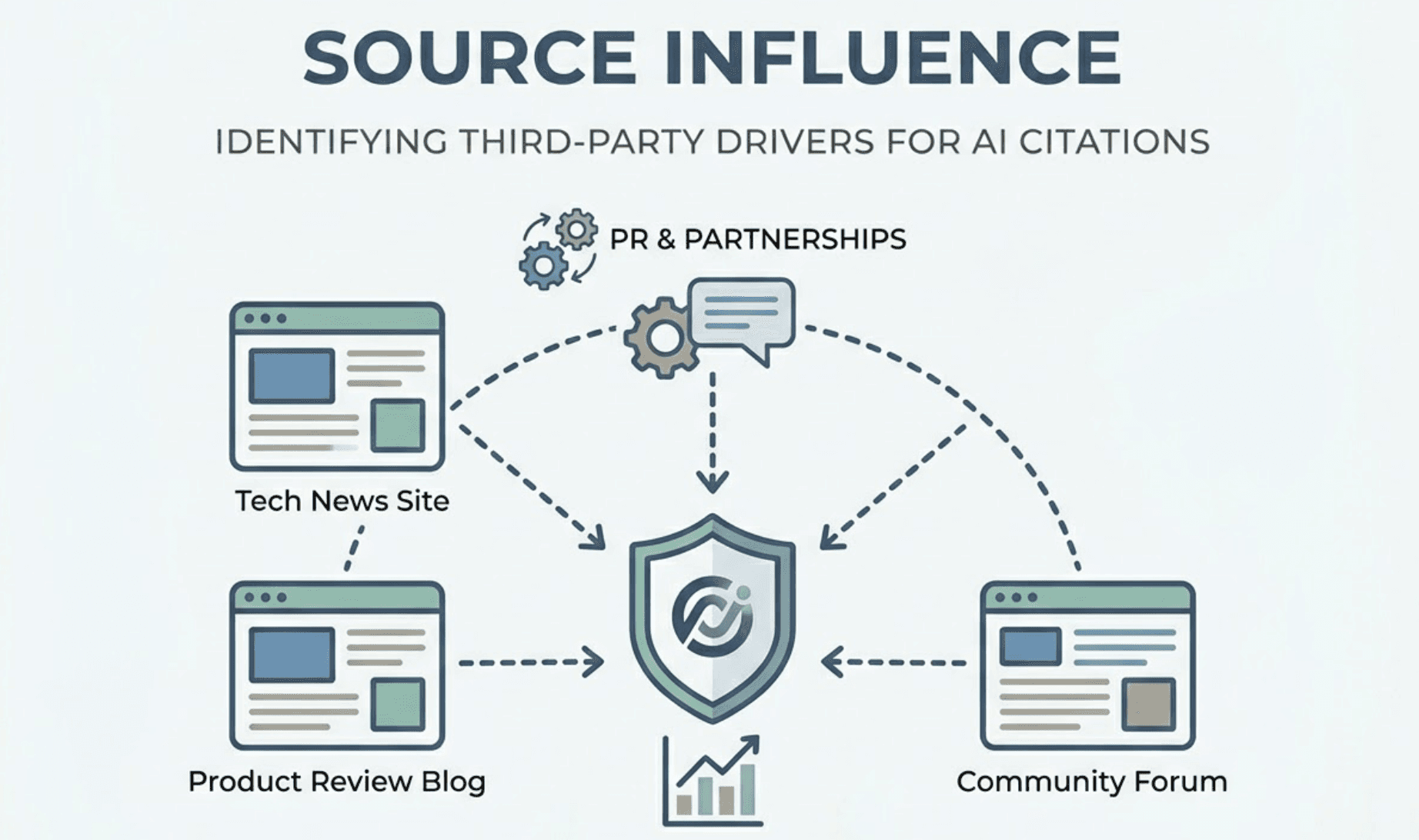
Position Tracking monitors where your brand consistently ranks when AI generates ordered recommendations. Volume Analytics tells you the search demand behind the prompts where you appear — high visibility on low-volume prompts moves the needle less than most teams assume. Source Influence identifies which third-party domains are driving AI to cite your brand, pointing directly to where PR and content partnerships pay off. CVR (Conversion Visibility Rate)estimates how likely AI-generated mentions are to push users toward brand interaction, because not all visibility carries equal commercial weight.
Topify tracks all seven of these metrics across ChatGPT, Gemini, Perplexity, DeepSeek, and other major AI platforms from a single dashboard. In practice, that means you can spot a drop in visibility on one platform and trace it back to a specific source domain that stopped citing your brand — without switching between tools or exporting CSVs.
A Strategy for AI Brand Monitoring Analytics That Goes Beyond Dashboards
Most brands treat analytics as the end state.
It's not. Data without action is just overhead.
A functional strategy for ai brand monitoring analytics operates at three levels. The Tracking Layer defines which prompts actually matter for your brand. This means covering category queries ("best CRM software"), comparison queries ("Brand A vs Brand B"), and problem-based queries ("how to automate sales follow-up"). Brands that monitor only branded queries miss the majority of how AI surfaces them to new audiences who haven't heard of them yet.
The Analysis Layer identifies where you lead and where you're invisible. AI clustering analysis surfaces which topics your brand dominates and which create a visibility gap. The highest-leverage opportunities are often mid-tier prompts — queries where you rank 6th to 10th in AI responses, close enough to push up with targeted content updates. That's the gap most brands still can't see.
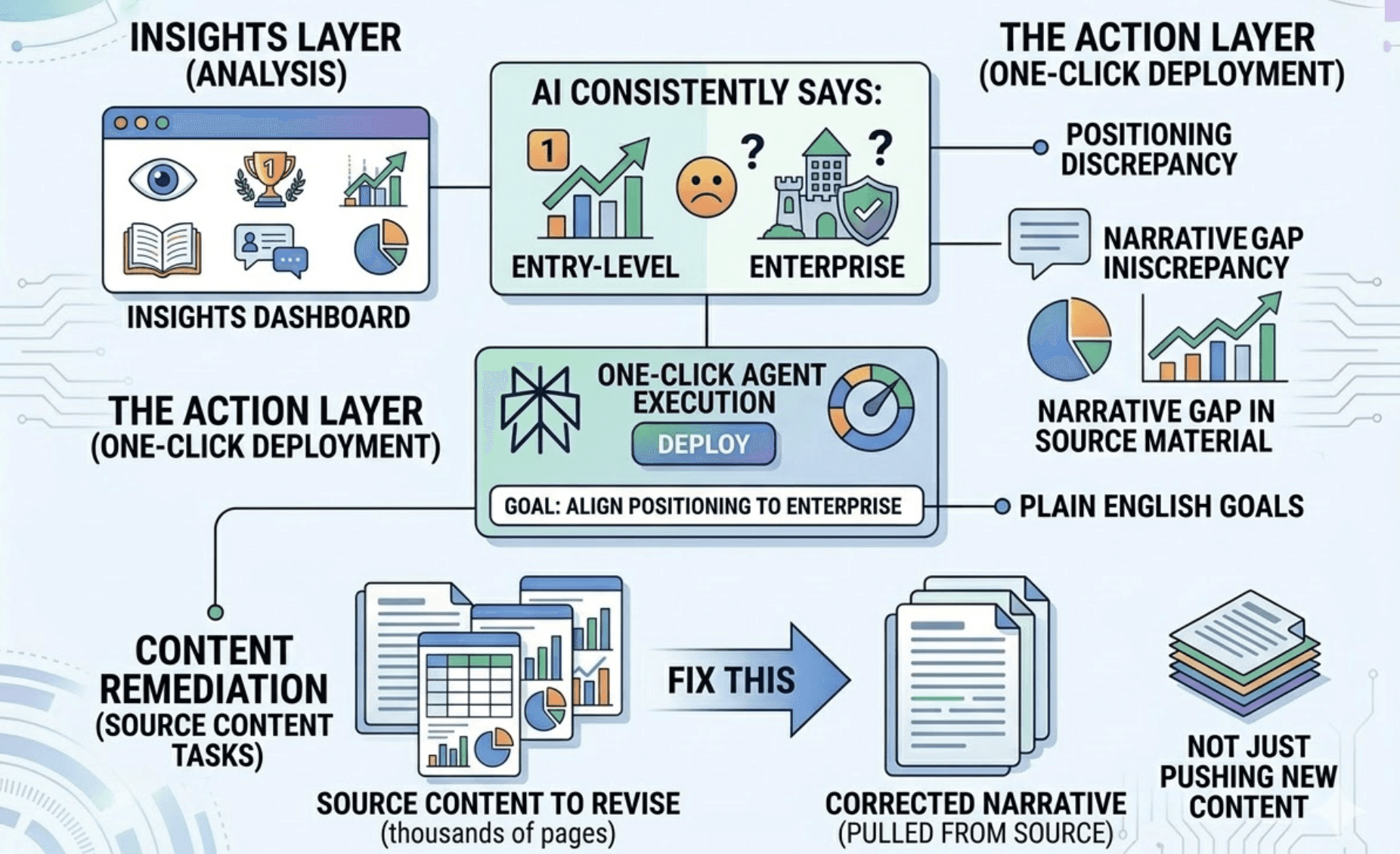
The Action Layer turns insights directly into content tasks. If AI consistently describes your product as "entry-level" when your positioning is enterprise, that signals a narrative gap in your source material. You fix the content AI is pulling from, not just the content you're publishing. Topify's One-Click Agent Execution lets teams define their visibility goals in plain English and deploy the strategy without manual workflows — connecting the analysis layer to the action layer automatically.
For affordable AI search visibility brands at the strategy stage, the priority isn't spending more. It's making sure your monitoring covers enough platforms and prompt types to give you an accurate picture. Monitoring only ChatGPT when your audience also uses Perplexity and Gemini creates a structural blind spot that no amount of additional content will fix.
Common Mistakes in AI Brand Monitoring Analytics
These four mistakes appear consistently across brands that struggle to turn monitoring into results.
Only monitoring one AI platform. ChatGPT has high name recognition, but it's not where every purchase decision happens. Perplexity drives more research-intent queries. Google AI Overviews — which already appear in over 50% of Google searches — reach users mid-funnel. A brand that only tracks ChatGPT can show 80% visibility on one platform while being completely invisible on the platforms that actually drive conversions.
Tracking mentions without tracking sentiment. A brand can appear in 60% of relevant AI responses and still lose deals if AI consistently describes them as "budget-friendly" when their market is mid-enterprise. Raw mention count is a vanity metric without the sentiment layer underneath it.
Using prompts that are too narrow. Many teams monitor their brand name and two or three category keywords. That's not a representative sample. AI surfaces brands across dozens of contextual variations, and a narrow prompt set creates sampling bias — you see the data that confirms you're visible, not the full picture of where you're missing.
Confusing AI hallucinations for real visibility. AI models sometimes generate brand attributes that don't exist: fabricated pricing, invented features, incorrect partnerships. If your monitoring system doesn't flag these errors, you may be measuring fictional performance data and building strategy on top of it. This is one of the more underappreciated risks in building an AI brand monitoring analytics program.
Examples of AI Brand Monitoring Analytics in Practice
SaaS brand, B2B category. A project management platform noticed their visibility score dropped 18% on Perplexity over six weeks with no corresponding drop in traditional search traffic. Source analysis revealed that a competitor had secured citations on three high-authority review domains that had previously linked to the SaaS brand. The brand responded by refreshing content on those sites and publishing a proprietary data study. AI platforms began referencing the new study within 30 days, and visibility recovered.
Marketing agency, multi-client management. An agency managing eight client brands discovered that five were invisible in AI responses for their primary category queries. One client had strong sentiment scores where they did appear, but near-zero Share of Voice on comparison prompts — the exact query type prospects use before choosing a vendor. Rebuilding the GEO reporting framework around prompt-level visibility, rather than aggregate brand mentions, gave the agency a concrete action plan for each client.
E-commerce brand, consumer goods. An online retailer found AI consistently describing their flagship product as "ideal for occasional use" — despite positioning it as a daily-use product. The disconnect traced back to a frequently cited review article using that exact phrase. Updating structured data and securing new citations with corrected language shifted the AI description within 45 days.
Each example follows the same pattern: visibility data surfaces a specific, fixable problem — not a vague directive to "produce more content."
Affordable AI Search Visibility Tools for AI Brand Monitoring Analytics
The market for ai brand monitoring analytics tools ranges from lightweight starters to full enterprise platforms. Here's where the main options sit by function and price.
Tool | Core Focus | Price Range | Best For |
|---|---|---|---|
Full GEO analytics + one-click execution | $99–$499+/mo | Teams that need tracking and strategy execution in one platform | |
Otterly.ai | Brand mention tracking | $29–$189/mo | Small teams, basic mention monitoring |
Peec AI | Research + geo-targeting | $99–$545/mo | Agencies with multi-region clients |
Riff Analytics | Accuracy + emerging models | $49–$199/mo | Teams tracking Grok, DeepSeek |
For affordable AI search visibility brands starting from scratch, Topify's Basic plan at $99/month covers ChatGPT, Perplexity, and AI Overviews tracking across 100 prompts with 9,000 AI answer analyses per month. That's enough coverage to build a meaningful visibility baseline for most mid-market brands, with 4 projects and 4 seats included.
The Pro plan at $199/month expands to 250 prompts and 22,500 AI answer analyses — suited for brands tracking multiple product lines or competing in high-volume categories where prompt diversity matters.
For context on ai brand monitoring analytics pricing: a full-service mid-market GEO strategy (software, consulting, and execution combined) typically runs $2,500 to $7,500 per month. An analytics-first approach through a platform like Topify reduces that cost significantly while keeping the data layer in-house and actionable.
The ROI case is also clearer than many teams expect. Brands cited in AI summaries see 35% higher organic click-through rates compared to brands that aren't cited. Visitors arriving from AI-generated recommendations show 32% longer session durations and 27% lower bounce rates than average traffic — which suggests AI pre-qualifies intent before the click in a way traditional search rarely does.
A Checklist for AI Brand Monitoring Analytics
Use this to evaluate whether your current setup is actually complete.
Coverage
[ ] Tracking brand mentions across at least 3 major AI platforms (ChatGPT, Perplexity, Gemini minimum)
[ ] Monitoring both branded and category-level prompts
[ ] Including comparison and problem-based prompt types
[ ] Covering the markets and languages where your audience actively searches
Metrics
[ ] Visibility Score tracked at the prompt level, not just as an aggregate
[ ] Share of Voice measured against direct competitors in AI responses
[ ] Sentiment analysis in place — not just positive/negative, but framing accuracy
[ ] Source Influence identified: you know which domains drive your AI citations
[ ] Position Tracking shows where you rank in ordered AI recommendation lists
Action Mechanism
[ ] Visibility drops trigger a content review process within 7 days
[ ] AI hallucinations about your brand have a documented correction workflow
[ ] Monitoring data feeds directly into content calendar and PR decisions
[ ] Competitor visibility shifts are tracked weekly, not quarterly
If you're missing more than three items in the action mechanism section, your analytics setup is generating data that isn't changing decisions. That's the most common failure mode — and the most fixable one.
Get started with Topify to run this framework automatically across all major AI platforms, with visibility alerts built in.
Conclusion
AI brand monitoring analytics has moved from an experimental practice to a core requirement. With over 50% of Google searches already returning AI summaries — and that share projected to exceed 75% by 2028 — the brands that understand what AI says about them will compound an advantage that becomes harder to close every quarter.
The starting point is more accessible than most teams expect. Pick the right prompts, track the right signals, and connect what you find to what you publish. The brands building that habit now aren't just monitoring faster. They're building the kind of citation authority that compounds in ways paid acquisition never will.
FAQ
Q: What is AI brand monitoring analytics?
A: AI brand monitoring analytics is the practice of tracking how AI systems represent, describe, and recommend your brand in response to user queries across platforms like ChatGPT, Perplexity, and Gemini. It differs from traditional brand monitoring, which tracks what people say about your brand. AI brand monitoring analytics tracks what AI tells people — which increasingly shapes decisions before a user ever reaches your website.
Q: How do I measure AI brand monitoring analytics effectively?
A: Start with four signals: Visibility Score (how often your brand appears in relevant AI responses), Share of Voice (your weight relative to competitors in AI recommendation lists), Sentiment analysis (how AI frames your brand, not just whether it mentions you), and Source Influence (which third-party domains drive your AI citations). These four together give you a functional and actionable picture of your AI presence.
Q: How often should I review my AI brand monitoring analytics?
A: Prompt-level visibility data should be reviewed weekly — AI citation patterns shift faster than traditional search rankings. Competitive benchmarking works well on a bi-weekly cadence. Full strategy reviews based on trend data are typically monthly. The key is connecting the review cadence to a content update cadence; data reviewed without a response mechanism doesn't change outcomes.
Q: What's the most affordable way to start with AI search visibility tracking?
A: Topify's Basic plan at $99/month covers the core platforms (ChatGPT, Perplexity, AI Overviews) with enough prompt capacity to build a real visibility baseline. For teams not ready to commit to a platform, a manual audit — querying 20 to 30 category and comparison prompts across three AI platforms — can surface major gaps without any tool cost. The manual approach doesn't scale, but it's a legitimate starting point for teams building the business case.