
You've spent a week comparing AI rank tracking tools. Every platform claims to monitor your brand across ChatGPT, Claude, and AI Overviews. But when you dig into the details, most free plans run 10 to 30 prompts a month on a single platform, while "full coverage" tiers price out at $300 to $700 before you've confirmed the data is even actionable.
The real issue isn't that AI brand monitoring dashboards don't exist. It's that the gap between what a free plan actually shows you and what you need to make decisions is wider than most product pages admit.
Free AI Rank Tracking Costs More Than You Think
Here's the thing about "free" in this category: it's typically not a product, it's a taste test.
Most free-tier tools give you enough data to feel like you're monitoring something. A handful of prompts, one platform, weekly refresh. You see your brand appear in two out of five queries and assume things are fine. What you don't see is how that compares to your top competitor, whether the framing is favorable, or what's happening on the three other platforms your audience uses.
The cost isn't the subscription price you're avoiding.
It's the decisions you're making on incomplete signal. AI-referred traffic converts at 4.4 times the rate of traditional organic search. A brand that's invisible in AI answers isn't just missing impressions. It's missing the highest-converting traffic channel available right now.
4 Things a Real AI Brand Monitoring Dashboard Must Track
Most tools in this category count mentions. A capable AI brand monitoring dashboard measures four distinct dimensions.
Visibility (Mention Rate): How often does your brand appear across relevant prompts? If you're present in 35 out of 100 targeted queries, that's your baseline. Tracking this over time tells you whether a content or distribution change actually moved the needle.
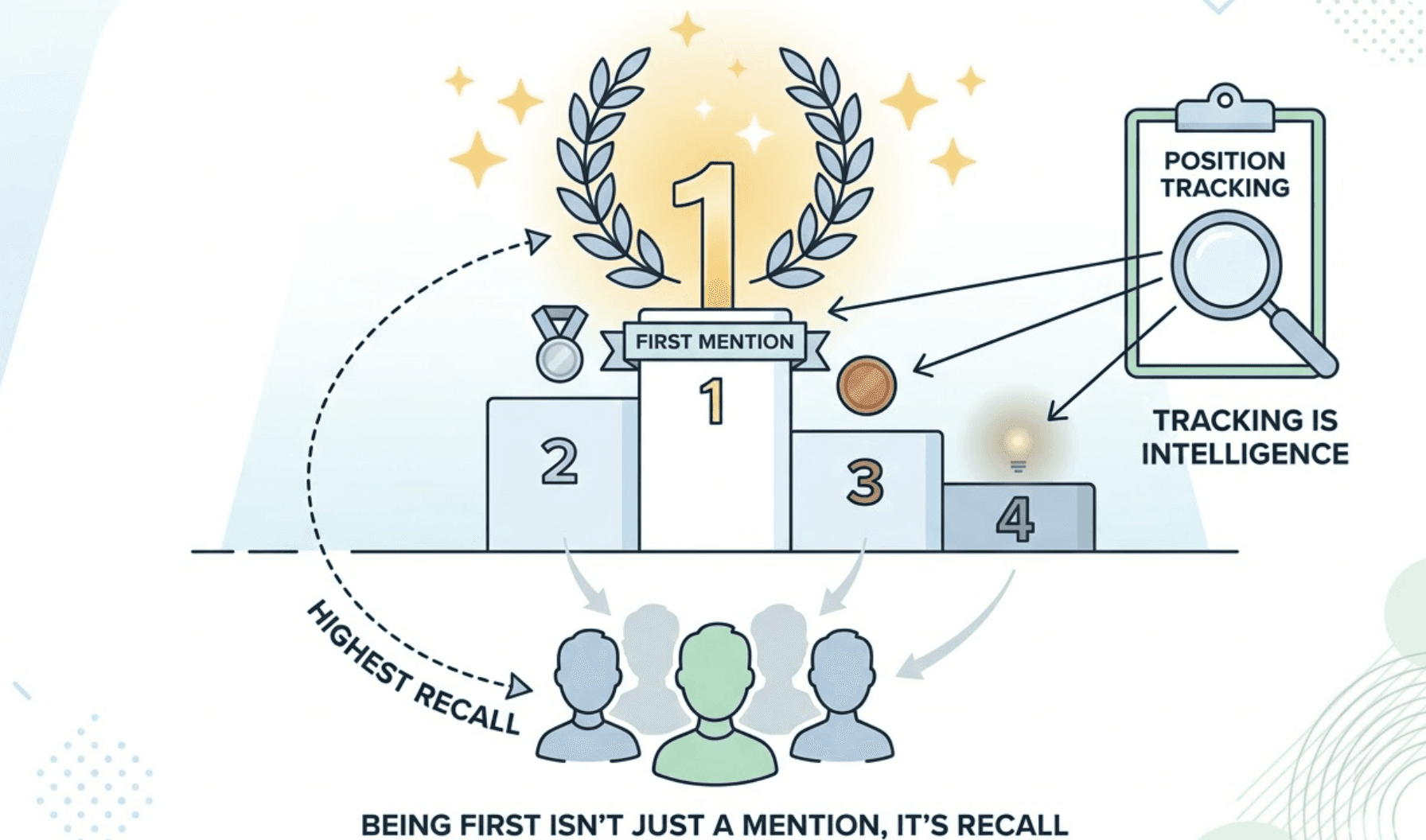
Position in Response: The first brand named in an AI recommendation captures a disproportionate share of recall. Being mentioned fourth isn't the same as being first, even if both register as a "mention." Position tracking is what separates visibility data from competitive intelligence.
Sentiment and Framing: AI assistants attach descriptors to every brand they mention. If ChatGPT consistently frames your enterprise product as "a solid choice for small teams," that's a positioning problem, not just a visibility gap. Monitoring framing polarity is now a primary function for brand and PR teams.
Source Attribution: Which URLs is the AI pulling from when it mentions your brand? Knowing the exact domains driving citations lets you reinforce what's working and fill the gaps that are costing you recommendations.
Without all four dimensions, you're seeing part of a picture. And when organic CTR for queries with AI Overviews dropped 61% between June 2024 and September 2025, partial data leads to decisions made on the wrong assumptions.
5 AI Brand Monitoring Dashboards Worth Your Time in 2026
Not all tools are built the same. Here's a direct comparison across the platforms most marketing teams are currently evaluating:
Tool | Platforms Covered | Free Tier | Starting Price | Best For |
|---|---|---|---|---|
ChatGPT, Gemini, Perplexity, Claude, AI Overviews, DeepSeek + more | 30-day trial | $99/mo | Teams needing full-stack GEO analytics and execution | |
Otterly AI | ChatGPT, Perplexity | Yes (limited) | ~$20/mo | Solo founders, quick brand mention checks |
Peec AI | ChatGPT, Perplexity, Gemini | Limited | ~$99/mo | Growing teams, basic sentiment benchmarking |
Profound | ChatGPT, Perplexity, Gemini | No | $300+/mo | Enterprise brands, multi-portfolio visibility tracking |
Semrush AI Toolkit | ChatGPT, Perplexity | No | $99–$745 add-on | Teams already on Semrush who want combined SEO and AI workflows |
Topify: The Dashboard Built for Full-Stack AI Brand Monitoring
Topify structures AI search as a managed growth channel, not just a reporting feature. Its GEO Analytics matrix tracks seven dimensions simultaneously: visibility, sentiment, position, volume, mentions, intent, and CVR. In practice, that means a single dashboard surfaces not just whether your brand appears, but where it ranks relative to competitors, how AI platforms are framing your messaging, and which source domains are driving those citations.
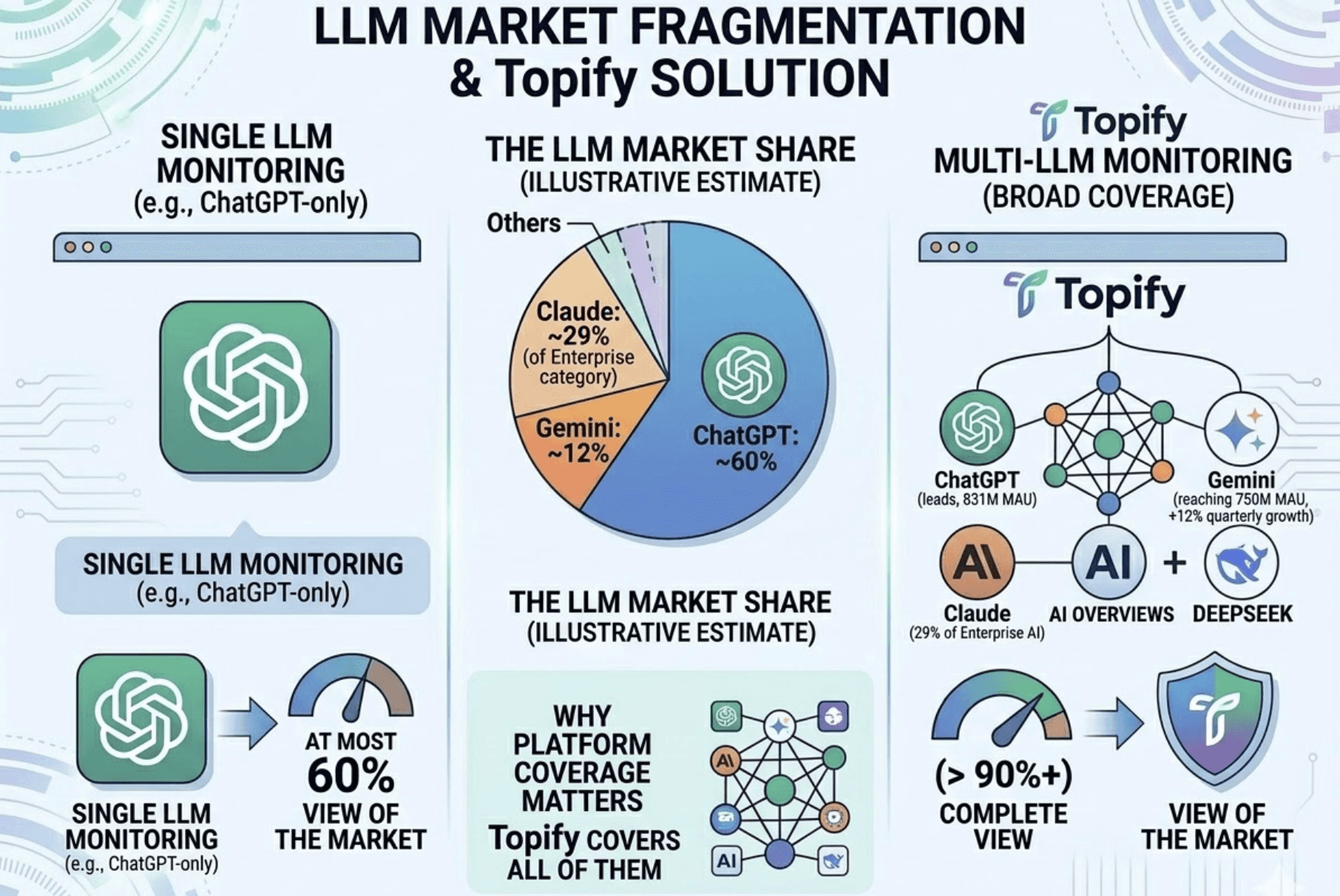
Platform coverage matters in a fragmented LLM market. ChatGPT leads with 831 million monthly active users and roughly 60% market share. But Gemini has reached 750 million MAU with 12% quarterly growth, and Claude holds 29% of the enterprise AI assistant category. Topify covers all of them, plus AI Overviews, DeepSeek, and several others. A dashboard that only tracks ChatGPT gives you a 60% view of the market at most.
The Basic plan at $99/month includes 100 tracked prompts, 9,000 AI answer analyses across 4 projects, and a 30-day trial with full platform access. That's enough coverage for most growing marketing teams to get a statistically reliable read on brand visibility before committing to an annual plan.
Two things separate Topify from dashboards that stop at the report. First, the Competitor Monitoring feature auto-detects rivals in AI responses and gives you a live view of how your position compares to theirs across every platform. Second, One-Click Agent Execution lets you define a GEO goal in plain English and deploy a strategy without building manual workflows. Most tools in this category hand you data and leave the next step entirely to you.
Topify is trusted by 50+ enterprises and startups, and its team includes founding researchers from OpenAI and Google SEO practitioners who have scaled brands from zero to 1 million organic visits. That background shows in how the platform handles prompt simulation depth, which turns out to be more important than most buyers realize before they see the data.
ChatGPT and Claude Free Rank Tracking: What the Free Tier Actually Gets You
There's genuine demand for chatgpt free rank tracking software and claude free rank tracking software. The honest breakdown: free tiers exist, but they come with structural constraints that limit their usefulness for anything beyond a one-time audit.
Typical free plans in the $0 to $20 range cap at 10 to 30 prompt runs per month, cover one or two platforms, and refresh data weekly or less. That's workable for validating whether AI platforms recognize your brand at all. It's not enough to catch a visibility drop in time to act on it.
For Claude specifically, free-tier coverage is thin across most tools in the $20 to $99 range. That gap is worth noting. Claude AI has reached 18.9 million monthly active users with 14% quarterly growth and 29% enterprise AI assistant market share. For B2B and SaaS brands, Claude isn't a niche channel anymore. But most LLM free rank tracking software still treats it as secondary.
On the flip side, Topify's 30-day full-access trial is a more useful evaluation window than a permanently restricted free plan. You get real data across all platforms, not a sample designed to show you just enough to want more.
Google AI Overviews Rank Tracking: The Platform Most Dashboards Quietly Skip
AI Overviews isn't the same thing as ChatGPT or Claude, and it can't be monitored the same way.
When a user queries ChatGPT, they get a generated conversational response. When they search Google and an AI Overview appears, that's a structured SERP feature sitting above organic results, pulling from indexed sources with its own retrieval logic. The monitoring approach, the content signals, and the optimization levers are all different.
The performance gap is significant. Brands cited within AI Overviews see 35% higher organic CTR and 91% higher paid CTR compared to brands that are omitted. AI Overviews now appear in 13% to 30% of all Google queries, with some verticals reaching near-ubiquitous coverage. And 60% of all Google searches already end without a click, rising to 77.2% on mobile.
Most ai overview free rank tracking software is either limited to keyword-level detection without brand citation tracking, or bundled into expensive SEO suites priced for enterprise budgets. One major platform's AI Overviews monitoring add-on starts at $699 per month.
That pricing puts standalone AI Overviews monitoring out of reach for most marketing teams. Topify's Basic plan includes AI Overviews tracking as part of its core coverage, not a premium add-on. For teams that need both LLM monitoring and ai overviews free rank tracking under one dashboard, that's one of the few entry-level options where both are genuinely included from day one.
Before You Sign Up, Ask This One Question About Data Quality
Most tool comparisons skip the most important question in this category: how many times does the tool actually run each prompt?
Research from SparkToro found that asking an AI for brand recommendations 100 times produces close to 100 distinct responses, in terms of which brands appear and in what order. AI responses are non-deterministic by design.
A tool that checks your brand visibility once per day is capturing a single data point from a highly variable distribution. That single point can swing dramatically in either direction, masking real shifts or flagging phantom changes that aren't there.
To get a statistically stable visibility score, a prompt set needs to run 60 to 100 times per cycle and be averaged. Most low-cost tools don't disclose whether they do this. It's the right question to ask before you trust a dashboard number. Topify runs multiple prompt iterations per cycle to produce an averaged result, not a snapshot. For teams using AI visibility data to justify content investment or distribution decisions, that distinction matters more than the dashboard's visual design.
Conclusion
Your brand's position in AI search is already being set, whether you're monitoring it or not. As 25% of organic search traffic migrates to AI assistants by late 2026, the performance gap between brands with structured monitoring and those flying blind will compound quickly.
The practical starting point is a dashboard that covers ChatGPT, Claude, Perplexity, and AI Overviews in one place, runs enough prompt iterations for statistically valid data, and surfaces position and sentiment alongside raw mention counts. Topify's 30-day trial covers all of this at the Basic tier. Get started here and run your first cross-platform brand audit before end of week.
The data will tell you things your current SEO reports can't.
FAQ
Q: Is there a truly free AI brand monitoring dashboard?
A: Most tools offer limited free tiers capped at 10 to 30 prompts per month on one or two platforms, typically ChatGPT and Perplexity. These work for a one-time audit but not for continuous monitoring. Topify offers a 30-day full-access trial on its Basic plan, which gives a more complete picture before you commit to a paid plan.
Q: What's the difference between tracking ChatGPT vs. Claude vs. AI Overviews?
A: ChatGPT and Claude are generative LLMs that respond to conversational queries. AI Overviews is a Google SERP feature that synthesizes content from indexed sources and operates on a different retrieval architecture. They require different monitoring approaches, and a complete AI brand monitoring dashboard should cover all three, since your audience is distributed across each of them.
Q: How often should an AI brand monitoring dashboard refresh rankings?
A: Refresh frequency matters less than sample size per run. Because AI responses are non-deterministic, a single daily prompt check produces unreliable data. Look for tools that run each prompt 60 to 100 times per cycle and report averaged results. Weekly deep-scan monitoring with proper sampling is more useful than daily single-prompt snapshots.
Q: Do I need to track LLMs and AI Overviews separately?
A: Ideally, no. Running two separate tools for LLM tracking and ai overview free rank tracking adds workflow overhead and makes it harder to correlate signal across channels. Platforms that cover both under one dashboard simplify reporting and help you identify whether a visibility shift is happening in conversational AI, search AI, or both simultaneously.