
Search "AI search monitoring" and you'll find platforms ranging from $29 to $2,000 a month, each claiming full coverage. Half of them only pull data from ChatGPT. The other half lock multi-platform support behind enterprise tiers that cost more than most teams' entire tool stack combined.
The real problem isn't finding an AI search monitoring solution. It's figuring out which one actually measures what matters, across the platforms your audience is using, without requiring a procurement process to afford it.
Most AI Rank Tracking Tools Charge You for Capacity You Won't Use for Months
The pricing logic behind most AI search monitoring platforms follows enterprise assumptions: pay for maximum capacity upfront, grow into it later. That works for Fortune 500 brand teams with dedicated GEO budgets. It doesn't work for a four-person SaaS marketing team trying to validate whether they're appearing in ChatGPT before committing to a full GEO strategy.
Three traps show up repeatedly when evaluating cheap rank tracking tools:
Single-platform coverage buried in the fine print. Some tools market "AI search monitoring" while only pulling ChatGPT data at base tier. One well-known enterprise platform charges $99/month for a Starter plan that covers ChatGPT exclusively. Adding Perplexity and AI Overviews jumps the bill to $399. That's a 300% price increase for platforms that already account for a significant share of AI search behavior.
Prompt caps that expire faster than expected. A plan with 15 monthly prompts sounds workable until you realize each brand-category-platform combination counts separately. Track 5 queries across 3 platforms and you've hit 15 before the end of week one.
Data refresh cycles that make trend analysis impossible. Weekly or monthly refresh intervals mean that by the time you see a competitor gaining ground in AI recommendations, they've already had three weeks of uncontested visibility. If the update cadence isn't daily or near-daily, the monitoring data is more historical artifact than operational signal.
The good news: the market has caught up to these pain points. Several platforms have built specifically around them.
The 5 Best AI Search Monitoring Solutions Ranked by Value
Before the deep dives, here's how the main options compare on the metrics that actually matter at budget-conscious tiers:
Tool | Starting Price | Platforms Covered | Min. Prompts Included | Competitor Monitoring |
|---|---|---|---|---|
Topify | $99/mo | ChatGPT, Perplexity, AI Overviews + more | 100 | Yes |
Mangools AI Search Watcher | $12–$37/mo | ChatGPT, Gemini, Claude, Grok, Llama | Limited | No |
Nightwatch | $32/mo | ChatGPT, Claude + traditional SERP | Limited | No |
SE Ranking | $52–$189/mo | ChatGPT, AIO, Gemini, Perplexity | Varies | Partial |
AI Rank Checker | $0.03/check | ChatGPT, Gemini, Claude, others | Pay-per-use | No |
The gap between the top option and the rest isn't purely about features. It's about what happens after the data comes in.
#1 Topify: The Most Complete AI Search Monitoring Solution at This Price Point
Topify tracks brand performance across seven metrics: visibility, sentiment, position, volume, mentions, intent, and CVR. At the Basic plan ($99/month), you get 100 prompts, 9,000 AI answer analyses, 4 projects, and 4 seats, covering ChatGPT, Perplexity, and AI Overviews with a 30-day trial included.
That depth matters in practice.
A SaaS marketing team tracking "best project management software for remote teams" doesn't just want to know whether they appear in AI answers. They want to know whether they appear in a positive context, where they rank relative to competitors, and which domains AI is citing when it recommends their category. Topify surfaces all of that in a single view. No stitching together reports from multiple tools.
The competitor monitoring feature is where Topify pulls away from tools in the same price range. Most ai cheap rank tracking tools show you your own data. Topify shows you the gap: which brands AI engines are recommending instead of you, what position those brands hold, and what content changes would close the distance. That's the data that actually drives editorial decisions.
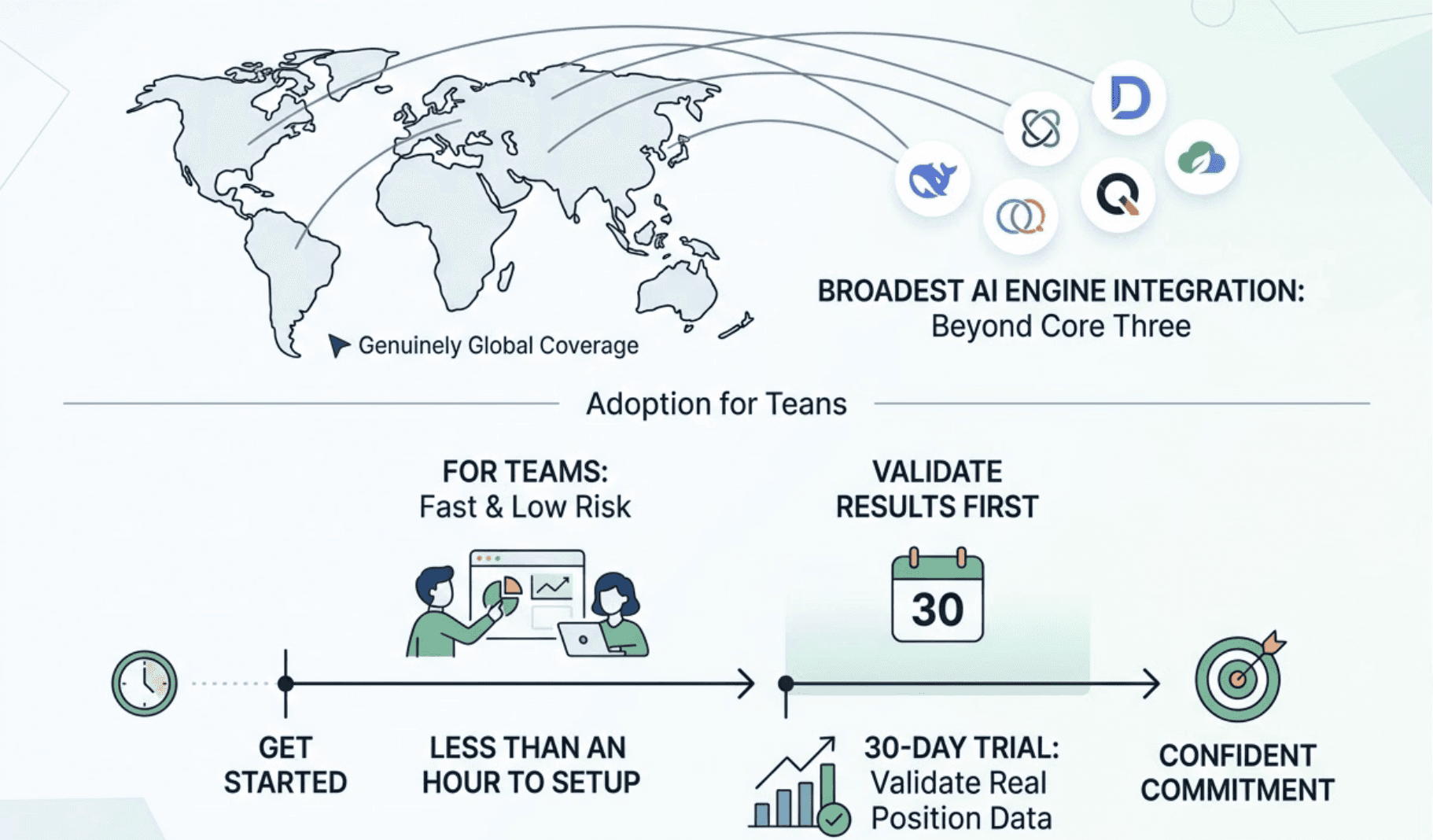
Topify also covers DeepSeek, Gemini, Doubao, Qwen, and other platforms beyond the core three, making it one of the few tools in this tier with genuinely global AI engine coverage.
For teams ready to move past manual ChatGPT spot-checks, getting started takes less than an hour. The 30-day trial means you can validate real position data before committing to a plan.
Best for: In-house marketing teams, SaaS brands, agencies managing multiple clients Pricing: Basic $99/mo · Pro $199/mo · Enterprise from $499/mo · Full pricing here
#2 Mangools AI Search Watcher
Mangools is the lowest-friction entry point in this comparison. At $12 to $37 per month depending on your existing Mangools subscription, the AI Search Watcher covers ChatGPT, Gemini, Claude, Grok, and Llama.
One technical detail worth noting: Mangools runs each prompt five times and averages the results. Because AI outputs are non-deterministic, that methodology produces more statistically stable data than single-run tools. It's an unusually rigorous approach at this price point.
The limitation is depth. There's no competitor monitoring and no sentiment analysis. You'll know whether you're appearing, but not the context around that appearance or how it compares to what AI says about competitors.
Best for: Individual consultants, small teams running initial benchmarks Pricing: $12–$37/mo (bundled with Mangools suite)
#3 Nightwatch
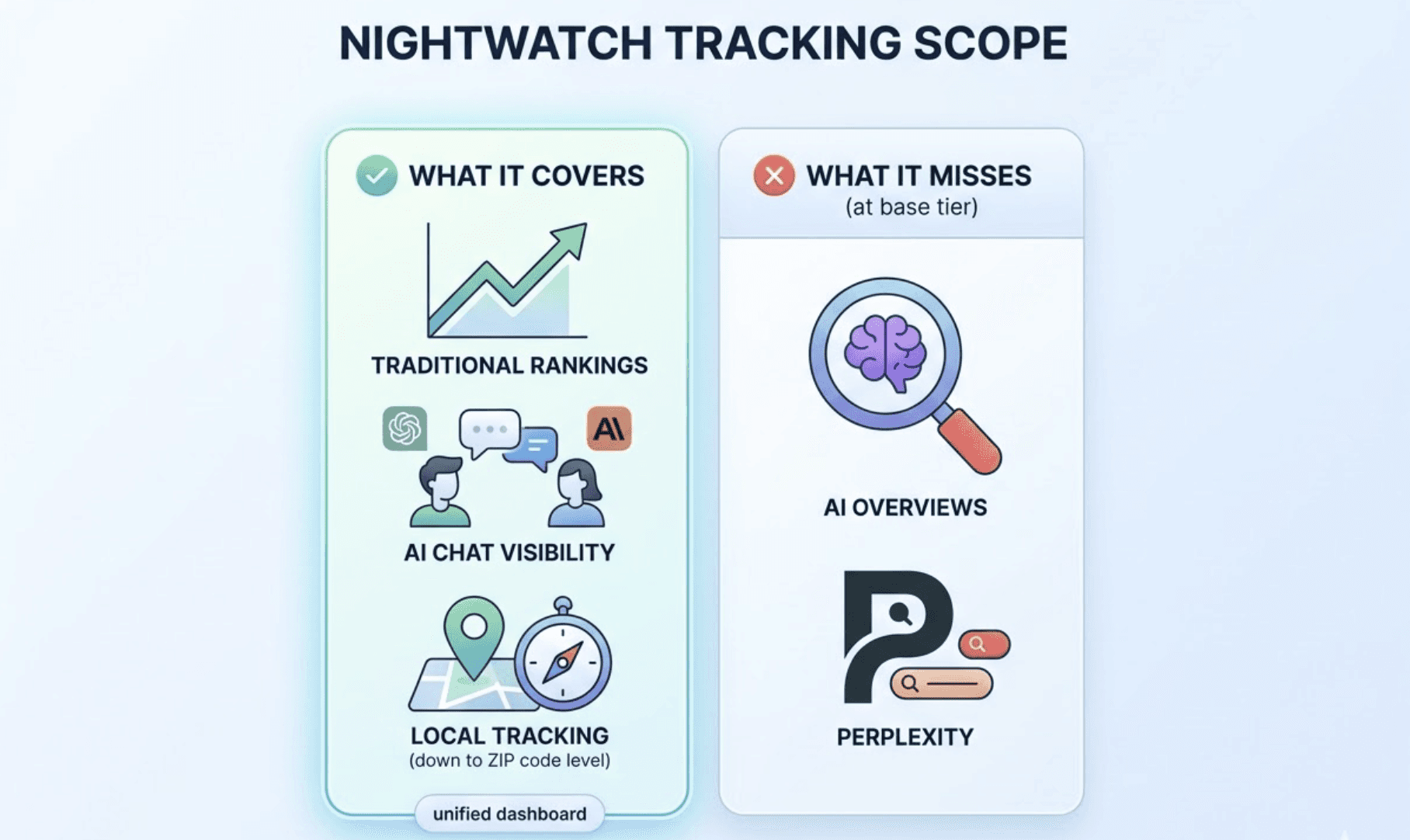
Nightwatch positions itself as a unified tracker: traditional keyword rankings plus AI chat visibility in one dashboard. ChatGPT and Claude coverage at $32/month is competitive, and its local tracking capability, down to ZIP code level, is useful for brands with regional targeting needs.
The trade-off is platform breadth. If Perplexity or AI Overviews are priorities for your audience, Nightwatch doesn't cover them at base tier.
Best for: Local businesses, SEO teams already using Nightwatch for traditional rank tracking Pricing: From $32/mo
#4 SE Ranking
SE Ranking's Essential plan starts at $52/month, but AI visibility tracking comes through its SE Visible add-on at additional cost. Total spend typically lands between $89 and $189/month for meaningful AI monitoring.
The case for SE Ranking is consolidation. One interface for traditional SEO metrics and AI visibility data cuts tool-switching time and prevents the monitoring gaps that happen when two separate dashboards go out of sync. Platform coverage includes ChatGPT, AI Overviews, Gemini, and Perplexity.
Best for: Teams already on SE Ranking for traditional SEO who want to layer in AI monitoring without a separate subscription Pricing: $52–$189/mo (plan + add-on)
#5 AI Rank Checker
No subscription, no monthly commitment. AI Rank Checker charges $0.03 per check across ChatGPT, Gemini, Claude, and other platforms.
This model works well for point-in-time audits or low-frequency monitoring. It breaks down fast for teams running 200+ monthly checks, where per-check costs exceed a flat-rate subscription within the first two weeks.
Best for: Freelancers, occasional audits, pre-subscription validation before committing to a plan Pricing: $0.03 per check
What "Cheap" Actually Costs When Your AI Rank Tracker Skips Claude and Other LLMs
Here's the data point that should change how you evaluate platform coverage.
Claude AI is currently the fastest-growing major AI platform at 14% quarterly growth. Among users aged 18 to 24, Claude's penetration sits at 51.88%. If your audience skews toward younger demographics, developers, or enterprise buyers who favor long-form analysis, your brand's visibility in Claude carries more weight than raw market share percentages suggest.
Perplexity, at 5.8% overall market share, punches above its weight in research-oriented queries. These are users deep in evaluation mode, and research consistently shows that AI-driven visitors convert at 4.4 times the rate of standard organic search traffic. Missing visibility in Perplexity doesn't show up in your traffic dashboard immediately. It tends to show up in pipeline metrics six to eight weeks later.
The pattern holds across llm cheap rank tracking tools as a category: tools that only monitor ChatGPT are making a bet that the market won't fragment further. That bet is getting harder to justify every quarter. Gemini has hit 15.2% market share with 12% quarterly growth. Grok saw 1,279% growth in a single month in 2025, driven by its integration into X and its real-time social search capabilities.
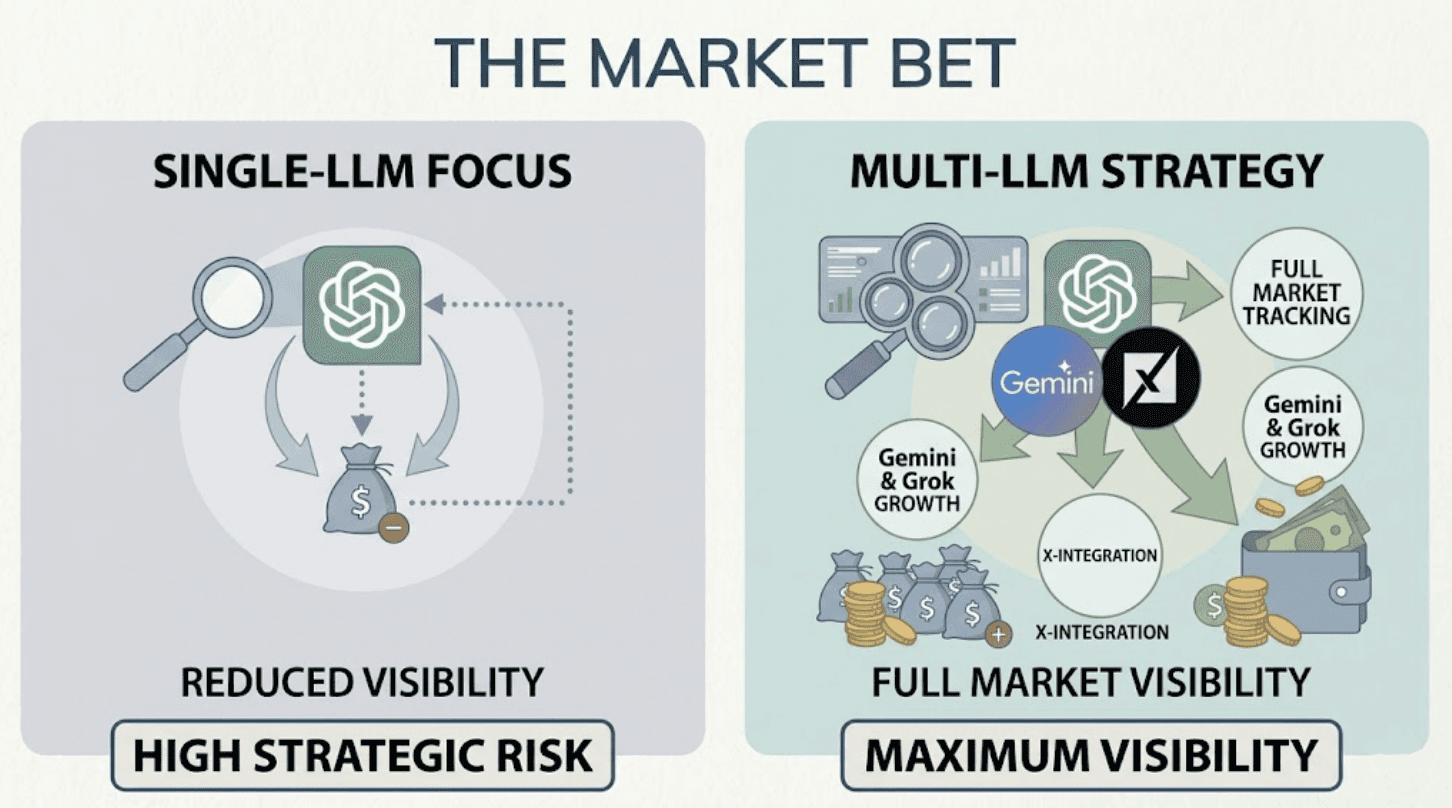
Monitoring all of these platforms with a different tool for each one isn't realistic on a tight budget. The value of a multi-platform solution like Topify at $99/month isn't the feature list. It's the time and cost savings from not running five separate point checks across five separate interfaces.
How to Track AI Overviews and AI Mode Rankings Without Enterprise Pricing
AI Overviews now appear across a wide range of Google search categories. On mobile, AI Overviews can occupy up to 75.7% of the initial screen, pushing traditional organic results well below the fold.
The citation economics have shifted accordingly. Brands cited in AI Overviews see 35% higher organic CTR and 91% higher paid CTR compared to brands that aren't cited. That gap is now one of the highest-leverage variables in search performance, and it's not visible in any traditional rank tracking report.
For ai overviews cheap rank tracking, the options used to be limited to enterprise tools with enterprise pricing. That's no longer the case. Topify's Basic plan includes AI Overviews tracking alongside ChatGPT and Perplexity at $99/month. The position data shows not just whether you're included, but where you rank relative to competitors within the AI Overview itself. That distinction matters: appearing as the third-mentioned brand in an AI Overview is meaningfully different from appearing first.
For ai mode cheap rank tracking, the monitoring logic follows the same framework. As Google's AI Mode expands, the brands that have already built visibility tracking infrastructure for AI Overviews will be positioned to extend it to AI Mode quickly. Waiting until the behavior is fully mainstream before starting to monitor it means entering the game six months behind.
The general principle: the time to build monitoring infrastructure for a new AI search format is before the data accumulates, not after.
Over 60% of AI search queries are new, long-tail conversational queries that don't map to traditional keyword formats. Brands that set up prompt-based tracking now, using the actual language their buyers use in AI conversations, tend to surface visibility gaps that no keyword report would ever catch.
Conclusion
The AI search monitoring market looks expensive from the outside. It doesn't have to be.
Start with 10 to 20 prompts that map to your highest-intent buyer queries. Track them across at least three AI platforms. Watch for changes in mention rate and position, not just raw visibility score. That baseline takes less than a week to set up and gives you data most competitors still don't have.
Topify's Basic plan covers that workflow at $99/month, with a 30-day trial to validate real data before committing. For teams that need affordable AI search monitoring across ChatGPT, Claude, Gemini, and AI Overviews without jumping to enterprise pricing, it's the clearest starting point available right now.
Get started with Topify and run your first visibility report within the hour.
FAQ
Q: What's the difference between a cheap AI rank tracking tool and a professional AI search monitoring solution?
A: Cheap tools typically tell you whether your brand appears in AI answers. A professional AI search monitoring solution measures position (where you appear relative to competitors), sentiment (how AI describes your brand's tone and attributes), and citation sources (which domains AI references when recommending your category). The data tier determines whether you can act on results or just observe them.
Q: Do I need to track Claude and other LLMs separately from ChatGPT?
A: Yes, and the difference is larger than platform market share numbers suggest. Claude is growing at 14% quarterly, the fastest of any major AI platform, and holds 51.88% penetration among users aged 18 to 24. AI-driven visitors in research mode, particularly on Perplexity, convert at rates up to 4.4 times higher than standard organic search traffic. A monitoring setup that covers only ChatGPT is leaving meaningful visibility data on the table.
Q: Can I track AI Overviews rankings with a budget-friendly tool?
A: Yes. Topify's Basic plan at $99/month includes AI Overviews tracking alongside ChatGPT and Perplexity. Most tools either exclude AI Overviews at base tier or require separate add-ons that push the total cost significantly higher. It's worth confirming platform coverage in the feature list before subscribing, since pricing pages don't always make the breakdown explicit.
Q: How many prompts do I actually need to monitor AI search visibility effectively?
A: For most teams starting out, 20 to 30 prompts covering core product categories and buyer-intent queries provides a solid baseline. Over 60% of AI queries are new long-tail conversational questions that don't match traditional keyword formats, so building your prompt set around how buyers actually phrase questions in AI tools, rather than how they'd type a Google search, tends to surface more actionable visibility gaps.