
Your keyword rankings are solid. Your domain authority is respectable. But someone just asked ChatGPT for a tool recommendation in your category, and your brand wasn't in the answer. Not mentioned once.
That's not a content problem. That's a visibility system problem. Traditional SEO metrics were built to measure placement in a list of links. They weren't built to measure whether an AI synthesizes your brand into its response. In 2026, those are two entirely different things.
What AI SEO Actually Means in 2026
AI SEO, also known as Generative Engine Optimization (GEO), is the practice of structuring a brand's digital footprint so it gets retrieved, synthesized, and recommended by AI platforms during their answer-generation process.
The architectural difference from traditional SEO matters here. Traditional search engines match keywords to documents. Generative engines match user intent to specific, citable facts across multiple documents. One produces a ranked list. The other produces a synthesized answer.
That distinction reshapes the entire game. AI-driven search interactions have grown from under 10% in 2023 to 30% by 2026, and the average AI search query is now 23 words long, compared to four words for traditional search. Users aren't looking for options anymore. They want the answer.
Generative AI SEO tools are designed specifically for this new environment. They don't track where you rank. They track whether you get cited.
Your Google Rankings Don't Predict AI Search Visibility
This is the part that surprises most SEO teams.
In early 2025, there was a 76% overlap between top 10 organic rankings and AI citation sources. By early 2026, that overlap had dropped to between 17% and 38%. High-DA brands like Forbes rank for thousands of keywords but receive fewer AI citations than smaller, more factually dense niche sites.
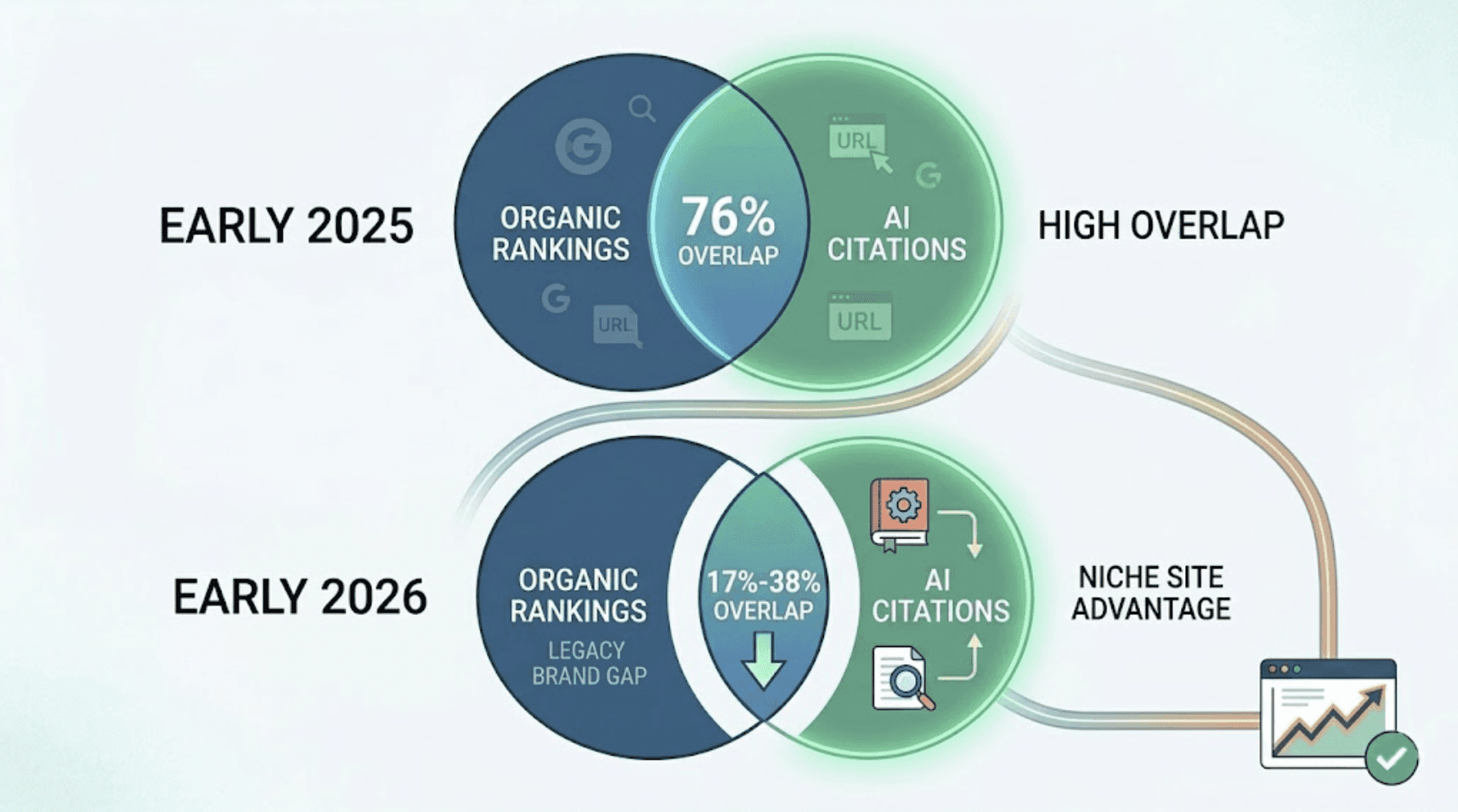
The reason is Google's "Query Fan-out" method, where AI decomposes a query into multiple sub-queries and pulls answers from diverse sources. 88% of citations in Google's AI Mode don't appear in the organic SERP for the same query. That means your #1 ranking offers no guarantee of inclusion.
On the flip side, this creates real opportunity. A Princeton University study on GEO found that structural content optimizations helped pages ranked at position #5 achieve a 115% increase in AI visibility. Smaller brands that optimize for extractability can outperform larger ones that don't.
That's not a fluke. That's the new citation economy at work.
How Generative AI SEO Actually Works (And What Signals Matter)
The mechanism runs on Retrieval-Augmented Generation (RAG). When a user enters a query, the AI identifies semantic intent, retrieves the most citable passages from training data and the live web, and synthesizes a response. The decision of what to include comes down to a set of measurable signals.
Semantic completeness is the strongest predictor, with a 0.87 correlation coefficient. A page needs to function as an "answer island," resolving the query without requiring additional context. Content with a cosine similarity score above 0.88 with the user's intent sees a 7.3x higher AI citation selection rate.
Factual specificity matters more than comprehensiveness. Adding statistics alone improves AI visibility by up to 40%. Citing credible external sources, such as government data or peer-reviewed studies, increases citation probability by 89%.
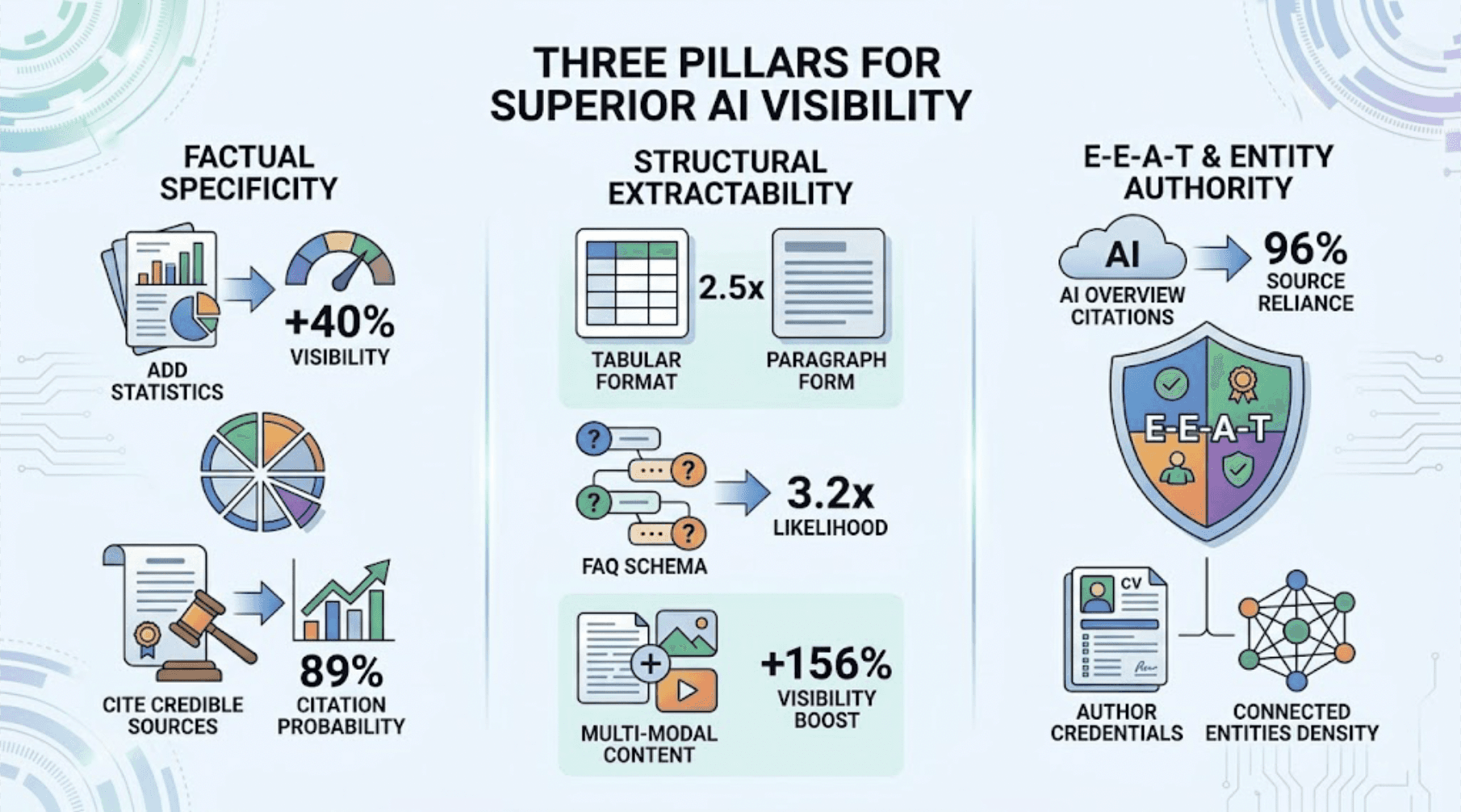
Structural extractability is where most brands fall short. Data presented in tabular format gets cited 2.5x more frequently than the same data in paragraph form. FAQ schema makes content 3.2x more likely to appear in AI Overviews and ChatGPT responses. Multi-modal content combining text, image, and video data shows a 156% visibility boost.
E-E-A-T and entity authority close the loop. 96% of AI Overview citations come from sources with strong Experience, Expertise, Authoritativeness, and Trustworthiness signals. The AI evaluates both author credentials and the density of connected entities in the text.
Track it. Structure it. Prove it.
The AI SEO Strategy That Actually Moves the Needle
Most teams start this process backwards. They optimize content before they know where they actually stand in AI answers. The right sequence runs in four steps.
Step 1: Audit AI visibility first. Query ChatGPT, Gemini, and Perplexity with 50-100 high-intent prompts from your category. Track whether your brand appears, how it's described, and which sources the AI cites as proof. This baseline is your real starting point.
Step 2: Identify high-value AI prompts. This replaces traditional keyword research. Instead of search volume, you're looking for conversational strings where your category shows up in AI answers. Topify's High-Value Prompt Discovery continuously surfaces these opportunities as AI recommendation patterns shift, prioritizing prompts closest to a purchase decision.
Step 3: Restructure content for extraction. Apply the BLUF principle: Bottom Line Up Front. 44.2% of AI citations come from the first 30% of a page's text. Each H2 section should stand alone as a complete answer. This is "Section Modularity," and generative AI SEO services built around this principle consistently outperform those that don't use it.
Step 4: Monitor and iterate. Citation patterns shift when models update. The January 2026 rollout of Gemini 3 as the global default changed citation behavior across the board. Teams that weren't tracking it didn't notice for weeks.
Generative AI in SEO agencies has matured to the point where this four-step loop is now standard practice for client delivery. The agencies that still lead with link-building proposals are losing pitches.
Generative AI SEO Tools: What Teams Are Actually Using
The 2026 tooling stack splits into two categories: monitoring tools and actionable optimization platforms. Most brands need both, and the distinction matters.
Tool | Category | Key Strengths |
|---|---|---|
End-to-End GEO Platform | Visibility, Sentiment, Position, Source Analysis, Competitor Monitoring, One-Click Execution | |
Share of Model™ | Brand Perception | Cross-LLM sentiment, attribute mapping |
Lumar | Technical GEO | Schema validation, AI crawlability |
ZipTie.dev | Monitoring & Audit | Screenshot evidence, AI Success Score |
AthenaHQ | Technical Foundation | llms.txt generation, structured content |
Topify tracks brand performance across seven core metrics: visibility, sentiment, position, volume, mentions, intent, and CVR, across ChatGPT, Gemini, Perplexity, DeepSeek, and other major platforms. The "Near-Top 3" feature identifies prompts where a brand is close to breaking into an AI citation, letting teams prioritize content refreshes with the highest ROI.
What separates Topify from traditional SEO suites is the ability to track brand generative AI mentions and cross-reference them with competitor positions in the same answer. That context, knowing not just that you were cited but where you ranked relative to alternatives, is what drives actual optimization decisions.
For teams managing multiple clients, Topify's agency-tier plan handles up to 10 seats and 8 projects simultaneously, which is where most agency GEO workflows start to require dedicated infrastructure rather than manual prompt testing.
How to Measure AI SEO: The Metrics That Actually Tell You Something
Click-through rate and keyword position don't disappear, but they move to secondary status. The six metrics that matter in 2026 are:
Share of Model (SoM): How often your brand appears in AI responses across a representative set of category prompts, compared to competitors. This is the generative equivalent of market share.
Answer Inclusion Rate (AIR): The percentage of relevant queries where your brand is included in the synthesized response. The closest analog to a #1 ranking.
Brand Sentiment Score: AI doesn't just mention brands. It describes them. Whether Perplexity calls you "enterprise-grade" or "budget-friendly" directly affects purchase consideration. Topify's Sentiment Analysis scores this 0-100.
Citation Authority and Velocity: How often authoritative sources cite your brand, and whether that frequency is accelerating or declining. High velocity from credible sources correlates with sustained AI visibility.
Entity Confidence Score: How accurately the model understands your brand's attributes. Low confidence leads to AI hallucinations about your product category, pricing, or features.
Synthetic CVR: AI-referred traffic converts at 14.2% to 18.4%, compared to the 2.8% average for traditional organic search. Volume is lower, but the quality gap is significant.
Metric | SEO Baseline (2024) | AI SEO Standard (2026) |
|---|---|---|
Primary KPI | Organic Clicks | Brand Citations / Mentions |
Volume Unit | Search Volume | Prompt Frequency |
Position | Rank (1-100) | Answer Placement (Top/Middle/None) |
User Value | CTR | CVR (AI referrals convert 23x higher) |
The shift is structural, not incremental. Teams still tracking only Google Search Console data are measuring the wrong thing.
Generative AI SEO Services and Pricing: What to Expect
The AI SEO pricing market has settled into three tiers, each designed for a different stage of organizational maturity.
Tier 1: DIY and Tool-First Platforms ($99-$249/month) Startups and smaller teams typically start here. Topify's Basic plan starts at $99/month and covers ChatGPT, Perplexity, and AI Overviews tracking across 100 prompts and 4 projects. The Pro plan at $199/month expands to 250 prompts and 10 seats, which fits most growing in-house marketing teams.
Tier 2: Managed Services and Hybrid Agencies ($2,000-$7,500/month) Mid-market companies that need strategy alongside tooling typically invest in hybrid arrangements combining platform access with agency execution. Topify's managed service offering starts at $3,999/month and includes 60 high-quality GEO articles, Reddit visibility posts, and 40 SEO keywords per cycle, structured around a continuous feedback loop of monitoring, content, and optimization.
Tier 3: Enterprise Solutions ($15,000-$50,000+/month) Large enterprises with complex brand portfolios and multi-market AI search exposure require full lifecycle management. This includes custom AI visibility strategy, digital PR to influence citation sources, and sentiment management across all major models. Topify's Enterprise plan starts at $499/month for the platform tier and scales to full managed service engagements.
Service Model | Monthly Cost | Best For |
|---|---|---|
SaaS Platform | $99-$249 | Startups, small teams |
Managed Service | $3,999-$5,999 | Growing brands, agencies |
Enterprise | $15,000-$50,000+ | Fortune 500, high-competition |
The ROI case for this investment is clearer than it is for most traditional marketing channels. B2B SaaS companies report an average ROI of 702% from search optimization, and AI-referred visitors spend 8 seconds longer on-site and view 50% more pages than traditional search visitors.
5 Mistakes That Keep Your Brand Out of AI Answers
Most brands aren't invisible to generative AI because of a strategy failure. They're invisible because of a handful of consistent technical and content errors.
Neglecting schema and structured data. Only 12.4% of sites currently use FAQPage, Article, or Product schema. AI models struggle to extract claims from flat HTML with confidence. This is the highest-ROI technical fix available in 2026, and most brands still haven't done it.
Optimizing only for Google's top 10. AI Overviews pull from the top 100 results and beyond. Brands that focus entirely on position #1 rankings miss the entire "fan-out" query layer where AI builds its answers from multiple sources.
Ignoring third-party source authority. AI acts as a curator. If Reddit threads, industry journals, and YouTube transcripts aren't mentioning your brand, the AI lacks the "vouchers" needed to recommend you confidently. Topify's Source Analysis identifies exactly which third-party sites are generating citations for your competitors.
Using promotional language. Promotional tone reduces citation probability by 26%. AI systems are trained to prefer objective, factual information. A page that reads like a landing page will not be synthesized as a trusted source.
Not monitoring competitor AI performance. Rank trackers don't show how an LLM frames your competitors. Without Topify's Competitor Monitoring, you can't see if a rival is being described as "the most trusted alternative" in the same responses where your brand is absent.
These aren't edge cases. They're common mistakes in AI SEO that persist because most teams are still managing AI search visibility with tools built for a different era.
Conclusion
The overlap between traditional organic rankings and AI citation sources dropped from 76% to under 38% in a single year. That's not a gradual shift. That's a structural break.
The brands that adapt fastest are the ones treating AI visibility as a distinct, measurable channel rather than a byproduct of their existing SEO work. The starting point is always the same: run an AI visibility audit to establish your current Share of Model, identify the high-intent prompts where your category shows up in AI answers, and restructure your content to be the extractable answer the model actually needs.
Topify provides the tracking, competitor benchmarking, and execution infrastructure to manage this across every major AI platform. The window for early-mover advantage in AI SEO is real, and it's still open.
FAQ
Q: What is AI SEO and how is it different from traditional SEO?
A: AI SEO, also called Generative Engine Optimization (GEO), is the practice of optimizing content to be cited and recommended by AI platforms like ChatGPT, Gemini, and Perplexity. Traditional SEO focuses on ranking in a list of links based on keyword matching. AI SEO focuses on being included in the synthesized answer itself. The core difference is architectural: traditional engines rank documents, generative engines cite facts.
Q: How do I know if my brand is showing up in generative AI answers?
A: The most reliable method is structured prompt testing. Query major AI platforms with 50-100 high-intent prompts from your category and track where your brand appears, how it's described, and which sources the AI cites. Tools like Topify automate this across ChatGPT, Gemini, Perplexity, DeepSeek, and other platforms, giving you a composite visibility score without manual querying.
Q: What are the best tools for AI SEO in 2026?
A: A functional AI SEO stack typically includes an end-to-end GEO platform for visibility and competitor tracking (Topify), a technical GEO tool for schema validation and crawlability (Lumar or AthenaHQ), and a brand sentiment monitoring layer. For teams starting out, Topify's Basic plan at $99/month covers the core tracking and optimization workflow across the major AI platforms.
Q: How much do generative AI SEO services cost?
A: Pricing varies by tier. DIY tool platforms run $99-$249/month. Mid-market managed services average $3,000-$7,500/month. Enterprise solutions range from $15,000 to $50,000+ monthly depending on complexity. The ROI profile is strong across tiers, with AI-referred visitors converting at up to 18.4% compared to 2.8% for traditional organic traffic.